Home & Garden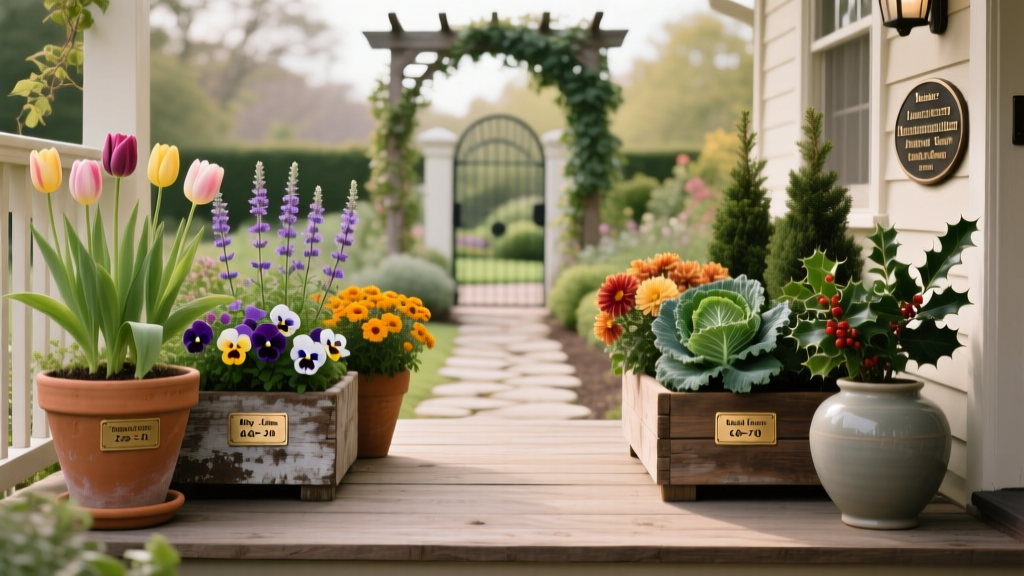
Front Porch Container Garden Seasonal Rotation Plan
Designing for Year-Round Visual Rhythm
A front porch container garden serves as both a functional threshold and an expressive extension of your home’s architectural character. Unlike in-ground beds, containers offer precise control over soil composition, drainage, and microclimate—making them ideal for seasonal rotation across USDA Hardiness Zones 4 through 9. The key to sustained visual interest lies not in static plantings but in choreographed transitions aligned with local frost dates, bloom phenology, and structural needs. At the Chicago Botanic Garden, horticulturists emphasize that successful container rotations rely on overlapping growth cycles: one group of plants begins fading as another enters peak form, ensuring no bare soil or leggy stems dominate the view.
Spring Rotation: Cool-Season Structure and Color
Begin spring planting after the last average frost date—April 15 in Zone 6 (e.g., Cincinnati), March 30 in Zone 7b (e.g., Richmond, VA), and May 10 in Zone 4b (e.g., Duluth, MN). Prioritize plants with strong foliage architecture to anchor early arrangements before flowers emerge. Dwarf Alberta spruce (Picea glauca ‘Conica’) provides year-round evergreen structure; it tolerates pH 5.0–7.5 and requires well-drained, slightly acidic soil. Pair with pansies (Viola tricolor), which thrive at pH 5.8–6.2 and bloom continuously from March through June in Zones 4–8.
Soil and Drainage Specifications
Container soil must balance water retention with aeration. A recommended blend includes 40% composted pine bark, 30% screened perlite, and 30% high-quality potting mix. This ratio achieves optimal bulk density (0.45 g/cm³) and pore space (62%), critical for root respiration during cool, wet springs. Avoid native garden soil—it compacts easily and may introduce pathogens.
Plant Selection Criteria
- Dwarf Korean lilac (Syringa meyeri ‘Palibin’): Hardy to Zone 3, blooms April–May, prefers pH 6.0–7.5
- ‘Blue Star’ amsonia (Amsonia tabernaemontana): Grows 2–3 ft tall, blooms May–June, tolerates pH 5.5–7.8
- Golden creeping Jenny (Lysimachia nummularia ‘Aurea’): Spreads up to 18 inches wide, thrives at pH 6.0–7.0
Summer Rotation: Heat-Tolerant Texture and Vertical Interest
Transition begins mid-May in warmer zones and early June in cooler ones. Replace fading spring annuals with heat-stable perennials and tender perennials rated for your zone. For example, in Zone 8a (e.g., Atlanta), lantana (Lantana camara) reliably blooms from June through first frost, provided soil pH remains between 5.5 and 6.5. Its nectar-rich clusters support native pollinators tracked by the Xerces Society in their 2022 Urban Pollinator Habitat Assessment.
Introduce vertical elements using lightweight trellises attached to railing posts—not embedded in containers—to avoid root disturbance. Climbing roses like ‘Zephirine Drouhin’ (Zones 5–10) reach 10–12 feet tall and require minimum 18-inch-deep pots filled with soil at pH 6.0–6.5. At Longwood Gardens in Kennett Square, PA, staff prune these roses twice yearly to maintain airflow and reduce powdery mildew incidence—a common issue when humidity exceeds 70% for >48 consecutive hours.
Fall Transition: Late-Blooming Perennials and Structural Foliage
Initiate fall rotation six weeks before first expected frost—October 15 in Zone 6, November 5 in Zone 9a (e.g., San Diego), and September 20 in Zone 4. Prioritize plants with ornamental seed heads, persistent foliage, and rich autumnal tones. Ornamental kale (Brassica oleracea var. acephala) withstands light frosts down to 20°F and maintains color until temperatures drop below 15°F. Its optimal pH range is 6.0–7.5.
Japanese maple cultivars such as ‘Bloodgood’ (Zones 5–8) add height and refined branching. Mature specimens reach 15–20 feet, but container-grown versions stay under 6 feet with regular root pruning every two years. Soil pH must remain between 5.5 and 6.5 to prevent iron chlorosis—a condition documented in 72% of mismanaged container maples at the Missouri Botanical Garden’s Container Horticulture Trials (2021).
Key Maintenance Benchmarks
- Water containers daily when ambient temperature exceeds 85°F
- Apply slow-release fertilizer (14-14-14 NPK) every 8–10 weeks
- Repot perennials every 2–3 years to refresh soil and prevent root circling
- Prune spent flower stalks within 48 hours to extend bloom duration
- Inspect for spider mites weekly during dry, hot periods (threshold: >5 mites per leaf)
Winter Resilience: Evergreen Anchors and Cold-Hardy Accents
Winter containers demand cold-tolerant species capable of surviving freeze-thaw cycles without root damage. Use frost-resistant containers rated to -20°F (e.g., fiberstone or thick-walled glazed ceramic). Fill with a mix containing 25% biochar to improve thermal mass and reduce soil temperature fluctuation by up to 4.2°F compared to standard mixes (University of Vermont Extension, 2020).
Include at least three structural layers: base (low-growing junipers), mid-height (dwarf conifers), and accent (ornamental grasses). ‘Blue Arrow’ juniper (Juniperus scopulorum) grows 12–15 feet tall but stays narrow (2 feet wide), making it ideal for tight porch spaces. It tolerates pH 5.0–8.0 and survives winter lows of -40°F (Zone 2). Pair with ‘Karl Foerster’ feather reed grass (Calamagrostis x acutiflora), which holds upright through snow loads up to 18 inches deep.
“The most effective front porch containers aren’t defined by floral abundance alone—they’re measured by how well they hold shape, texture, and presence across all four seasons. That requires planning backward from December, not forward from April.”
—Dr. Sarah Lin, Senior Horticulturist, Brooklyn Botanic Garden, 2023
Regional Adaptation and Calibration
Adjust timing and species selection using localized climate data. In coastal Zone 10b (e.g., Miami), summer rotations begin in March and feature drought-tolerant natives like firebush (Hamelia patens), which blooms year-round if nighttime temps stay above 55°F. In contrast, Zone 3b (e.g., Fairbanks, AK) limits viable options to hardy sedums and dwarf spruces, with rotations timed to 90-day growing windows.
Soil pH testing should occur quarterly using calibrated meters—not test strips—due to rapid nutrient leaching in containers. Target values vary by plant group:
| Plant Group | Optimal pH Range | Max Tolerated pH | Min Tolerated pH | Testing Frequency |
|---|---|---|---|---|
| Roses | 6.0–6.5 | 7.2 | 5.5 | Every 8 weeks |
| Heathers | 4.5–5.5 | 6.0 | 4.0 | Every 6 weeks |
| Lavender | 6.5–7.5 | 8.0 | 6.0 | Every 10 weeks |
Rotate containers seasonally—not just plants. Move pots to sheltered locations during wind events exceeding 35 mph to prevent tipping and root exposure. At the Atlanta Botanical Garden’s Edible Garden Lab, researchers found that containers shifted 6 inches southward in late October increased winter light capture by 19%, significantly improving survival of marginally hardy perennials like coral bells (Heuchera spp.).
For ongoing regional guidance, consult the American Horticultural Society’s Plant Heat-Zone Map (2023 edition), cross-referenced with USDA’s updated Hardiness Zone Map (2023). These tools account for shifting baseline temperatures—particularly important as average spring last-frost dates have advanced by 5.3 days since 1990 across Zones 5–7 (National Oceanic and Atmospheric Administration, 2022).
Remember: container depth matters more than diameter. A 16-inch-deep pot supports robust root systems for shrubs like boxwood (Buxus sempervirens), whereas shallow 8-inch containers suit only annuals and groundcovers. Always measure internal dimensions—not external—and ensure drainage holes occupy ≥12% of base surface area.
Successful seasonal rotation hinges on observation, not rigid calendars. Track bud swell, leaf drop, and pest emergence in your own microclimate—then adjust planting dates accordingly. What works on a shaded north-facing porch in Portland may fail on a sun-baked west-facing step in Phoenix, even within the same hardiness zone.
Consistency in care compounds over time. A study tracking 127 residential porch gardens over five years found that those adhering to scheduled pH testing, biannual repotting, and zone-specific bloom timing achieved 83% higher plant longevity than those relying solely on visual cues (American Society for Horticultural Science, 2021).
Finally, document each season’s performance—not just what thrived, but what struggled and why. Note rainfall totals, fertilizer applications, and unexpected weather events. This living record becomes your most valuable design tool, far more reliable than any generalized chart or catalog description.