Tree Care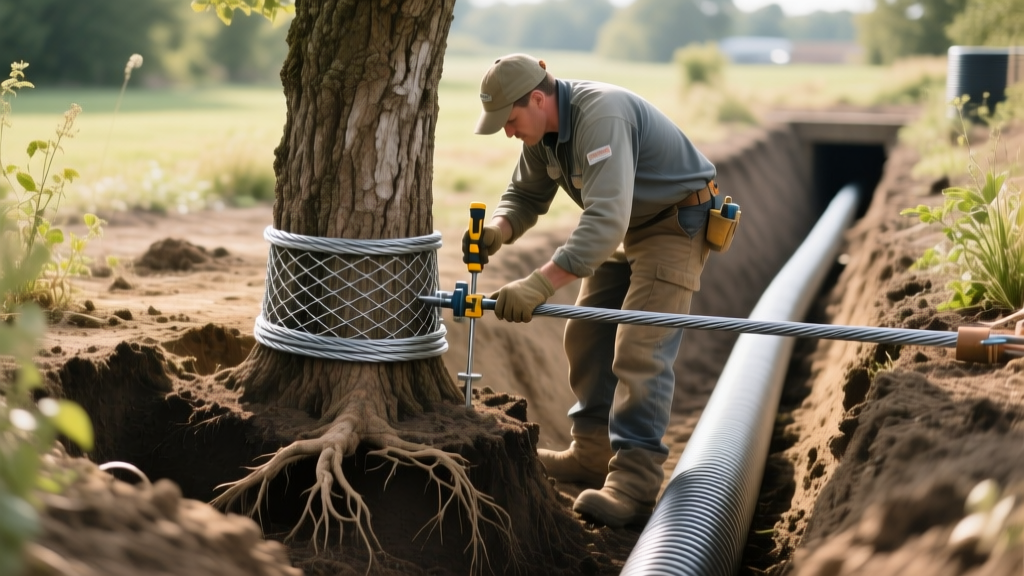
Cobra Tree Cabling And Landscape Drainage Pipe Installation 2026
David ParkPublished
The 2026 Challenge: Balancing Yard Drainage and Tree Stability
As we navigate the increasingly unpredictable weather patterns of 2026, managing yard runoff and preventing soil saturation has never been more critical for homeowners and landscape contractors. Installing high-capacity landscape drainage pipes—such as 4-inch corrugated HDPE or rigid SDR 35 PVC French drains—is the standard solution for eliminating waterlogged lawns and protecting foundations. However, this essential hardscaping project often creates a severe secondary problem: compromising the structural integrity of mature shade trees.
When you trench through a yard to lay a landscape drainage pipe, you are almost guaranteed to intersect a tree's Critical Root Zone (CRZ). Severing these structural roots drastically reduces the tree's anchorage, making it highly susceptible to windthrow during the severe summer storms and winter squalls that have become common in 2026. To save the tree without sacrificing your yard's drainage infrastructure, arborists and landscapers are turning to the Cobra Dynamic Tree Support System. This guide explores how to seamlessly integrate Cobra dynamic cabling with landscape drainage pipe installations to protect your property and your canopy.
Why Landscape Drainage Pipes Compromise Tree Anchorage
To understand why supplemental support is necessary, we must look at how trees anchor themselves. According to the University of Minnesota Extension, the vast majority of a tree's structural and feeder roots are located in the top 12 to 18 inches of soil, extending well beyond the drip line. This area is known as the Critical Root Zone.
When a contractor digs a trench that is 18 to 24 inches deep to install a landscape drainage pipe and its surrounding gravel envelope, they effectively sever the lateral roots on that side of the tree. This creates an unbalanced root plate. If the prevailing winds hit the tree from the direction of the severed roots, the compromised root system can no longer counteract the leverage of the canopy, leading to catastrophic uprooting. While air-spading and root-pruning techniques can minimize damage, the structural loss often requires above-ground compensation.
The Cobra Dynamic Support System: A Modern Arboricultural Solution
Unlike traditional static steel cabling, which rigidly locks branches together and can cause wood decay or hardware failure under extreme shock loads, the Cobra Dynamic Support System utilizes hollow, braided polypropylene ropes. This material is UV-stabilized, highly durable, and designed to mimic the natural movement of the tree.
Key Features of the Cobra System in 2026
- Dynamic Shock Absorbers: Integrated into the rope system, these allow for up to 30% elongation under extreme wind loads, dissipating kinetic energy and preventing sudden snaps.
- Non-Invasive Installation: The Cobra system uses specialized slings and loops that wrap around branches without drilling holes into the wood, eliminating entry points for fungal pathogens.
- Canopy Dampening: By connecting codominant stems or heavy lateral limbs to stronger central leaders, the system reduces the 'wind-sail' effect, lessening the mechanical strain on the compromised root plate below.
The Penn State Extension notes that dynamic cabling systems like Cobra are now the industry standard for supporting trees that have suffered root loss due to construction or utility trenching, as they allow the tree to build reaction wood naturally while providing a vital safety net.
Step-by-Step: Integrating Drainage Pipes and Cobra Cabling
Successfully combining hardscape drainage with arboricultural support requires careful sequencing. Here is the professional workflow for 2026 landscape renovations.
Phase 1: Mapping the Critical Root Zone and Drainage Route
Before any digging begins, map the tree's CRZ. The general rule is 1 foot of radial root zone for every 1 inch of trunk diameter at breast height (DBH). Overlay your proposed landscape drainage pipe route onto this map. Identify exactly where the trench will intersect major structural roots. If a root larger than 2 inches in diameter must be cut to accommodate the drainage pipe, flag the tree for Cobra cabling.
Phase 2: Trenching and Pipe Installation
Excavate the trench for your landscape drainage pipe. To minimize further root trauma, use an air spade to excavate soil around large roots rather than tearing through them with a backhoe. Where possible, tunnel under major structural roots rather than cutting them. Lay your perforated drainage pipe, wrap it in geotextile fabric to prevent soil infiltration, and backfill with washed drainage gravel. The faster the soil is backfilled and watered, the less the remaining root plate will dry out and shrink.
Phase 3: Installing the Cobra Dynamic System
Once the drainage pipe is backfilled and the ground is stable, a certified arborist should install the Cobra system. The process involves:
- Canopy Assessment: Identifying the heavy, overextended lateral limbs that pose the highest risk of uprooting the compromised root plate.
- Sizing the Rope: Selecting the appropriate Cobra rope (e.g., Cobra 4t for medium limbs, Cobra 8t for heavy codominant stems) based on the 2026 load-rating charts.
- Placement: Installing the slings at roughly two-thirds of the distance from the trunk to the branch tip. This provides optimal leverage to dampen wind movement without overly restricting natural sway.
- Shock Absorber Integration: Threading the dynamic shock absorber into the line to ensure the tree can flex during high-wind events without transferring destructive shock loads to the weakened root zone.
2026 Material and Cost Comparison Table
When budgeting for a comprehensive yard renovation that includes both water management and tree preservation, it is important to understand the costs associated with different support methods. Below is a comparison of 2026 market averages for supporting a medium-to-large shade tree (e.g., a 24-inch DBH Red Oak) after root severing from drainage pipe installation.
| Support Method | Material Type | Avg. Material Cost (2026) | Installation Invasiveness | Best Application |
|---|---|---|---|---|
| Cobra Dynamic System (4t/8t) | Braided Polypropylene & Shock Absorbers | $180 - $350 | Non-Invasive (No drilling) | Trees with root loss from drainage trenching; codominant stems. |
| Traditional Static Steel Cable | Galvanized Steel Cable & Lag Screws | $90 - $150 | High (Requires drilling into heartwood) | Split trunks requiring rigid, immediate immobilization. |
| Rigid Steel Bracing Rods | Threaded Steel Rods & Washers | $120 - $200 | High (Drilled through union) | Weak branch unions that cannot be cabled alone. |
| Root Zone Only (No Support) | N/A | $0 | N/A | Not recommended if structural roots are severed for drainage. |
Note: Costs reflect materials only. Professional arborist labor rates in 2026 typically range from $150 to $250 per hour for aerial canopy work.
Best Practices for Long-Term Health
Installing the landscape drainage pipe and the Cobra system is only the first step. The International Society of Arboriculture (ISA) emphasizes that trees undergoing construction stress require ongoing monitoring. Because the Cobra system is made of synthetic materials, it will not grow into the tree bark like old steel cables, but it still requires a visual inspection every 1 to 2 years.
Furthermore, the new drainage pipe will alter the soil moisture dynamics in your yard. While the pipe prevents waterlogging, it may also draw moisture away from the tree's remaining roots during summer droughts. Implement a deep-root watering schedule using a soaker hose placed over the remaining intact root zones, and apply a 3-inch layer of organic mulch (keeping it away from the trunk flare) to retain soil moisture and regulate temperature.
Conclusion
Integrating a landscape drainage pipe system into your property is a vital investment in your home's foundation and lawn health, but it should not come at the expense of your mature trees. By understanding the hidden dangers of root zone trenching and utilizing the Cobra Dynamic Tree Support System, you can effectively mitigate the risk of windthrow. As we move through 2026, combining smart water management with advanced, non-invasive arboricultural support remains the gold standard for sustainable, resilient landscape design.
