Tree Care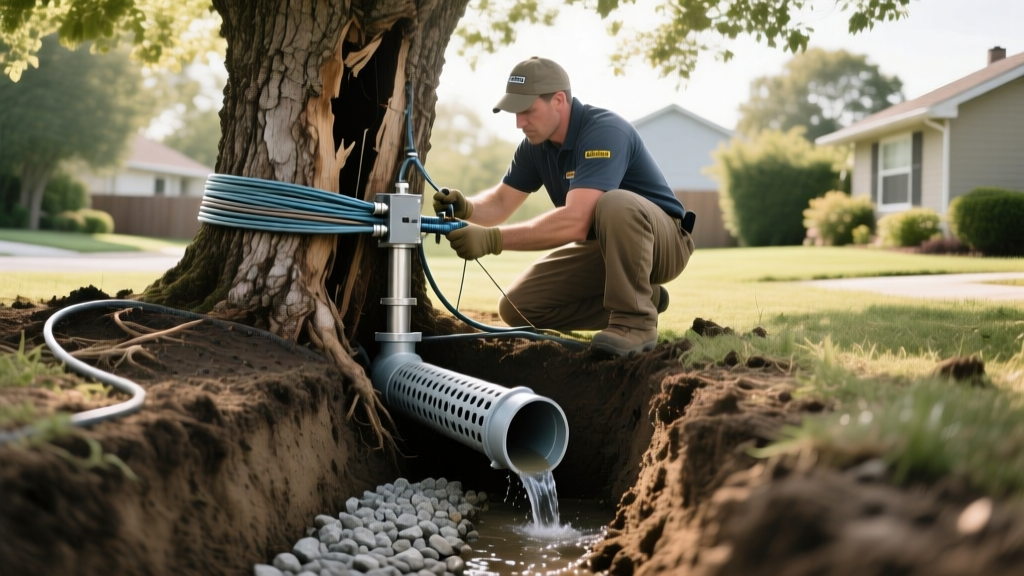
2026 Guide: Cobra Tree Cabling & French Drain Install
Robert HayesPublished
Why Soil Saturation Demands Dual Solutions in 2026
As extreme weather events and heavy precipitation continue to challenge residential landscapes in 2026, homeowners and landscape architects are increasingly facing a dual problem: poor yard drainage and compromised tree stability. When soil becomes chronically saturated, it loses its shear strength. For mature trees with structural defects—such as co-dominant stems, heavy lateral limbs, or shallow root plates—this saturated soil dramatically increases the risk of windthrow or catastrophic limb failure. Addressing this requires a two-pronged approach: installing a French drain to manage the water table and utilizing the Cobra dynamic support system to secure the tree's canopy without restricting its natural movement.
Integrating French drain installation with advanced arboricultural cabling is a specialized process. Trenching for drainage severs critical structural roots, temporarily reducing a tree's anchorage. By proactively installing a Cobra dynamic cabling system before or during the drainage excavation, arborists can compensate for the lost root stability, ensuring the tree remains safe and healthy for decades to come.
Understanding the Cobra Dynamic Support System
Unlike traditional static steel cables that rigidly lock branches in place, the Cobra dynamic support system is engineered from high-strength, UV-stabilized polypropylene hollow braid ropes. According to the Penn State Extension, dynamic cabling allows trees to sway naturally in the wind. This natural movement is crucial because it stimulates the tree's reaction wood (thickening of the trunk and branches), allowing the tree to build its own structural strength over time.
Key Components of the Cobra System
- Cobra Hollow Braided Rope: The primary cable that stretches slightly under extreme loads, absorbing shock and reducing the sudden snapping force on weak unions.
- Cobra Shock Absorber: A specialized elastic component integrated into the line that elongates during high-wind events, dissipating kinetic energy.
- Cobra Crown / Sling: A friction-based loop that wraps around the branch without the need for drilling holes or inserting lag bolts, preventing decay pathways and girdling.
- Installation Needle: A specialized pneumatic or manual tool used to shoot a pilot line through the canopy, minimizing the need for arborists to climb into dangerous, weak unions.
How French Drain Excavation Impacts Tree Anchorage
A standard French drain requires digging a trench typically 12 to 24 inches deep and 6 to 12 inches wide, sloped at a minimum of 1 inch per 8 feet to ensure proper gravity flow. When this trench must pass through the critical root zone (CRZ) of a mature tree, structural roots are inevitably severed. The International Society of Arboriculture (ISA) emphasizes that severing roots on the windward side of a tree can severely compromise its ability to remain upright during storms.
If a tree already possesses a weak canopy structure—such as a tight V-shaped crotch with included bark—the loss of root anchorage from French drain installation creates a highly dangerous scenario. The lever effect of the canopy, combined with a weakened base and saturated soil, is a recipe for uprooting. This is precisely where the Cobra system acts as an essential insurance policy during landscape drainage renovations.
Step-by-Step Integration: French Drains and Cobra Cabling
Executing this dual-project requires careful sequencing to protect both the tree's biology and the integrity of the drainage system. Below is the industry-standard workflow for 2026 landscape renovations.
Step 1: Site Assessment and Root Mapping
Before any digging begins, a certified arborist must assess the tree's structural defects and map the root system. Using an AirSpade (a pneumatic excavation tool that uses compressed air to safely move soil without cutting roots), the arborist can expose the structural roots in the proposed trench line. This allows the landscape contractor to route the French drain around critical taproots or major lateral anchors whenever possible.
Step 2: Pre-Trenching Cobra Installation
It is highly recommended to install the Cobra dynamic cables before the heavy machinery or trenching begins. If the tree is stressed by root severing, climbing it immediately afterward poses a safety risk to the arborist. Using the Cobra installation needle, the pilot line is shot over the target branches. The hollow braided rope is then pulled through, and the slings are secured. The system is tensioned with exactly 1% to 2% slack to ensure dynamic movement is preserved.
Step 3: French Drain Trenching with Root Preservation
With the canopy secured, the drainage crew can begin excavation. When roots smaller than 2 inches in diameter are encountered, they should be cleanly cut with sharp bypass pruners rather than torn by an excavator bucket. For roots larger than 2 inches, the trench should be routed around them, or a tunnel should be bored beneath them using directional boring equipment to maintain the tree's structural base.
Step 4: French Drain Assembly and Backfilling
The trench is lined with a non-woven geotextile fabric to prevent soil infiltration. A 4-inch perforated PVC or corrugated pipe is placed at the base, surrounded by washed 3/4-inch drain gravel. The fabric is folded over the top of the gravel to create a 'gravel burrito,' preventing fine silts from clogging the system. Finally, the trench is backfilled with native soil or topsoil, and the area is graded to ensure surface water also flows away from the tree's trunk flare.
'Integrating dynamic support systems during drainage renovations is no longer optional for high-value trees; it is a critical risk-management strategy in an era of increasingly saturated soils and severe wind events.' — 2026 Urban Forestry Best Practices Report
2026 Cost Analysis: Cobra vs. Static Steel Systems
When budgeting for a combined drainage and tree stabilization project, homeowners must weigh the upfront costs against long-term maintenance and tree health. The following table outlines the estimated 2026 pricing for different support methodologies when paired with French drain installation.
| Support System | Material Cost (Per Union) | Installation Labor | Impact on Tree Health | Lifespan / Maintenance |
|---|---|---|---|---|
| Cobra Dynamic System | $150 - $250 | $300 - $500 | Excellent (No drilling, allows sway) | 8-12 years (Visual inspection required) |
| Static Steel Cable (J-Hook) | $80 - $120 | $400 - $600 | Poor (Drilling creates decay, restricts sway) | 15+ years (Requires hardware tightening) |
| Rigid Bracing (Threaded Rod) | $100 - $180 | $500 - $800 | Fair (Invasive, but stops splitting) | 20+ years (Permanent fixture) |
While the Cobra system may have a slightly higher material cost than basic steel hardware, the labor is often faster and safer due to the needle-installation method. More importantly, the lack of invasive drilling prevents the introduction of wood-decay fungi, which is vital when a tree's root system is already stressed by French drain excavation.
Best Practices for Long-Term Monitoring
Once the French drain is operational and the Cobra system is in place, the tree's environment will change. The improved drainage will eventually lead to drier, more stable soil, which may encourage new root growth and improve the tree's natural anchorage over the next three to five years. However, the canopy will continue to grow and add weight.
Homeowners should schedule an annual inspection with an ISA Certified Arborist. The arborist will check the Cobra slings to ensure they are not girdling the expanding branches and verify that the shock absorbers have not been permanently stretched by a severe storm. Simultaneously, the drainage contractor should inspect the French drain cleanouts to ensure no root intrusion has occurred, utilizing root-inhibiting foams if necessary to keep the perforated pipe clear without harming the tree.
Conclusion
The intersection of water management and tree risk management is one of the most critical aspects of modern landscape architecture. By combining the water-diverting power of a properly engineered French drain with the biomechanical brilliance of the Cobra dynamic support system, property owners in 2026 can save their most valuable, mature trees from the dual threats of soil saturation and structural failure. Always consult with a team that includes both a certified arborist and a licensed drainage contractor to ensure both systems are installed harmoniously, protecting your property and your urban forest for years to come.