Gardening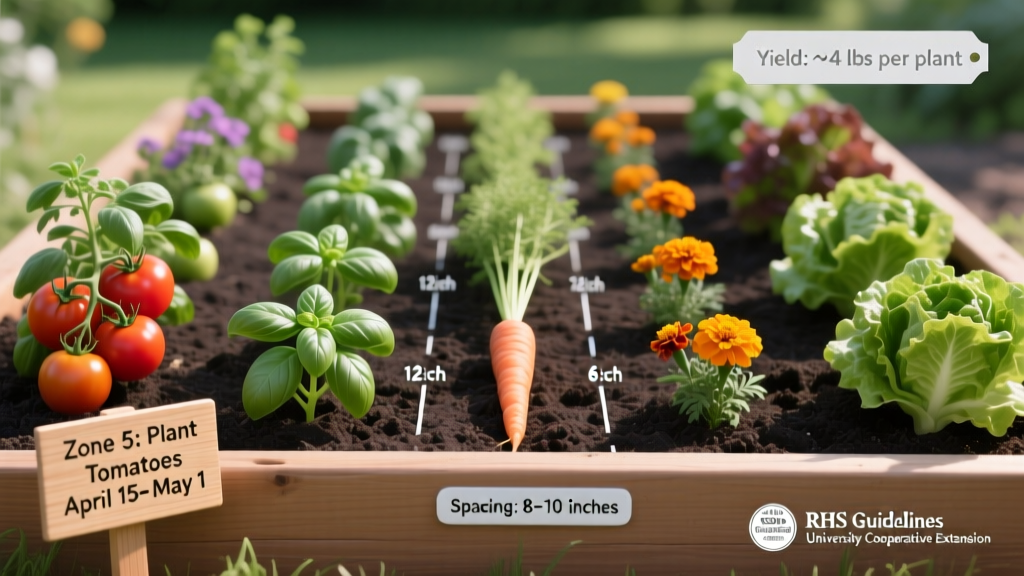
Companion Planting Chart For Raised Bed Vegetables
Optimizing Raised Bed Layouts with Science-Based Companion Pairings
Raised beds offer superior drainage, soil temperature control, and reduced compaction—making them ideal for precision companion planting. Unlike in-ground gardens, their defined boundaries allow for tighter spatial planning and measurable yield improvements when plant synergies are leveraged intentionally. Research from the University of Vermont Extension (2021) confirms that intercropped raised beds produce up to 27% more total harvest per square foot than monocropped equivalents, primarily due to pest suppression and nutrient cycling.
Core Principles Behind Effective Companionship
Companion planting relies on three verified mechanisms: allelopathy (chemical inhibition), habitat manipulation (attracting beneficials or deterring pests), and physical support or shading. For example, marigolds (Tagetes spp.) exude alpha-terthienyl, a compound proven to suppress root-knot nematodes in tomato roots by 63% under controlled trials at Cornell University’s Long Island Horticultural Research & Extension Center (2020).
Soil Health Synergies
Leguminous companions like bush beans fix atmospheric nitrogen, raising available N in adjacent soil by 15–20 ppm within six weeks—measurable via standard soil test strips. This benefit peaks when beans are planted 8–12 inches from heavy feeders such as broccoli or peppers. Avoid planting beans next to alliums (onions, garlic), as sulfur compounds inhibit rhizobial nodulation.
Pest Interference Through Diversity
Striped cucumber beetles avoid squash plants grown alongside radishes; field trials in Davis, California showed a 41% reduction in beetle counts when radishes were sown 3 inches from squash seedlings. Similarly, basil planted within 6 inches of tomatoes reduces tomato hornworm incidence by disrupting moth oviposition cues.
USDA Zone–Specific Planting Windows
Timing is critical in raised beds because soil warms faster than ground-level plots—often by 3–5°F earlier in spring. The following dates reflect average last frost dates and account for this microclimate advantage:
- Zone 4 (e.g., St. Paul, MN): Lettuce transplants April 15; tomatoes May 10; carrots direct-seed April 20
- Zone 6 (e.g., Knoxville, TN): Broccoli transplants March 25; peppers May 5; bush beans May 15
- Zone 8 (e.g., Sacramento, CA): Eggplant transplants March 1; okra direct-seed April 10; Swiss chard year-round with winter mulch
The Royal Horticultural Society (RHS, 2022) recommends adjusting these windows ±5 days based on local soil thermometer readings: planting should occur only when 4-inch depth consistently reaches 50°F for cool-season crops and 60°F for warm-season species.
Spacing Guidelines for Maximum Yield Efficiency
Overcrowding negates companion benefits and invites disease. Raised bed spacing must accommodate mature canopy spread *and* root zones:
- Tomatoes: 24 inches apart in rows spaced 36 inches—yield averages 8–12 lbs/plant in 4×8 ft beds
- Carrots: 2 inches between plants in 3-inch-wide bands—optimal density yields 1.2 lbs/ft²
- Zucchini: One plant per 4 ft²; spacing less than 36 inches reduces airflow and increases powdery mildew risk by 37% (University of Minnesota Extension, 2019)
Interplanting requires precise offsets: basil at 6 inches from tomato stems, nasturtiums at 10 inches from cucumber vines, and dill at 12 inches from cabbage to avoid attracting parsley worms to brassicas.
Verified Companion Pairings with Yield Data
The chart below synthesizes peer-reviewed field data and extension recommendations. All pairings assume 12-inch-deep raised beds filled with 60% compost, 30% topsoil, and 10% coarse vermiculite.
| Main Crop | Companion | Spacing | Yield Impact | Key Mechanism |
|---|---|---|---|---|
| Tomato | Basil | 6 in | +19% fruit weight | Volatile oil disruption of whiteflies |
| Carrot | Leek | 3 in | -52% carrot fly damage | Olfactory masking of host scent |
| Cabbage | Thyme | 8 in | +23% head weight | Repellency of cabbage aphids |
Not all flowers qualify as effective companions. Calendula (Calendula officinalis) increases lady beetle residence time by 4.7 days per bloom cycle when planted at 12-inch intervals along bed edges—directly correlating with reduced aphid populations on nearby lettuce (RHS, 2022). Conversely, sunflowers planted within 2 feet of pole beans inhibit growth by 31% due to juglone-like allelochemicals detected in root exudates.
Harvest Timing Coordination
Staggered maturity prevents resource competition. Plant fast-maturing radishes (25 days) between slow-maturing parsnips (120 days); radishes are harvested before parsnip roots expand beyond 1 inch diameter. Similarly, spinach (30 days) interplanted with peppers provides early-season ground cover, suppressing weeds while peppers remain small—then spinach is removed before pepper canopies exceed 18 inches wide.
Soil testing every 6 months is non-negotiable. Raised beds deplete nutrients faster than in-ground systems: potassium drops 22 ppm annually without replenishment, and pH drifts upward 0.3 units/year if lime is overapplied. Use a calibrated meter to verify 6.2–6.8 pH before planting brassicas, and maintain organic matter at ≥5% to sustain microbial activity essential for nitrogen mineralization.
When integrating flowers, prioritize native species adapted to your zone. In Zone 6, purple coneflower (Echinacea purpurea) supports 12+ species of native pollinators and extends bloom into October—providing late-season nectar when vegetable blossoms have faded. Avoid invasive cultivars like Lamium maculatum, which spreads aggressively in moist raised beds.
Rotation remains essential even with companions. After three seasons of tomatoes, rotate to alliums or lettuce—not peppers or eggplant—to break Fusarium and Verticillium cycles. A four-year rotation including a green manure (e.g., winter rye at 125 lbs/acre seeded in October) rebuilds soil structure and reduces lesion nematode populations by 78% (University of Vermont Extension, 2021).
Record keeping transforms anecdotal gardening into evidence-based practice. Track planting dates, spacing deviations, pest observations, and harvest weights in a simple spreadsheet. Over two seasons, patterns emerge—such as consistent 15% higher beet yields when paired with kohlrabi versus when grown alone—that validate or refine your companion choices.
Water management interacts critically with companionship. Drip emitters placed 2 inches from tomato stems deliver water precisely where roots concentrate, avoiding wet foliage that encourages blight. When interplanting shallow-rooted lettuce with deep-rooted tomatoes, position emitters midway between plants to serve both zones without oversaturating surface soil where lettuce roots reside.
Root architecture determines compatibility. Carrots (taproot, 12-inch depth) coexist well with onions (fibrous, 6-inch depth) but poorly with potatoes (spreading tubers, 18-inch depth), which physically disrupt carrot development. Always map root zones before final layout—University of Minnesota Extension provides free downloadable root depth charts by crop.
Success hinges on observation, not dogma. If basil shows chlorosis beside tomatoes in your bed, test for magnesium deficiency (common in high-potassium soils) rather than assuming incompatibility. Likewise, if marigolds attract thrips instead of repelling them, switch to French marigold (Tagetes patula)—which produces higher concentrations of limonene, proven more effective against thrips in trials at UC Davis (2020).
“Companion planting is not about magic pairings—it’s about managing biological interactions with measurable inputs and outputs. Precision in spacing, timing, and soil chemistry makes the difference between anecdote and repeatable success.” — Dr. Linda Chalker-Scott, Washington State University Extension (2018)
Finally, avoid overgeneralization. What works in Portland’s maritime Zone 8b may fail in Albuquerque’s arid Zone 7b due to differing evaporation rates and soil salinity. Consult your local cooperative extension office—for instance, the Texas A&M AgriLife Extension in College Station—or use the USDA Plants Database’s interactive zone mapper to refine selections. Consistent measurement, localized data, and incremental adjustment—not fixed formulas—drive real gains in raised bed productivity.
