Lawn Care
The Ultimate Cool-Season Grass Lawn Care Schedule
Understanding Cool-Season Grasses
Cool-season grasses, including Kentucky Bluegrass, Tall Fescue, Fine Fescue, and Perennial Ryegrass, dominate the northern two-thirds of the United States. Unlike their warm-season counterparts, these grasses experience two distinct peak growth periods: early spring and early fall. During the sweltering heat of summer, cool-season grasses naturally slow their growth and may even enter a state of drought-induced dormancy to survive. Because of this unique biological rhythm, a generic year-round approach to lawn maintenance will yield poor results. To achieve a thick, vibrant, and weed-free lawn, you must align your maintenance tasks with the natural growth cycles of your turf.
According to the University of Minnesota Extension, timing is the single most critical factor in cool-season lawn care. Applying fertilizer at the wrong time can push top growth during heat stress, depleting root reserves and inviting disease. Below is your comprehensive, actionable checklist and schedule to keep your cool-season lawn pristine year-round.
Spring Lawn Care Checklist (March – May)
Spring is about waking up the lawn, preventing weeds, and preparing the turf for the stressful summer months ahead.
1. Cleanup and Soil Testing (March)
- Raking and Dethatching: Once the soil is dry enough that it doesn't compress underfoot, lightly rake the lawn to remove dead grass blades, leaves, and debris. This prevents snow mold and allows sunlight to reach the soil.
- Soil Testing: Before applying any amendments, conduct a soil test. Aim for a pH between 6.0 and 7.0. If your pH is below 6.0, apply pelletized lime at a rate of 50 lbs per 1,000 square feet to raise it gradually.
2. Pre-Emergent Weed Control (April)
Crabgrass and other summer annual weeds germinate when soil temperatures consistently reach 50°F to 55°F at a 2-inch depth. This usually coincides with the blooming of forsythia bushes.
- Product Selection: Use a pre-emergent herbicide containing Prodiamine or Dithiopyr. Products like Dimension offer a slightly longer application window and can kill young crabgrass seedlings post-emergence.
- Application Cost: Expect to spend $40 to $80 for a high-quality granular pre-emergent covering 5,000 square feet.
- Warning: Do not apply pre-emergent if you plan to overseed your lawn in the spring, as it will prevent grass seed from germinating.
3. Mowing and Spring Fertilization (May)
- Mowing Height: Begin mowing when the grass reaches 3.5 inches. Set your mower deck to cut at 3 to 3.5 inches. Never remove more than one-third of the grass blade in a single mowing.
- Fertilization: Apply a light, slow-release nitrogen fertilizer in late spring (late May). Look for an N-P-K ratio like 20-0-10 or use a natural alternative like Milorganite. Avoid heavy nitrogen applications, which force blade growth at the expense of deep root development.
Summer Lawn Care Checklist (June – August)
Summer is survival mode for cool-season grasses. The goal is to minimize stress, conserve moisture, and protect the crown of the plant.
1. Irrigation Best Practices
The Purdue University Turfgrass Program emphasizes that deep, infrequent watering is vastly superior to daily light sprinklings. Deep watering encourages roots to grow downward in search of moisture, creating a more drought-resilient lawn.
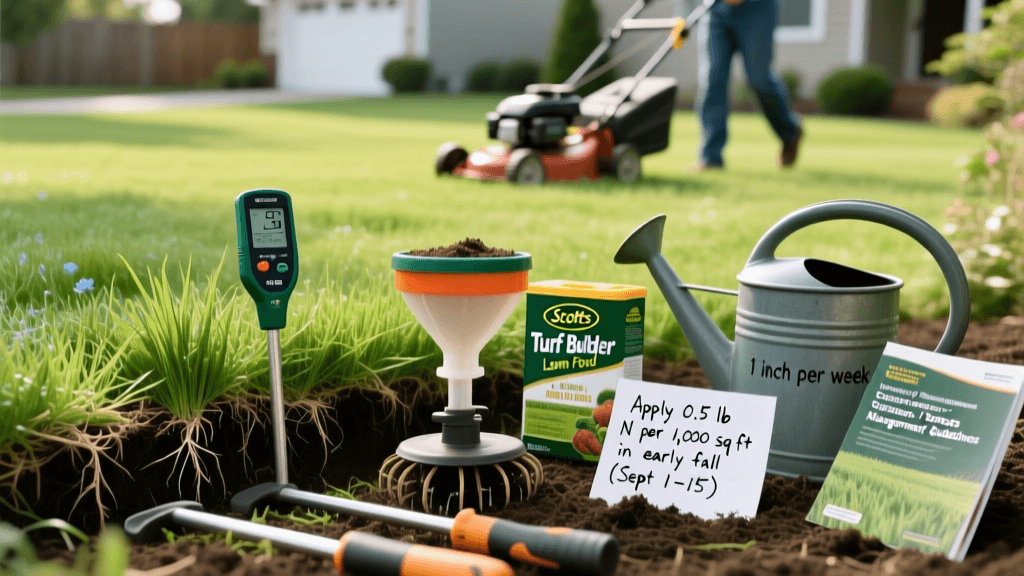
- Measurement: Your lawn needs 1 to 1.5 inches of water per week, including rainfall. Use the 'tuna can test'—place an empty tuna can (which is roughly 1 inch deep) on your lawn and time how long your sprinklers take to fill it.
- Timing: Water between 4:00 AM and 8:00 AM. Watering in the evening leaves the grass wet overnight, creating a breeding ground for fungal diseases like Brown Patch and Dollar Spot.
2. Summer Mowing and Pest Control
- Raise the Blade: Increase your mowing height to 3.5 or 4 inches. Taller grass shades the soil, reducing water evaporation and preventing weed seeds from getting the sunlight they need to germinate.
- Grub Control: If you have a history of grub damage (spongy turf that rolls back like a carpet), apply a preventive grub control product containing Imidacloprid or Chlorantraniliprole in late June or early July.
Fall Lawn Care Checklist (September – November)
Fall is the most important season for cool-season grasses. The soil is still warm from summer, but the air is cooling, triggering massive root growth and turf recovery.
1. Core Aeration and Overseeding (Early September)
Over time, soil becomes compacted, and a layer of thatch builds up, blocking water and nutrients from reaching the root zone.
- Core Aeration: Rent a core aerator (approx. $80–$150 per day) or hire a professional ($75–$150 per average yard). The machine should pull soil plugs 2 to 3 inches deep and 0.5 inches wide, spaced 3 inches apart. Leave the plugs on the lawn to break down naturally.
- Overseeding: Immediately after aerating, overseed your lawn. For Tall Fescue, apply 5 to 8 lbs of seed per 1,000 square feet. For Kentucky Bluegrass, apply 1 to 2 lbs per 1,000 square feet. Keep the seed consistently moist with light, daily watering for the first 14 days.
2. Fall Fertilization (Late October – November)
This is the most crucial feeding of the year. A late-fall application provides the nutrients the grass needs to survive winter and green up rapidly the following spring.
- Product Selection: Use a high-nitrogen, fast-release fertilizer with an N-P-K ratio similar to 32-0-10. Apply at a rate of 1 lb of nitrogen per 1,000 square feet.
- Leaf Management: Mulch fallen leaves with your mower. As long as you can still see the grass blades through the shredded leaves, they will decompose and add valuable organic matter to the soil. If leaves pile up too thick, bag them to prevent smothering the turf.
Winter Lawn Care Checklist (December – February)
During winter, cool-season grasses are dormant. Your primary job is to protect the lawn from physical damage and prepare your equipment for the spring.
- Limit Traffic: Avoid walking on frozen or snow-covered grass. Heavy foot traffic on dormant turf can damage the crowns and lead to dead patches in the spring.
- Ice Melt Caution: Keep sodium chloride (rock salt) away from your lawn edges, as it dehydrates and kills grass. Use calcium magnesium acetate (CMA) or calcium chloride near landscaped beds and turf borders.
- Equipment Maintenance: Winter is the perfect time to sharpen your mower blades, change the oil, and replace spark plugs. A sharp blade cuts grass cleanly, preventing the frayed tips that invite disease.
Month-by-Month Cool-Season Grass Schedule
Use this quick-reference table to stay on track with your lawn care duties throughout the year.
| Month | Primary Focus | Key Action Items | Mowing Height |
|---|---|---|---|
| March | Cleanup & Prep | Light raking, soil testing, lime application if needed. | N/A |
| April | Weed Prevention | Apply pre-emergent crabgrass preventer (soil temp 50°F+). | 2.5 - 3.0 inches |
| May | Spring Feeding | Apply slow-release nitrogen fertilizer, begin regular mowing. | 3.0 - 3.5 inches |
| June | Pest & Water Mgmt | Apply preventive grub control, begin deep watering routines. | 3.5 - 4.0 inches |
| July | Summer Survival | Water 1-1.5 inches weekly, monitor for fungal diseases. | 3.5 - 4.0 inches |
| August | Drought Management | Allow dormancy if water is restricted; avoid heavy foot traffic. | 3.5 - 4.0 inches |
| September | Renovation | Core aeration, overseeding, and starter fertilizer application. | 2.5 inches (to allow seed-to-soil contact) |
| October | Recovery | Continue watering new seed, mulch falling leaves. | 3.0 - 3.5 inches |
| November | Winter Prep | Apply late-fall high-nitrogen fertilizer, final mowing. | 2.5 - 3.0 inches (gradually lower) |
| December | Rest & Maintenance | Minimize foot traffic, service lawn mower and spreaders. | N/A |
Final Thoughts on Consistency
Maintaining a cool-season lawn is less about heroic, one-time interventions and more about consistent, well-timed maintenance. By following this schedule, you work with your grass's natural biology rather than against it. Always remember to calibrate your spreader before applying fertilizers or herbicides to prevent chemical burn, and consult your local cooperative extension office for specific recommendations tailored to your exact microclimate and soil type.