Lawn Care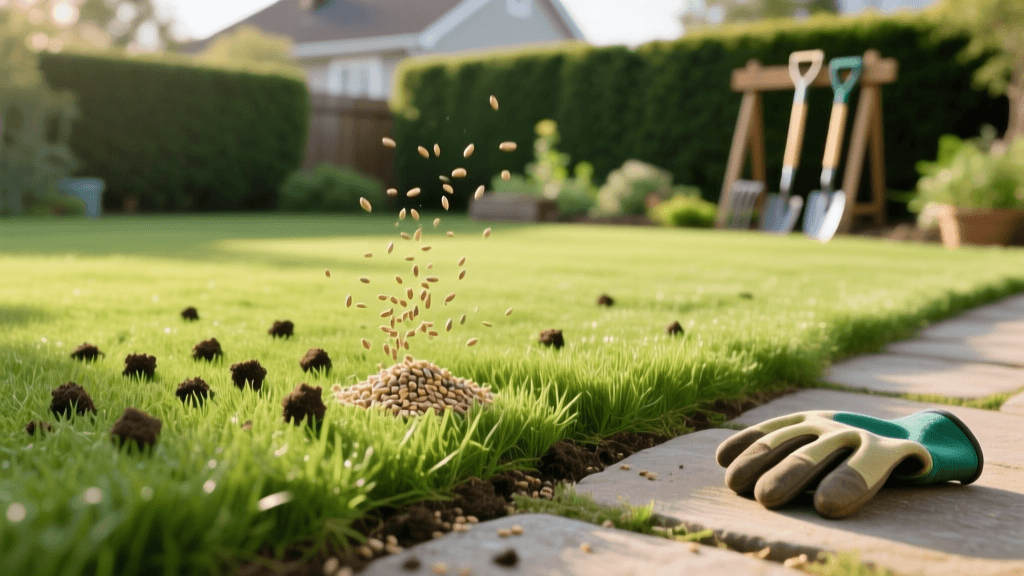
Expert Core Aeration and Overseeding Guide for Cool-Season Lawns
The Science Behind Core Aeration and Overseeding
When it comes to transforming a thin, tired cool-season lawn into a dense, carpet-like turf, the combination of core aeration and overseeding is the undisputed gold standard. Cool-season grasses, such as Turf-Type Tall Fescue (TTTF) and Kentucky Bluegrass (KBG), endure immense stress during the sweltering summer months. By late August, soil compaction, thatch accumulation, and heat-induced dormancy often leave lawns vulnerable to weed invasion and erosion. Core aeration alleviates soil compaction by physically extracting plugs of soil, reducing bulk density, and restoring vital gas exchange between the atmosphere and the root zone. When paired with overseeding, these aeration holes serve as perfect micro-environments for seed-to-soil contact, protecting germinating seeds from drying out and providing direct access to moisture and nutrients.
Pinpointing the Perfect Timing Window
Timing is the most critical variable in lawn renovation. According to turfgrass agronomists at Penn State Extension, the optimal window for aerating and overseeding cool-season grasses is late summer to early fall—specifically, when soil temperatures at a 2-inch depth consistently range between 50°F and 65°F. In most northern and transitional zones, this falls between August 15th and October 10th. During this window, daytime air temperatures are cooling, reducing heat stress on vulnerable seedlings, while the soil remains warm enough to stimulate rapid germination and deep root establishment before the first hard frost. Furthermore, fall overseeding allows new grass to outcompete winter annual weeds like Poa annua and henbit.
Pre-Renovation Preparation
Proper preparation dictates the success of your aeration and seeding efforts. Begin by mowing your existing lawn shorter than usual, dropping the mower deck to 1.5 or 2.0 inches. This scalp mowing reduces the existing grass canopy, allowing sunlight to reach the soil surface and ensuring the overseeded grass is not immediately shaded out. Next, identify and mark all shallow irrigation heads, valve boxes, and invisible dog fence lines with bright landscaping flags to prevent catastrophic damage from the aerator tines. Finally, deeply irrigate the lawn 48 hours before aeration. Applying roughly 1 inch of water softens the topsoil, allowing the aerator tines to penetrate deeply and extract full, 3-inch plugs rather than crumbling the surface.
Executing the Core Aeration
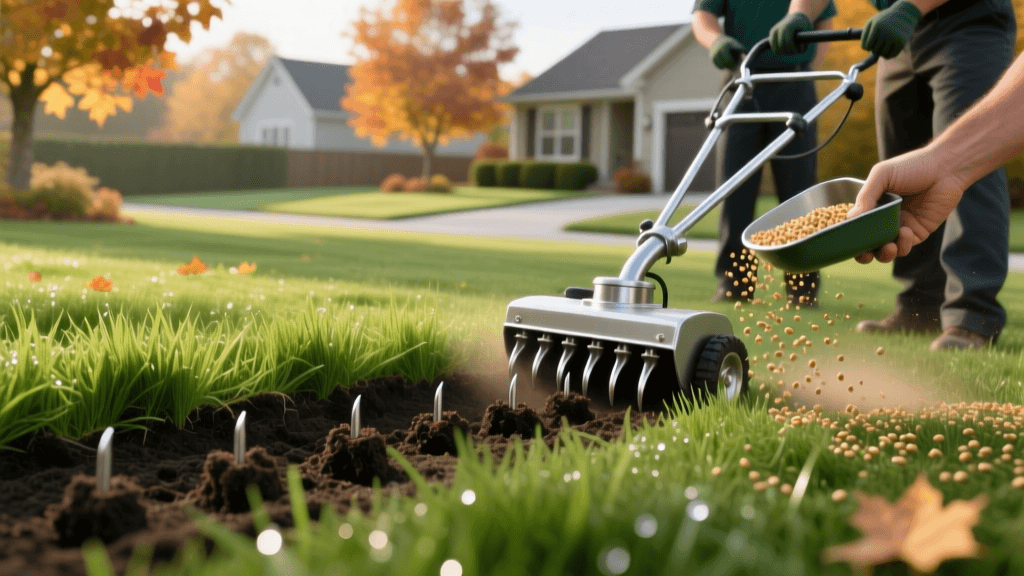
When renting an aerator, opt for a camshaft-driven core aerator over a traditional drum aerator. Camshaft models use a mechanical lifting action to pull tines straight up and out of the ground, minimizing surface tearing and reducing damage to existing turf crowns. Expect to pay between $80 and $120 for a half-day rental. Run the aerator over the lawn in two overlapping passes: one horizontally and one vertically, creating a grid pattern. Your goal is to extract plugs that are 2 to 3 inches deep, spaced no more than 2 to 3 inches apart. Do not rake up the extracted soil plugs; instead, let them break down naturally over the next two weeks, returning valuable microorganisms and topdressing to the thatch layer.
Seed Selection and Application Rates
Selecting the right seed is paramount. Always look for seed blends certified by the National Turfgrass Evaluation Program (NTEP). Avoid cheap, big-box store mixes that contain high percentages of annual ryegrass or coarse forage grasses. For high-traffic areas and drought resistance, Turf-Type Tall Fescue is the premier choice. For lawns requiring deep shade tolerance and aggressive lateral spread via rhizomes, a Kentucky Bluegrass blend is superior. Use a broadcast spreader for the bulk of the application, and a drop spreader for precise edging.
| Grass Type | Overseeding Rate (lbs/1,000 sq ft) | Bare Ground Seeding Rate (lbs/1,000 sq ft) | Germination Time (Days) |
|---|---|---|---|
| Turf-Type Tall Fescue | 4.0 - 6.0 | 8.0 - 10.0 | 7 - 12 |
| Kentucky Bluegrass | 1.5 - 2.0 | 2.5 - 3.5 | 14 - 21 |
| Perennial Ryegrass | 3.0 - 5.0 | 5.0 - 7.0 | 5 - 7 |
| Fine Fescue Blend | 3.0 - 4.0 | 5.0 - 6.0 | 7 - 14 |
Fertilization and Soil Amendments
New grass seedlings require immediate access to Phosphorus (P) for rapid root development. Apply a high-quality starter fertilizer, such as a 10-18-10 or 18-24-12 N-P-K formulation, immediately after seeding. Products like Lesco Professional Starter Fertilizer or Scotts Turf Builder Starter Food for New Grass are excellent choices. Apply at a rate of 1.0 lb of actual nitrogen per 1,000 square feet. If a recent soil test from Logan Labs or your local university extension indicates a low pH (below 6.0), apply fast-acting calcitic lime simultaneously to optimize nutrient availability.
The 21-Day Aftercare Protocol
The first three weeks dictate the survival rate of your new turf. The golden rule of overseeding is to keep the top 1 inch of soil consistently moist, but never waterlogged. For the first 14 days, water the lawn lightly three times a day—typically at 8:00 AM, 12:00 PM, and 4:00 PM—for about 5 to 10 minutes per zone, depending on your sprinkler output and local evaporation rates. Once the seeds have germinated and reached a height of 1 inch, transition to watering once a day for 15 minutes to encourage deeper root growth. By day 21, reduce watering to every other day, applying roughly 0.5 inches of water per session.
The First Mow
Resist the urge to mow until the new grass reaches a height of 3.5 to 4.0 inches. When you do mow, ensure your mower blades are freshly sharpened to prevent tearing the delicate, unanchored seedlings. Set the deck to 2.5 or 3.0 inches and never remove more than one-third of the grass blade in a single pass. Bag the clippings for this first mow to prevent them from smothering the remaining seedlings.
Expert Troubleshooting and Common Mistakes
Even with meticulous planning, environmental factors can disrupt your renovation. One of the most common issues is Pythium blight, a devastating fungus that thrives in the warm, wet conditions required for seed germination. To mitigate this, avoid watering in the late evening, which leaves the grass canopy wet overnight. If you notice cottony, white mycelium on the turf in the early morning, apply a preventative systemic fungicide containing Azoxystrobin or Propiconazole immediately. Another common mistake is seed washout during heavy rainstorms. If a severe downpour occurs within 48 hours of seeding, inspect low-lying areas for seed pooling and be prepared to spot-seed with a thin layer of peat moss or straw erosion control blankets.
Proper lawn renovation relies heavily on seed-to-soil contact and consistent moisture management. Skipping the aeration step or allowing the seedbed to dry out even once during the germination window will result in severe seedling mortality. - Penn State Extension Turfgrass Management Guidelines
Final Thoughts
Core aeration and overseeding represent a significant investment of time, labor, and capital, often costing between $150 and $300 for an average 5,000-square-foot lawn when factoring in equipment rental, premium seed, and starter fertilizer. However, the return on investment is a dramatically improved turf density, enhanced drought resilience, and a natural defense against broadleaf weeds. By adhering to these expert best practices and relying on data-driven timing and application rates, you can achieve professional-grade results that will be the envy of your neighborhood.