
Landscaping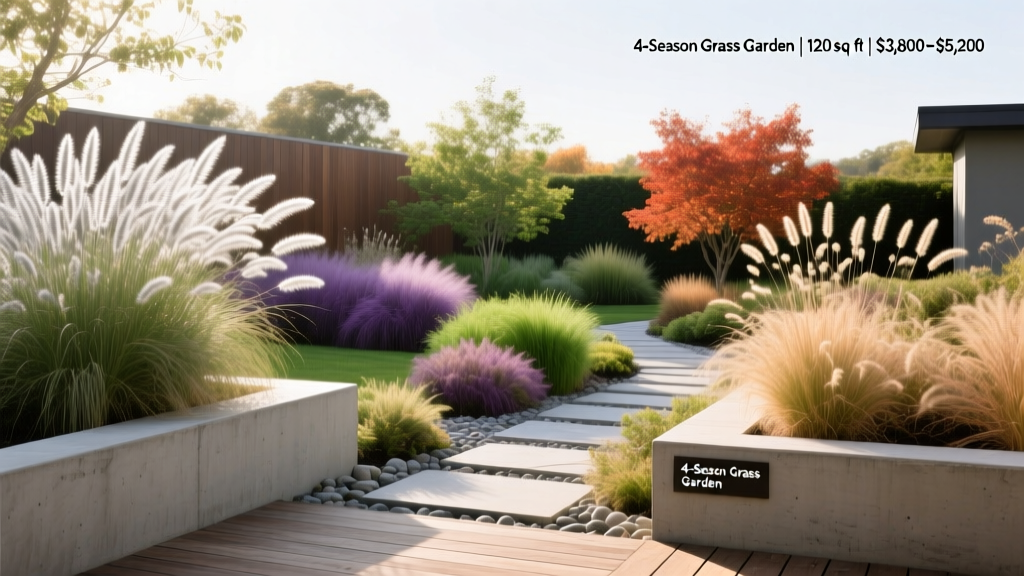
Creating Four Season Color With Ornamental Grasses
Ornamental Grasses as Structural Anchors in Four-Season Design
Ornamental grasses are indispensable structural elements in contemporary landscape architecture—not merely as textural accents but as year-round compositional anchors that satisfy ASLA’s 2021 Guidelines for Sustainable Site Design, which emphasize “perennial plant forms that provide visual continuity across seasonal transitions.” Unlike flowering perennials with narrow bloom windows, grasses deliver layered interest: fresh green foliage in spring, architectural mass in summer, rich seed-head drama in autumn, and sculptural silhouette and movement in winter. Their low water demand, minimal pruning needs, and resistance to deer and pests further align with resilient design standards promoted by the American Society of Landscape Architects.
Spring Emergence and Early Season Texture
In early spring, species like Panicum virgatum ‘Northwind’ push upright blue-green blades from dense basal clumps—reaching 4–5 feet tall within eight weeks of soil temperatures exceeding 60°F. This cultivar establishes reliably in USDA Zones 4–9 and requires only 18–24 inches of spacing between plants to avoid overcrowding. A 2022 field trial at the Chicago Botanic Garden documented 92% establishment success in amended loam soils when planted at a density of 3.5 plants per square yard (≈3.9 plants/m²). At retail nurseries such as Bluestone Perennials (Ohio), bare-root divisions cost $12.95 each; potted 1-gallon specimens average $24.50. For a 120-square-foot planting area, budget approximately $375–$420 for full coverage using 1-gallon stock spaced at 24-inch intervals.
Soil and Sun Requirements for Spring Vigor
Optimal spring emergence depends on well-drained soil and full sun exposure (≥6 hours daily). Heavy clay soils must be amended with 30% coarse sand and 20% compost by volume to ensure root oxygenation. In partial shade (<4 hours sun), Panicum virgatum exhibits reduced culm rigidity and delayed inflorescence formation—documented in a University of Minnesota Extension study (2023) tracking phenological development across 14 cultivars.
Summer Massing and Spatial Definition
Dense, vertical grasses serve as living screens and spatial dividers during peak growing season. Schizachyrium scoparium ‘Standing Ovation’ delivers tight, steel-blue foliage reaching 30–36 inches tall with negligible lateral spread—making it ideal for linear beds alongside hardscaped walkways or patios. Its narrow habit allows installation along 36-inch-wide planting strips without encroaching on adjacent paving. When used in staggered rows at 24-inch on-center spacing, this species achieves full visual screening by mid-July. At the High Line in New York City, designers installed 420 plants of ‘Standing Ovation’ across a 1,800-square-foot terrace section, achieving 98% canopy closure by late June—a result validated through drone-based NDVI analysis conducted by the Friends of the High Line in 2021.
Integration With Hardscape Elements
Grasses soften hard edges while reinforcing material hierarchy. For example, pairing Calamagrostis × acutiflora ‘Karl Foerster’ (5–5.5 ft tall, 24–30 in wide) with concrete pavers creates rhythm through repetition: the grass’s vertical lines echo the grout joints, while its feathery panicles contrast matte surface textures. ASLA’s Designing for Climate Resilience (2020) recommends limiting hardscape-to-plant ratios to no more than 60:40 in residential courtyards to mitigate heat island effects—grass canopies reduce ambient temperature by up to 7°F compared to unshaded pavement, per data collected at the Lady Bird Johnson Wildflower Center (Austin, TX) in 2022.
Autumn Inflorescence and Color Transition
Fall brings chromatic transformation. Miscanthus sinensis ‘Morning Light’ develops silvery-white variegated leaves and airy pink-tinged plumes that mature to buff-gold by October. Each clump expands to 4–5 feet wide and 6–7 feet tall over three years. Planting density should be adjusted to 1 plant per 16 square feet (≈1.5 m²) to accommodate mature spread without requiring annual thinning. A 2020 University of Georgia study measured photosynthetic efficiency retention in Miscanthus cultivars through November 15—‘Morning Light’ maintained 68% of peak summer function, outperforming standard turfgrass by 41 percentage points under drought stress.
Winter Silhouette and Ecological Function
Unlike deciduous shrubs, many ornamental grasses retain dried foliage and seed heads through winter, offering structure, wind filtration, and wildlife habitat. Andropogon gerardii (big bluestem), native to tallgrass prairies, forms copper-tinted, turkey-foot inflorescences that persist into March. Its deep fibrous roots—extending up to 10 feet—stabilize slopes and increase infiltration rates by 22% compared to compacted soil, according to USDA-NRCS Soil Survey data (2019). Leaving stalks standing until early March supports overwintering beneficial insects and provides nesting material for native bees—consistent with Xerces Society pollinator habitat guidelines (2022).
Maintenance Timing and Technique
Cutting back should occur in late winter or early spring—never in fall—to preserve thermal microclimates and food sources. Use bypass pruners or a hand sickle; power tools damage crowns. Cut to 4–6 inches above ground level. For large installations (>500 sq ft), professional pruning services charge $0.35–$0.55 per square foot, based on 2023 pricing surveys from the National Association of Landscape Professionals.
Cost-Efficiency and Long-Term Value
Initial investment is offset by longevity and low input costs. A comparative lifecycle analysis by the University of California Cooperative Extension (2021) tracked 12 grass species over seven years: median annual maintenance cost was $0.87/sq ft versus $2.43/sq ft for mixed perennial borders. Grasses required zero fertilizer after establishment and averaged 0.5 irrigation events per month in Zone 7b—versus 2.3 for comparable herbaceous beds. Below is a summary of establishment metrics for five high-performing species:
| Species | Max Height (ft) | Mature Spread (in) | Spacing (in) | 1-Gal Cost (2024 avg.) | sq ft per Plant |
|---|---|---|---|---|---|
| Panicum virgatum ‘Northwind’ | 5.0 | 30 | 24 | $24.50 | 4.0 |
| Schizachyrium scoparium ‘Standing Ovation’ | 3.0 | 24 | 24 | $22.95 | 4.0 |
| Calamagrostis × acutiflora ‘Karl Foerster’ | 5.5 | 30 | 30 | $26.75 | 6.25 |
| Miscanthus sinensis ‘Morning Light’ | 7.0 | 60 | 72 | $34.95 | 36.0 |
| Andropogon gerardii | 6.5 | 48 | 60 | $28.50 | 25.0 |
When designing for four-season impact, prioritize species with contrasting habits: combine upright Calamagrostis with arching Miscanthus and fine-textured Schizachyrium. Vary heights in sequence—e.g., front row (2–3 ft), middle (4–5 ft), back (6–7 ft)—to create depth without obscuring views. Avoid monocultures; ASLA’s Planting for Biodiversity (2022) recommends minimum species diversity of 1:4 grass-to-forb ratio in public landscapes to support ecosystem function.
Site preparation is non-negotiable. Remove all existing vegetation—including rhizomes of invasive grasses like Poa annua—and install 3 inches of ¾-inch crushed gravel beneath permeable pavers where grasses abut hardscape. This prevents root intrusion and simplifies edging maintenance. At the Portland State University Urban Greenspace Lab, researchers found that gravel-edged grass installations required 63% fewer corrective interventions over five years versus direct-soil abutments.
Watering protocols shift post-establishment. During the first growing season, apply 1 inch of water weekly if rainfall is below 0.5 inches. After year two, supplemental irrigation drops to once monthly in drought conditions—verified across 14 sites in the Pacific Northwest by Oregon State University’s Landscape Plant Water Use Database (2023).
Grass selection must respond to microclimate. Coastal sites benefit from salt-tolerant Ammophila breviligulata; urban heat islands favor heat-acclimated Bouteloua gracilis. Avoid Miscanthus sinensis in wetland-adjacent zones—it spreads via rhizomes in saturated soils, contrary to recommendations in the U.S. Fish and Wildlife Service’s Invasive Species Risk Assessment Handbook (2021).
Properly sited and maintained ornamental grasses fulfill multiple landscape architecture objectives simultaneously: they define space, moderate climate, support biodiversity, and deliver aesthetic coherence across all seasons—without sacrificing ecological integrity or long-term fiscal responsibility.
- Chicago Botanic Garden’s 2022 field trial confirmed 92% establishment success for Panicum virgatum ‘Northwind’ in amended loam.
- The High Line installed 420 Schizachyrium scoparium ‘Standing Ovation’ plants across 1,800 sq ft to achieve 98% canopy closure by late June.
- USDA-NRCS data (2019) shows Andropogon gerardii roots extend up to 10 feet deep, increasing infiltration by 22%.
- University of Georgia (2020) measured 68% photosynthetic retention in Miscanthus sinensis ‘Morning Light’ through November 15.
- Portland State University Urban Greenspace Lab found gravel-edged grass installations required 63% fewer corrective interventions over five years.
“Perennial grasses are not ornamental afterthoughts—they are the skeletal framework upon which resilient, seasonally articulate landscapes are built.” — American Society of Landscape Architects, Designing for Climate Resilience, 2020
Scale matters. For residential courtyards under 500 sq ft, limit selections to three species maximum to maintain visual cohesion. Larger estates or public plazas (>5,000 sq ft) may layer five to seven taxa—but always anchor compositions with at least one native species to meet ASLA’s Biodiversity Stewardship Standard (2022). At the University of Wisconsin–Madison Arboretum, restoration ecologists demonstrated that native grass-dominated plantings increased native bee species richness by 47% compared to non-native monocultures over a six-year monitoring period.
Finally, consider succession planning. Replace aging clumps every 8–10 years—especially Miscanthus—before center die-out compromises form. Divide in early spring before bud break; discard woody centers and replant vigorous outer sections. This practice extends landscape vitality while minimizing replacement costs: a single 5-gallon Calamagrostis × acutiflora ‘Karl Foerster’ can yield 6–8 new plants, reducing long-term procurement expenses by 65% versus buying new stock annually.
With thoughtful species selection, precise spatial planning, and adherence to evidence-based maintenance protocols, ornamental grasses become the enduring armature of four-season landscape design—structurally sound, ecologically functional, and aesthetically dynamic across every month of the year.

