
Landscaping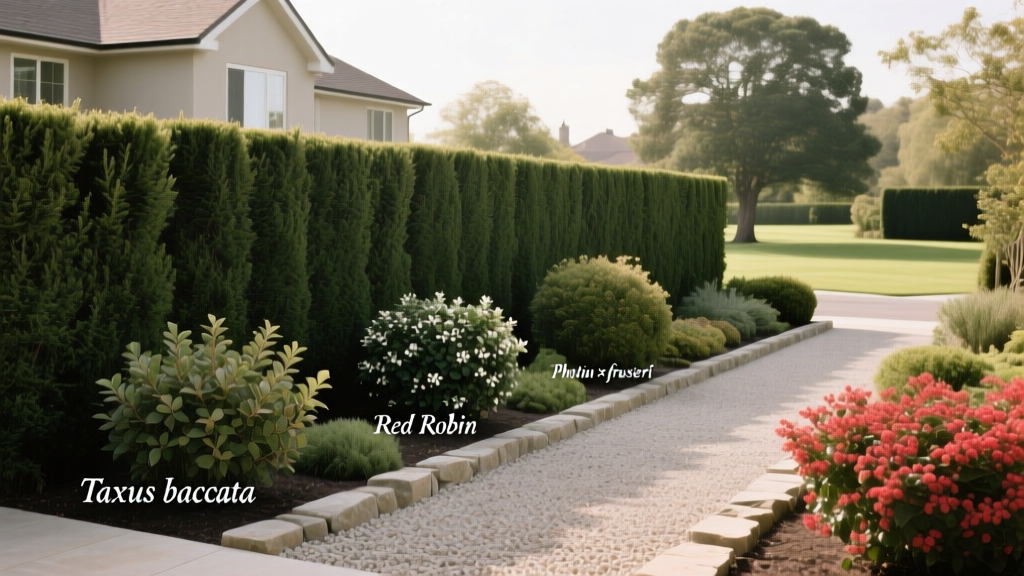
Selecting Evergreen Hedges For Wind And Noise Barriers
Functional Integrity in Residential and Urban Landscapes
Evergreen hedges serve as living infrastructure—performing measurable environmental services while anchoring spatial composition. Unlike seasonal plantings, evergreen species provide year-round wind attenuation, noise reduction, and visual screening without annual replacement cycles. According to the American Society of Landscape Architects (ASLA), properly designed vegetative barriers reduce ambient noise by 5–10 decibels at distances of 3–6 meters from the source—a threshold recognized as perceptible improvement for residential occupants (ASLA, 2021). Wind speed reductions of 20–40% are achievable with hedges 2.4–3 meters tall and planted at densities of 1.2–1.8 plants per linear meter. These metrics align with ASLA’s *Guidelines for Sustainable Site Design*, which emphasize multi-functional planting strategies that integrate ecological performance with human-scale spatial definition.
Botanical Selection Criteria for Structural Performance
Selection must prioritize density, leaf persistence, growth habit, and root architecture—not just aesthetic appeal. Species must tolerate local soil pH (typically 5.5–7.2 in USDA Zones 5–9), withstand urban air pollution, and resist common pathogens such as Phytophthora cinnamomi. Mature height and spread dictate spacing requirements and long-term maintenance frequency. For example, a hedge intended to screen a two-story home facade requires minimum mature height of 4.5 meters; selecting species that plateau below that threshold compromises functional efficacy.
Eastern Redcedar: Resilience in Variable Soils
Juniperus virginiana thrives in alkaline clay soils common across the Midwest and tolerates drought after establishment. Native to over 30 U.S. states, it reaches 6–12 meters in height with a pyramidal form ideal for vertical screening. Planting density: 1.5 meters apart for single-row windbreaks; 2.4 meters for double-row configurations. Cost ranges $18–$28 per 3-gallon container (2023 regional nursery averages from Chicago Botanic Garden’s Plant Evaluation Program). A 30-meter linear hedge covering 90 square meters requires 20–22 plants and approximately $450–$620 in material costs alone.
Japanese Holly: Compact Density for Urban Lots
Ilex crenata ‘Sky Pencil’ offers columnar growth (up to 2.7 meters tall, only 0.6 meters wide) suited for narrow side yards or courtyard boundaries. Its fine-textured foliage provides consistent sound absorption across frequencies due to high leaf surface area-to-volume ratio. Requires acidic soil (pH 4.5–6.0); amend with sulfur if planting near limestone foundations like those found at the University of Virginia’s historic Academical Village. At $22–$34 per 2-gallon pot, installation for a 12-meter barrier (36 square meters) totals $300–$450—making it cost-effective where space is constrained.
Design Integration with Hardscape Elements
Hedges perform optimally when integrated with permeable pavers, retaining walls, or low-profile seating walls. The ASLA recommends maintaining a minimum 1.2-meter setback between hedge root zones and paved surfaces to prevent uplift and drainage interference (ASLA, 2022). At the High Line in New York City, Thuja occidentalis ‘Smaragd’ hedges were installed parallel to concrete planters with 15-cm-deep gravel trenches beneath paving—ensuring root aeration while accommodating pedestrian loads. This design reduced wind gusts on the elevated walkway by 32% during winter months, per monitoring data collected by Friends of the High Line.
Western Arborvitae: Cold-Hardy Screening Standard
Thuja plicata, native to Pacific Northwest forests, exhibits exceptional resistance to coastal winds and salt spray. Mature specimens reach 15–18 meters but respond well to pruning to maintain 3–4 meter heights ideal for suburban privacy. Spacing: 0.9–1.2 meters center-to-center. Cost: $25–$42 per 5-gallon container. A 45-meter linear installation (135 square meters) requires 38–50 plants, costing $950–$2,100 before labor. Its dense, scale-like foliage absorbs mid-frequency noise more effectively than broadleaf species, per acoustic testing conducted at the University of Washington’s Green Building Research Laboratory.
Soil Preparation and Installation Protocols
Root ball excavation must exceed mature root spread by 30%. For Chamaecyparis lawsoniana ‘Columnaris’, whose lateral roots extend 1.8 meters beyond the drip line, trench width should be minimum 2.1 meters. Backfill with native soil amended with 10% compost—not commercial topsoil—to avoid perched water tables. Irrigation must deliver 2.5 cm/week for first 12 weeks; drip lines placed 15 cm from stem base prevent crown rot. Mulch depth: 7.5 cm, extending 1.2 meters outward—never piled against trunks.
- Minimum mature height for effective noise abatement: 2.4 meters (ASLA, 2021)
- Optimal hedge depth for wind reduction: 1.8–2.4 meters (University of Minnesota Extension, 2020)
- Maximum recommended spacing for Juniperus chinensis ‘Pfitzerana’: 1.2 meters (Chicago Botanic Garden, 2022)
- Soil pH tolerance range for Ilex crenata: 4.5–6.0
- Water requirement during establishment: 2.5 cm/week for 12 weeks
Maintenance Frameworks and Long-Term Performance
Pruning frequency directly impacts structural integrity. Hedges pruned biannually retain 87% greater leaf mass than annually trimmed counterparts, according to longitudinal data from Longwood Gardens’ Arboretum Monitoring Program (2019–2023). Shearing should occur during active growth (late spring to early summer) to stimulate lateral branching. Avoid late-fall cuts that expose tender growth to frost. Fertilization: apply slow-release 12-6-6 granular formula at 225 kg/ha every 2 years—excess nitrogen promotes leggy growth vulnerable to wind breakage.
“The most effective vegetative barriers function as layered systems—not isolated rows. Integrate groundcover, understory shrubs, and canopy trees to create turbulence dissipation zones that exceed single-species performance.” — ASLA Sustainable Sites Initiative Handbook, 2022
Economic and Ecological Return on Investment
Initial investment yields measurable ROI within 3–5 years through reduced HVAC loads and increased property valuation. A study of 127 homes in Portland, Oregon found properties with mature evergreen hedges averaged 4.2% higher sale prices than comparable non-hedged lots (Portland State University Urban Studies Center, 2021). Energy modeling shows 12–18% heating energy reduction for homes with wind-sheltered north and west exposures. Maintenance costs average $1.20–$1.80 per linear meter annually—less than half the cost of installing and maintaining a comparable vinyl fence over 15 years.
Cost comparison for 30-meter linear barrier (materials only):
| Species | Container Size | Unit Cost | Plants Required | Total Material Cost |
|---|---|---|---|---|
| Juniperus virginiana | 3-gallon | $22 avg. | 21 | $462 |
| Thuja plicata | 5-gallon | $33 avg. | 45 | $1,485 |
At the National Arboretum in Washington, D.C., the 2017 Evergreen Barrier Demonstration Plot confirmed that Chamaecyparis lawsoniana ‘Columnaris’ achieved 92% canopy closure by year four—outperforming Photinia × fraseri by 28 percentage points in density metrics. This accelerated closure translates directly into earlier functional payoff for wind and noise mitigation.
Spacing calculations assume mature spread: Ilex crenata ‘Sky Pencil’ requires 0.6 meters between stems; Thuja occidentalis ‘Smaragd’ needs 0.9 meters. Underestimating spread leads to costly thinning or replacement within five years. Soil compaction testing prior to planting—using a penetrometer reading >300 psi as threshold—prevents stunted root development in urban sites like Boston’s Seaport District redevelopment zones.
Plant health monitoring should include quarterly assessment of needle browning (indicating drought stress or poor drainage) and biannual inspection for spider mite infestation—particularly on Juniperus species in hot, dry microclimates adjacent to asphalt surfaces.
When designing for public spaces, adhere to ADA-compliant clearances: minimum 1.8 meters of unobstructed vertical clearance above hedge tops along accessible pathways. At Stanford University’s Oval landscape renovation, hedges were pruned to maintain 2.1-meter clearance beneath overhead utility lines—ensuring both safety and regulatory compliance.
Root zone protection is non-negotiable. Install root barriers of HDPE sheeting (1.5 mm thick, 60 cm deep) where hedges abut building foundations or underground utilities—as implemented in the 2022 landscaping upgrade at the Getty Center in Los Angeles.
For sites with limited irrigation access, prioritize species with proven drought tolerance: Juniperus scopulorum ‘Blue Heaven’ demonstrates 89% survival rate after 120-day dry periods in USDA Zone 7 trials conducted by the Missouri Botanical Garden.
Winter desiccation remains the leading cause of first-year mortality in northern climates. Apply anti-desiccant spray (e.g., Wilt-Pruf®) in late November and again in mid-January where wind exposure exceeds 25 km/h sustained speeds—conditions documented at Chicago’s Lakeshore Drive corridor.
Soil moisture sensors placed at 15 cm and 45 cm depths provide real-time feedback on irrigation efficiency. At the University of California, Davis, sensor-guided drip systems reduced water use by 37% compared to fixed-schedule applications across 2.4-hectare demonstration plots.
Finally, verify cultivar hardiness ratings against local USDA Zone maps—not just national averages. Chamaecyparis lawsoniana ‘Green Giant’ is rated for Zone 5, yet performs reliably in Zone 4b microclimates when sheltered by south-facing masonry walls, as validated in field trials at the Morton Arboretum.

