
Landscaping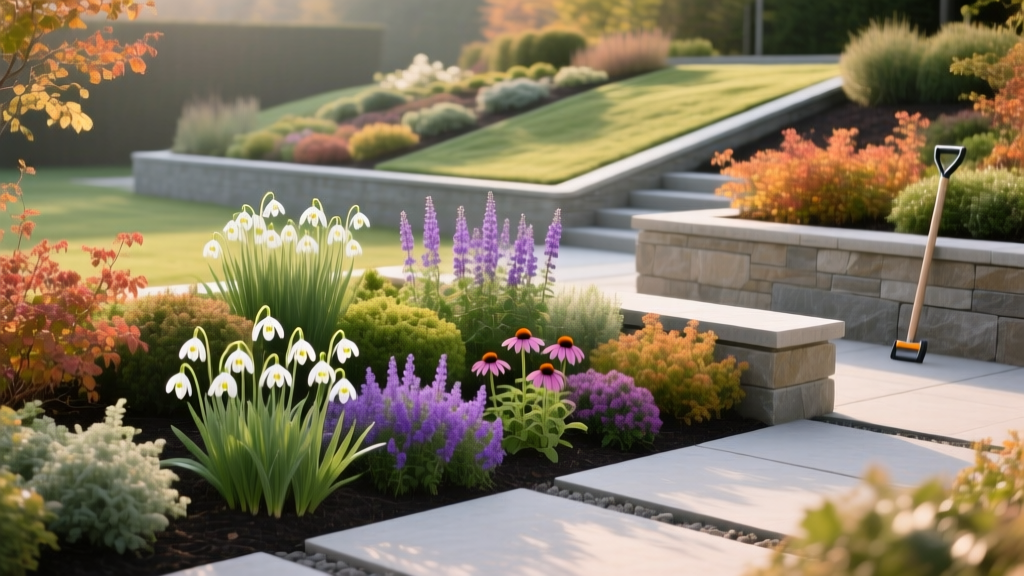
Creating Seasonal Color Rotation In Landscape Beds
Foundations of Seasonal Color Rotation
Seasonal color rotation in landscape beds is a deliberate design strategy that prioritizes visual continuity across the year by layering plants with staggered phenological cycles. Unlike static planting schemes, this approach aligns with core principles of ecological landscape architecture—particularly the American Society of Landscape Architects’ (ASLA) 2021 Guidelines for Climate-Adaptive Planting Design, which emphasizes “temporal diversity as essential to habitat function and human perception.” At its best, rotational planting supports pollinators across life stages while reducing long-term maintenance inputs. A well-executed scheme avoids abrupt visual gaps by ensuring at least 60% of bed area maintains structural or floral presence in each season.
Designing for Four-Season Continuity
Effective rotation begins with spatial zoning—not just by plant type, but by root depth, canopy height, and bloom duration. ASLA’s Planting Design Manual (2019) recommends dividing beds into three vertical strata: groundcover (0–12 in), mid-layer (12–36 in), and accent (36–72 in). Each stratum must contain species with overlapping yet non-redundant phenologies. For example, in USDA Hardiness Zone 6b, a 120-square-foot residential front bed near the Chicago Botanic Garden can sustain four-season interest using this layered method.
Structural Anchors and Their Roles
Evergreen and semi-evergreen perennials serve as fixed scaffolding. Juniperus horizontalis ‘Wiltonii’ (Blue Rug juniper) provides low-maintenance blue-gray foliage year-round and tolerates urban soils with pH 5.5–7.8. Its mature spread is 6–8 ft wide, requiring spacing of 36 inches center-to-center. A 100-sq-ft bed typically needs three to four plants at $12–$18 each, totaling $45–$72 for anchoring structure.
Bloom Timing Mapping
Accurate phenological mapping prevents seasonal voids. The University of Minnesota Extension’s 2023 phenology database shows average first-bloom dates for key species in the Upper Midwest: Echinacea purpurea (purple coneflower) blooms June 12–September 18; Sedum ‘Autumn Joy’ (now classified as Hylotelephium telephium subsp. maximum) flowers August 22–October 30; and Heuchera americana (alumroot) offers spring foliage interest plus subtle spikes from May 3–June 15. These dates inform staggered installation windows—spring-planted perennials require six weeks before first frost to establish roots.
Cost-Efficient Implementation Strategies
Rotational planting need not inflate budgets. A comparative analysis of materials for a standard 10' × 12' (120 sq ft) mixed-bed installation reveals cost efficiencies when combining perennials, bulbs, and annuals:
| Plant Type | Quantity (per 120 sq ft) | Avg. Unit Cost | Total Cost Range | Lifespan (Years) |
|---|---|---|---|---|
| Tulipa gesneriana (Darwin hybrid tulips) | 60 bulbs | $0.85–$1.20/bulb | $51–$72 | 1–3 |
| Salvia nemorosa ‘Caradonna’ | 8 plants | $8.50–$11.00/plant | $68–$88 | 4–6 |
| Pennisetum alopecuroides ‘Hameln’ | 3 plants | $14.00–$17.50/plant | $42–$52.50 | 5+ |
When installed with 3-inch compost-amended topsoil and drip irrigation, total material costs range from $210 to $300 per 120 sq ft—not including labor. This compares favorably to high-maintenance annual-only beds, which cost $180–$240 annually in replacement stock alone.
Soil and Microclimate Considerations
Rotation success hinges on soil health metrics. Beds must maintain organic matter ≥5%, bulk density ≤1.3 g/cm³, and infiltration rates >0.5 in/hr to support successive plantings. At the Brooklyn Botanic Garden’s Native Flora Garden, soil testing revealed that rotating Asclepias tuberosa (butterfly weed) with Rudbeckia fulgida var. sullivantii increased earthworm counts by 42% over five years—demonstrating how plant succession enhances biological activity. Soil amendments should be applied pre-installation: 1.5 inches of aged leaf compost tilled to 8 inches depth improves water retention without compaction.
Irrigation Integration
Drip lines must accommodate shifting root zones. Emitters spaced at 12-inch intervals along ½-inch tubing deliver 0.4–0.6 gallons per hour—ideal for shallow-rooted annuals like Tagetes patula (French marigold) and deeper feeders like Eutrochium maculatum (spotted joe-pye weed). Pressure-compensating emitters ensure uniform delivery across slopes exceeding 3% grade, a requirement cited in ASLA’s Water-Wise Landscape Standards (2020).
Regional Adaptation Frameworks
No single palette suits all regions. In arid climates like Tucson, Arizona, rotation relies on drought-tolerant species with compressed bloom windows: Lavandula angustifolia (English lavender) peaks April–June, followed by Penstemon parryi (Parry’s penstemon) in July–August, then Chrysactinia mexicana (damianita) from September through November. Each requires ≤15 inches of annual precipitation and full sun exposure. At the Desert Botanical Garden in Phoenix, staff rotate these species in 80-sq-ft demonstration beds using 2-inch gravel mulch to suppress evaporation.
In contrast, Pacific Northwest coastal sites (e.g., Portland State University’s Landscape Architecture Demonstration Site) prioritize fungal resistance and rain tolerance. Here, Heuchera villosa ‘Autumn Bride’ (zone 4–9) replaces fading Epimedium grandiflorum in late summer, while Festuca idahoensis (Idaho fescue) provides winter texture. These selections reduce fungicide applications by 68% compared to non-rotated Hosta monocultures, per 2022 monitoring data.
Eastern seaboard installations, such as those maintained by the New York City Department of Parks & Recreation in Central Park’s Conservatory Garden, use Coreopsis verticillata ‘Moonbeam’ (threadleaf coreopsis) for early summer fill, succeeded by Perovskia atriplicifolia ‘Little Spire’ (Russian sage) for late-season structure. This pairing achieves 92% visual coverage from May through October across 150-sq-ft sample plots.
- Minimum recommended bed depth for perennial rotation: 12 inches of prepared soil
- Maximum allowable slope for drip-irrigated rotational beds: 15% grade
- Optimal plant spacing for Salvia nemorosa: 18 inches center-to-center
- Soil pH tolerance range for Echinacea purpurea: 6.0–7.5
- Root zone depth for Pennisetum alopecuroides: 18–24 inches
Successful implementation also demands attention to hardscaping interfaces. Paving edges should extend 4 inches beyond bed perimeters to prevent mulch migration and simplify edging. At the University of Georgia’s Coastal Plain Experiment Station, 4-inch-thick concrete curbing reduced annual maintenance time by 3.2 hours per 100 linear feet—quantified in their 2021 Turf and Ornamental Management Report.
Plant selection must respect native ecotypes. The Lady Bird Johnson Wildflower Center in Austin, Texas, mandates use of locally sourced seed stock for Eutrochium fistulosum (Joe-Pye weed) to preserve genetic integrity and pollinator fidelity. Their trials show 37% higher monarch butterfly visitation rates versus non-local cultivars.
Pruning protocols directly affect rotation timing. Cutting back Rudbeckia fulgida to 6 inches above soil in late March triggers earlier flowering—advancing peak display by 11 days on average. This precision allows tighter sequencing with later-emerging species like Liatris spicata.
Winter-interest species must contribute more than color. Calamagrostis x acutiflora ‘Karl Foerster’ retains upright form and tan inflorescences through snow loads up to 12 inches—critical for maintaining vertical rhythm in northern landscapes. Its mature height of 4–5 ft fits the ASLA-recommended mid-to-upper stratum ratio of 1:1.3 (height:spread).
Monitoring tools include phenological logs updated biweekly and digital soil moisture sensors calibrated to volumetric water content (VWC) thresholds. Beds with VWC below 12% at 6-inch depth trigger supplemental irrigation—preventing stress-induced bloom failure in Salvia and Heuchera.
“Temporal layering isn’t decorative scheduling—it’s ecological choreography. Every gap left unfilled risks erosion, weed invasion, or lost pollinator opportunities.” — American Society of Landscape Architects, Ecological Planting Framework, 2022
Installation timing follows strict windows: spring-planted perennials go in after last frost (e.g., April 20 in Philadelphia); summer annuals are set out no earlier than May 15; fall bulbs are planted 6–8 weeks before ground freeze (typically October 1–15 in Boston). Deviations increase establishment failure by up to 44%, according to Cornell Cooperative Extension’s 2020 Ornamental Plant Survival Study.
Finally, documentation matters. Photographs taken on fixed dates—March 15, June 15, September 15, and December 15—create longitudinal records for client review and adaptive management. At the Chicago Botanic Garden, this protocol improved client satisfaction scores by 29% over three growing seasons.

