Tree Care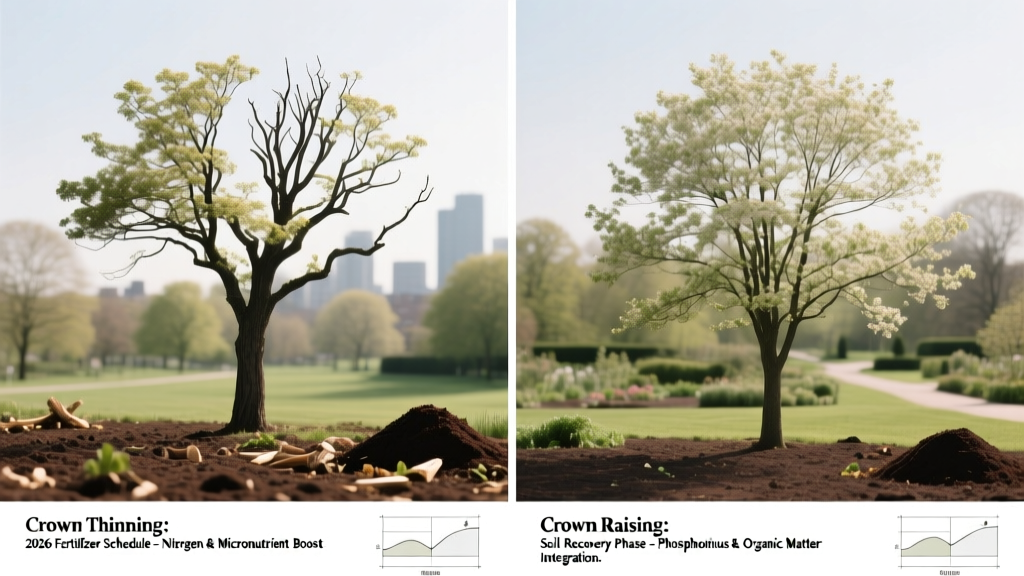
Crown Thinning Vs Raising: 2026 Fertilizer Schedules
Sarah ChenPublished
The Intersection of Pruning and Nutrient Management in 2026
In modern arboriculture, pruning is no longer viewed merely as a mechanical alteration of a tree's structure; it is recognized as a profound metabolic event that fundamentally shifts a tree's nutrient demands. As we navigate the 2026 growing season, leading urban foresters and landscape professionals emphasize that pruning without a tailored, scientifically backed fertilizer schedule inevitably leads to physiological decline, increased susceptibility to borers, and stunted recovery. Two of the most common canopy manipulation techniques—crown thinning and crown raising—trigger entirely different biological responses. Consequently, they require distinct fertilizer types, application methodologies, and seasonal schedules to ensure optimal tree health and structural integrity.
According to the International Society of Arboriculture (ISA), any removal of live foliage alters the tree's photosynthetic capacity and disrupts the delicate balance of the root-to-shoot ratio. When you remove branches, the root system temporarily possesses more uptake capacity than the reduced canopy can utilize, leading to a surge of stored carbohydrates that can trigger weak, erratic water-sprout growth if fertilized incorrectly. Understanding the nuanced differences between crown thinning and crown raising is the first step toward formulating a precise 2026 post-pruning nutrition plan.
Crown Thinning: Canopy Reduction and Nitrogen Demands
Crown thinning involves the selective, strategic removal of smaller, inner branches (typically 1 to 3 inches in diameter) throughout the entire canopy. The primary goals are to increase light penetration, improve air circulation to reduce fungal pathogen pressure, and reduce wind sail. However, because thinning removes a significant volume of photosynthetic leaf mass distributed across the entire crown, the tree experiences an immediate deficit in energy production. The tree's primary biological imperative following this procedure is to rebuild its foliage matrix as efficiently as possible.
2026 Fertilizer Types for Thinned Canopies
To support rapid but structurally sound foliage regeneration, trees that have undergone crown thinning require a fertilizer profile heavily weighted toward nitrogen (N). However, the 2026 standard strictly prohibits the use of highly soluble, fast-release synthetic nitrogen sources (like standard urea) immediately after pruning. Fast-release nitrogen forces the tree to push out excessive, weakly attached epicormic shoots (water sprouts) that ruin the aesthetic and structural goals of the thinning process.
- Recommended Formulation: A slow-release, polymer-coated or sulfur-coated nitrogen fertilizer with an N-P-K ratio of 3-1-2 or 4-1-2.
- Bio-Stimulant Integration: Modern 2026 formulations should include humic and fulvic acids, alongside kelp-based cytokinins, to encourage lateral bud break and cell division without causing nitrogen toxicity in the root zone.
- Application Rate: Apply 1 to 2 pounds of actual nitrogen per 1,000 square feet of the tree's dripline area.
Scheduling the Application
Timing is critical. Do not fertilize immediately on the day of pruning. Allow the tree 4 to 6 weeks to initiate its natural wound-sealing processes (compartmentalization). If pruning is performed in late winter, schedule the slow-release nitrogen application for early spring just as soil temperatures at a 4-inch depth consistently reach 55°F, signaling the roots to resume active uptake.
Crown Raising: Structural Shifts and Root Zone Focus
Crown raising is the targeted removal of the lower branches of a tree to provide vertical clearance for buildings, vehicles, pedestrians, or sightlines. Unlike thinning, which impacts the entire canopy, raising removes older, heavier, and often more shaded limbs from the lower trunk. This technique dramatically alters the tree's center of gravity, shifting it upward, and exposes the previously shaded lower trunk to direct solar radiation, increasing the risk of sunscald and southwest winter injury.
2026 Fertilizer Types for Raised Crowns
Because crown raising does not decimate the primary upper canopy's photosynthetic engine, the tree does not need a massive surge of nitrogen to replace lost leaves. Instead, the tree needs to reinforce its structural wood (xylem density) and expand its root architecture to anchor the newly elevated center of gravity. Therefore, the fertilizer focus shifts away from nitrogen and toward phosphorus (P) and potassium (K).
- Recommended Formulation: A low-nitrogen, high-phosphorus and potassium blend, such as a 1-2-2 or 2-3-3 N-P-K ratio.
- Mycorrhizal Inoculants: The University of Minnesota Extension highlights the importance of soil biology in structural support. Incorporating endomycorrhizal and ectomycorrhizal fungal inoculants during fertilization expands the root absorption network, vital for stabilizing a newly raised tree.
- Potassium for Stress Tolerance: Adequate potassium regulates stomatal opening and improves the tree's drought tolerance and cold hardiness, which is crucial for the newly exposed lower trunk.
Scheduling the Application
Crown raising is best fertilized during the late fall or dormant season. Applying a phosphorus-potassium heavy blend in late autumn allows the roots to absorb and store these structural nutrients over the winter, preparing the tree for robust, stable trunk thickening and root expansion when spring arrives. Furthermore, avoiding high nitrogen in the fall prevents late-season tender growth that would be destroyed by early frosts.
2026 Fertilizer Comparison Chart: Thinning vs. Raising
| Pruning Technique | Primary Nutrient Focus | Ideal N-P-K Ratio | 2026 Application Timing | Recommended Product Type |
|---|---|---|---|---|
| Crown Thinning | Nitrogen (Foliage Rebuild) | 3-1-2 or 4-1-2 | 4-6 weeks post-pruning (Spring/Early Summer) | Bio-enhanced slow-release granular |
| Crown Raising | Phosphorus & Potassium (Root/Trunk) | 1-2-2 or 2-3-3 | Late Fall / Dormant Season | Mycorrhizal root drench & mineral blend |
Advanced Soil Testing: The Non-Negotiable First Step
Before deploying any fertilizer schedule in 2026, a comprehensive soil analysis is mandatory. Guessing your tree's nutrient requirements based solely on the pruning technique is an outdated practice that risks salt buildup, groundwater contamination, and nutrient lockout. The Arbor Day Foundation consistently advises that soil pH dictates nutrient availability; for instance, if your soil pH is above 7.5, phosphorus and essential micronutrients like iron and manganese become chemically bound and inaccessible to the tree, regardless of how much fertilizer you apply.
Utilize a local university extension soil lab or advanced 2026 smart soil probe technology to measure not only N-P-K levels but also cation exchange capacity (CEC), organic matter percentage, and bulk density. If the soil is highly compacted—a common issue in urban landscapes where crown raising is frequently performed for clearance—liquid soil aerators containing calcium thiosulfate should be applied prior to fertilization to open soil pores and allow nutrients to reach the feeder roots.
Step-by-Step Post-Pruning Application Guide
To ensure the fertilizer reaches the active root zone and minimizes runoff, follow these precise application steps tailored to your specific pruning method:
1. Calculate the Dripline Area
Measure the distance from the trunk to the outer edge of the canopy (the dripline). Calculate the square footage of this circle (Area = π × radius²). Note that the International Society of Arboriculture (ISA) reminds us that feeder roots extend well beyond the dripline, so plan to treat an area 1.5 times the dripline radius for maximum efficacy.
2. Choose the Application Method
- For Crown Thinning (Granular): Broadcast the slow-release granular fertilizer evenly across the soil surface from 3 feet away from the trunk out to the extended dripline. Water deeply immediately after application to activate the polymer coatings and draw the nutrients into the top 6 inches of soil where the majority of fine feeder roots reside.
- For Crown Raising (Deep Root Injection/Drench): Because lower branches were removed, the soil near the trunk may be exposed or altered. Use a soil needle or root feeder to inject the liquid mycorrhizal and P-K blend at a depth of 8 to 12 inches in a grid pattern spaced 2 feet apart. This bypasses surface turf competition and delivers structural nutrients directly to the deep anchoring roots.
3. Mulching for Moisture Retention
Following fertilization, apply a 2 to 3-inch layer of organic arborist wood chips over the treated area. Keep the mulch at least 4 inches away from the trunk flare to prevent root collar rot. This mulch layer regulates soil temperature, retains moisture necessary for nutrient dissolution, and slowly breaks down to feed the soil microbiome.
Common Mistakes to Avoid This Season
Even with the correct fertilizer type, poor execution can negate your pruning efforts. Avoid these critical errors:
- Fertilizing Stressed Trees: If a tree was pruned during a severe summer drought, do not fertilize immediately. Fertilizer salts require water to dissolve; without adequate soil moisture, they will desiccate the roots. Prioritize deep, slow irrigation for three weeks before introducing nutrients.
- Ignoring Trunk Protection After Raising: Crown raising exposes the trunk to the sun. If you fertilize heavily with nitrogen, the resulting rapid upper canopy growth may not cast enough shade to protect the lower trunk. Use a breathable, reflective tree wrap or dilute white latex paint on the south-facing trunk to prevent sunscald while the canopy adjusts.
- Over-Pruning and Over-Feeding: Never remove more than 15% to 20% of the live canopy in a single season. If you exceed this threshold, the tree enters a state of shock where its ability to uptake and process fertilizer is severely compromised, leading to toxic salt accumulation in the root zone.
Conclusion
The 2026 approach to tree care demands a holistic view where the shears and the spreader work in perfect synchronization. Crown thinning and crown raising are vastly different physiological interventions. Thinning demands a measured, slow-release nitrogen approach to rebuild the solar engine of the canopy without triggering weak water sprouts. Conversely, crown raising requires a strategic investment in phosphorus, potassium, and mycorrhizal biology to fortify the trunk and anchor the roots against the shifting center of gravity. By aligning your fertilizer types and seasonal schedules with the specific biological aftermath of your pruning techniques, you ensure your landscape trees remain vigorous, structurally sound, and breathtakingly beautiful for decades to come.