Tree Care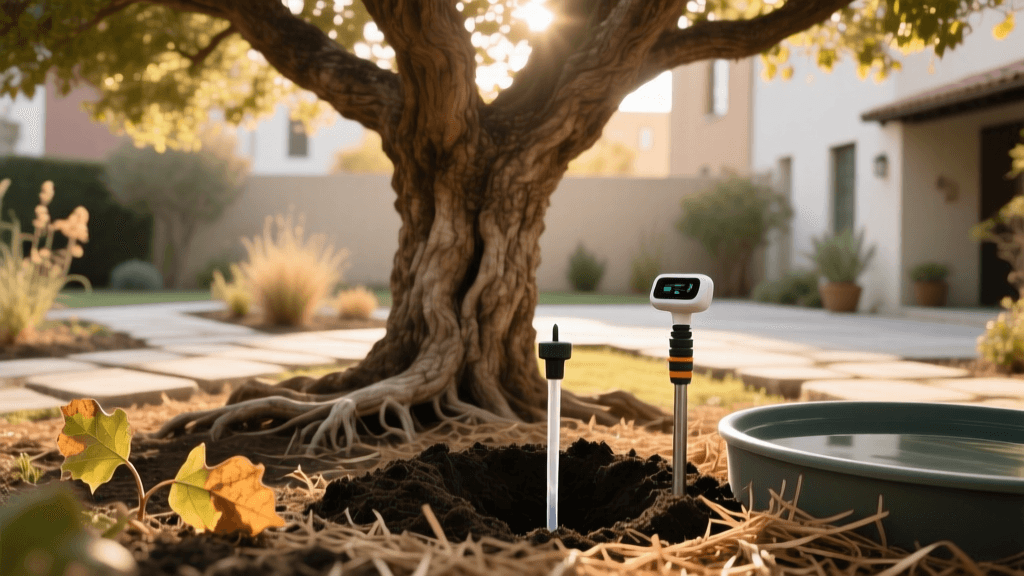
Deep Root Watering Guide for Mature Trees During Drought
The Hidden Crisis of Surface Watering
Mature trees are the cornerstone of any established landscape, providing immense shade, ecological benefits, and significant property value. However, during prolonged summer droughts, these towering giants often suffer in silence. Homeowners frequently make the critical mistake of relying on standard lawn sprinklers to hydrate their trees. While surface watering keeps the top two inches of soil moist, it entirely fails to reach the deep, water-absorbing roots of mature trees. In fact, frequent shallow watering encourages roots to grow upward toward the surface in search of moisture, making the tree highly vulnerable to drought stress, mechanical damage from mowers, and soil compaction.
To maintain tree health and structural stability, arborists universally recommend deep root watering. This expert-level practice involves delivering water directly into the lower soil profile, typically between 8 and 18 inches below the surface. By mimicking the slow, penetrating nature of natural rainfall, deep watering encourages a robust, deep root system that can access subsurface moisture reserves long after the topsoil has dried out.
Understanding the Critical Root Zone (CRZ)
Before you can effectively water a mature tree, you must understand where its roots are actually located. The common misconception is that a tree's root system mirrors its canopy exactly, or that the majority of roots are clustered tightly around the base of the trunk. In reality, the most active, water-absorbing roots are located in the Critical Root Zone (CRZ), which typically extends well beyond the drip line (the outer edge of the canopy).
To calculate the CRZ for your specific tree, measure the Diameter at Breast Height (DBH). The DBH is the trunk diameter measured at exactly 4.5 feet above the ground. As a general rule of thumb established by the International Society of Arboriculture (ISA), the CRZ extends outward from the trunk at a rate of 1 foot of radius for every 1 inch of DBH. Therefore, a mature oak with a 20-inch DBH has a critical root zone radius of 20 feet. When deep watering, your primary target should be the soil within this outer ring, rather than the soil immediately adjacent to the trunk base, which is mostly occupied by large, structural anchor roots that do not absorb water efficiently.
Soil Texture and Infiltration Rates
An expert watering strategy must account for local soil composition. Water moves through different soil textures at vastly different rates. Sandy loam soils drain rapidly, meaning water will percolate down to the 12-inch depth quickly but will also evaporate and deplete faster, requiring more frequent watering sessions. Conversely, heavy clay soils have incredibly slow infiltration rates. If you apply water too quickly to clay soil, it will pool on the surface and run off into the street or storm drains, wasting water and leaving the deep roots parched. For clay-heavy landscapes, the application rate must be drastically reduced to allow gravity to pull the moisture down into the subsoil layer over several hours.
Essential Tools for Deep Root Irrigation
Selecting the right equipment is paramount for efficient deep root hydration. Below is a comparison of the most effective tools used by landscape professionals and certified arborists.
| Tool Type | Estimated Cost | Best Application | Pros | Cons |
|---|---|---|---|---|
| Root Feeder Probe (e.g., Ross Root Feeder) | $35 - $55 | Targeted watering, fertilizing, and breaking up compacted clay soils. | Delivers water exactly at the 12-inch root depth; aerates soil simultaneously. | Labor-intensive; requires manually moving the probe every 15-20 minutes. |
| Soaker Hose / Drip Line (e.g., Dramm) | $20 - $40 | Large CRZ coverage, overnight watering, and set-and-forget irrigation. | Highly water-efficient; prevents runoff; can be left on for hours. | Slow infiltration; hoses can degrade under UV exposure over time. |
| Deep Root Watering Stake (e.g., Treegator or Rain Bird) | $15 - $30 per stake | Newly planted trees or specific targeted zones in small yards. | Easy to install; directs water straight down. | Less effective for massive mature trees with wide-spreading CRZs. |
| Oscillating Sprinkler | $15 - $30 | Lawns only. Not recommended for trees. | Covers wide areas quickly. | Wets only the top 1 inch of soil; promotes shallow roots and fungal diseases. |
The Soil Moisture Probe Test: When to Water
One of the most valuable expert tips for tree care is to never water on a rigid calendar schedule. Instead, water based on soil moisture levels. Evapotranspiration rates fluctuate wildly based on humidity, wind, and temperature. To determine if your mature tree needs water, use a 12-inch to 18-inch soil moisture probe or a simple long-bladed screwdriver.
Insert the probe into the soil within the CRZ. If you can easily push the probe 8 to 12 inches into the ground and it comes out with soil clinging to it, the moisture level is adequate. If the probe meets hard resistance and comes out clean and dusty, the deep soil profile is completely dry, and it is time to initiate a deep watering session. According to the Colorado State University (CSU) Extension (Fact Sheet No. 7.211), relying on physical soil moisture testing prevents both underwatering and the equally dangerous practice of overwatering, which can suffocate roots and invite Phytophthora root rot.
Step-by-Step Deep Watering Protocol
Follow this actionable protocol to ensure your mature trees receive the exact volume of water they need without waste:
- Step 1: Calculate the Required Volume. A mature tree generally requires 10 to 15 gallons of water per inch of DBH per watering session during peak drought. A 20-inch DBH tree will need approximately 200 to 300 gallons per session.
- Step 2: Set the Flow Rate. Attach your soaker hose or root feeder. The goal is slow infiltration. For soaker hoses, a flow rate of 1 gallon per minute (GPM) is ideal. Run the hose in concentric circles starting near the drip line and working outward.
- Step 3: Time the Application. To deliver 200 gallons at a slow drip rate, the system may need to run for 3 to 5 hours. It is best to start this process in the late evening to minimize evaporative losses to the sun and wind.
- Step 4: Rotate Zones. If using a manual root feeder probe, insert it 8 to 12 inches deep, turn on the water for 2 to 3 minutes per insertion point, and move in a grid pattern across the CRZ.
The Synergy of Deep Watering and Proper Mulching
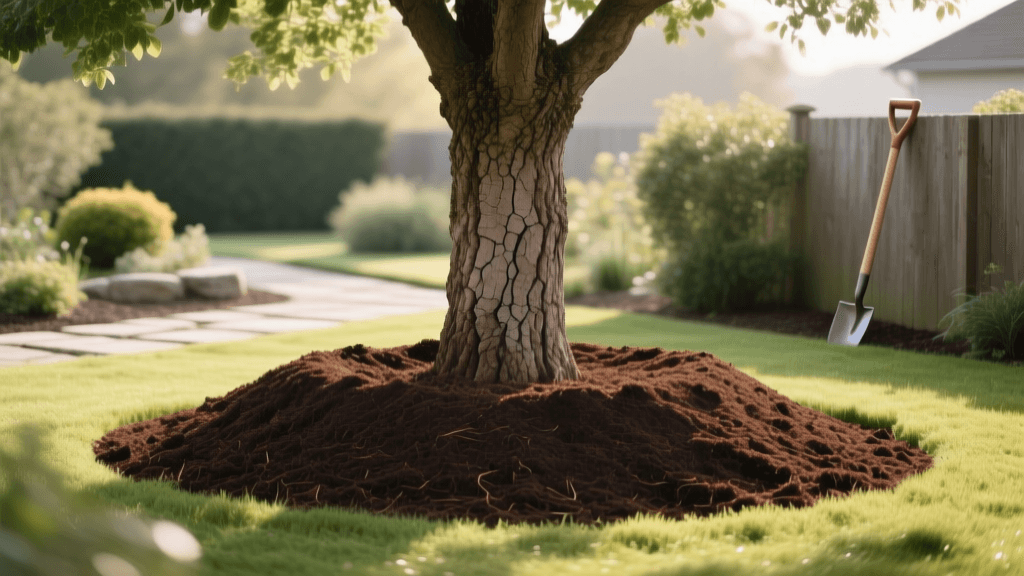
Deep watering is only half of the hydration equation; retaining that moisture is the other. Applying a proper layer of organic mulch over the CRZ reduces soil water evaporation by up to 70%. However, improper mulching can be fatal. Arborists strictly enforce the '3-3-3 Rule' for mulching: Apply a layer 3 inches deep, extending out to a 3-foot radius (or further to the drip line for mature trees), while keeping the mulch strictly 3 inches away from the trunk flare. Piling mulch against the trunk, a practice notoriously known as 'volcano mulching,' traps moisture against the bark, leading to girdling roots, bark decay, and severe fungal infections.
Expert Seasonal Watering Schedule
The frequency of deep watering depends heavily on the season and the presence of drought conditions. The table below provides a baseline schedule for mature trees during periods of zero rainfall.
| Season / Condition | Tree Size (DBH) | Target Volume | Frequency |
|---|---|---|---|
| Peak Summer Drought | 15 - 25 inches | 150 - 250 Gallons | Every 10 to 14 days |
| Late Fall (Pre-Winter) | 15 - 25 inches | 150 - 250 Gallons | Once a month until ground freezes |
| Winter Dormancy | 15 - 25 inches | 100 - 150 Gallons | Once every 3-4 weeks (if above 40°F) |
| Spring Thaw / Growth | 15 - 25 inches | 150 - 250 Gallons | Every 7 to 10 days (if no rain) |
'Trees require deep, infrequent watering to encourage deep root growth and prevent surface root dependency. Winter and drought watering are critical, as a tree's root system remains active and continues to transpire moisture long after the leaves have fallen.' — Colorado State University Extension, Drought Care Guidelines
Conclusion
Mastering deep root watering is one of the most impactful investments you can make in the longevity of your landscape. By moving away from superficial sprinkler routines and adopting targeted, volume-based hydration strategies, you protect your mature trees from the invisible stresses of drought. Utilize soil probes to monitor moisture, invest in slow-delivery irrigation tools like root feeders or soaker hoses, and always respect the boundaries of the Critical Root Zone. With these expert best practices in place, your trees will remain resilient, vibrant, and structurally sound for generations to come.