Tree Care
Deep Root Watering Strategies for Mature Trees During Droughts
Introduction: The Hidden Threat of Summer Drought on Mature Trees
When summer heat peaks and rainfall dwindles, the immediate casualty in most landscapes is the turfgrass. Homeowners quickly notice browning lawns and respond with frequent, shallow sprinkler sessions. However, the most expensive and ecologically vital components of your landscape—mature shade trees—are often suffering in silence. Unlike grass, which shows drought stress within days, mature trees can take months or even years to exhibit the fatal consequences of chronic underwatering. By the time you see canopy thinning, branch dieback, or premature autumn coloring in mid-July, severe root damage has already occurred.
As a senior arborist and tree care specialist, I cannot stress this enough: sprinkling your lawn is not watering your trees. To protect your mature trees from drought-induced decline, pest infestations (like bronze birch borers or bark beetles), and structural failure, you must implement targeted deep root watering strategies. This guide outlines the expert best practices, precise measurements, and professional tools required to keep your mature trees thriving during extreme dry spells.
Why Surface Watering Fails Mature Trees
The primary mistake homeowners make is assuming that a 20-minute run of their standard pop-up sprinkler system is sufficient for the large oak, maple, or ash trees in their yard. This approach fails for two critical reasons:
- Turfgrass Competition: The dense, fibrous root system of turfgrass acts like a sponge, intercepting the first half-inch of water before it ever reaches the deeper soil horizons where tree roots reside.
- Evaporation and Runoff: Standard sprinklers apply water faster than the soil can absorb it, especially in compacted urban soils or heavy clay. The result is massive water loss to evaporation and surface runoff.
Mature trees rely on a vast network of fine, non-woody absorbing roots. Contrary to popular belief, these roots do not mirror the tree's canopy deep underground. According to the International Society of Arboriculture (ISA), the vast majority of a tree's water-absorbing roots are located in the top 12 to 24 inches of soil, extending well beyond the dripline (the outer edge of the canopy). To hydrate this expansive zone, water must be applied slowly and deeply.
The Science of Deep Root Hydration and Soil Types
Deep root watering encourages roots to grow downward and outward, anchoring the tree and creating a resilient buffer against surface temperature fluctuations. However, your soil composition dictates your watering strategy.
- Clay Soils: Highly compacted and slow-draining. Water applied too quickly will pool and run off. Clay requires very slow application rates over longer periods to allow capillary action to pull moisture downward.
- Sandy Soils: Fast-draining and poor at retaining moisture. Sandy soils require more frequent watering sessions, as water quickly percolates past the 24-inch root zone.
- Loam Soils: The ideal balance. Water infiltrates evenly and is retained well.
Expert Best Practices: When and How Much to Water
Determining the exact volume of water a mature tree needs is a matter of arithmetic, not guesswork. The industry standard metric relies on the tree's Diameter at Breast Height (DBH), measured at 4.5 feet above the ground.
Calculating Gallons per Inch of Trunk Diameter
The general rule of thumb established by university extension programs is to provide 10 to 15 gallons of water per inch of DBH per watering session during a drought.
Example Calculation: If your mature Red Oak has a DBH of 20 inches, it requires between 200 and 300 gallons of water per deep watering session. A standard garden hose running at 5 gallons per minute (GPM) would need to run for 40 to 60 minutes to deliver this volume—but only if the water is distributed correctly and allowed to soak in.
Timing and Frequency
During peak summer droughts, mature trees should be deep-watered once every 10 to 14 days. Always water in the early morning (between 4:00 AM and 8:00 AM) to minimize evaporative loss and reduce the risk of fungal pathogens that thrive on wet foliage overnight.
“Trees should be watered in the spring and fall as well as during the growing season... Apply water slowly to allow it to soak into the soil. A deep soaking is better than frequent, light waterings.”
— Colorado State University (CSU) Extension, Fact Sheet No. 7.211: Fall and Winter Watering
Tool Comparison: Choosing the Right Deep Root Irrigation System
Investing in the right equipment saves water, time, and money. Below is a comparison chart of the most effective tools for deep root watering, ranging from budget-friendly DIY solutions to professional-grade equipment.
| Irrigation Tool | Estimated Cost | Depth Penetration | Efficiency & Best Use Case |
|---|---|---|---|
| Soaker Hose (Porous) | $25 - $40 | 6 - 12 inches | High efficiency. Best for wrapping in concentric circles from the trunk to the dripline. Excellent for clay soils due to ultra-slow weeping. |
| Drip Irrigation Grid | $80 - $150 | 12 - 18 inches | Very high efficiency. Requires initial setup and pressure regulators. Ideal for new plantings and automated landscape systems. |
| Deep Root Watering Probe | $30 - $60 | 12 - 24 inches | Moderate efficiency. Attaches to a hose and injects water directly into the root zone. Best for sandy soils or heavily compacted urban sites where surface infiltration is poor. |
| Oscillating Sprinkler | $20 - $35 | 1 - 3 inches | Low efficiency for trees. High evaporation loss. Only recommended if placed under the canopy on a low-setting for 2+ hours to simulate a slow, soaking rain. |
Step-by-Step Deep Root Watering Protocol
Follow this actionable protocol to ensure your mature trees receive optimal hydration without wasting municipal water or promoting root rot.
- Measure the DBH: Use a flexible measuring tape to find the circumference of the trunk at 4.5 feet high. Divide by 3.14 (Pi) to get the diameter.
- Map the Critical Root Zone (CRZ): Identify the dripline. Your watering zone should extend from halfway between the trunk and the dripline, out to 20% beyond the dripline.
- Deploy the Soaker Hose or Probe: If using a soaker hose, lay it out in concentric rings spaced 18 inches apart across the CRZ. If using a root probe, insert it at a 45-degree angle toward the trunk, moving every 2 feet across the zone.
- Monitor Infiltration: Turn the water on to a low-to-medium flow. Check after 20 minutes. If you see pooling or runoff, reduce the flow rate or turn the water off for an hour to let the soil absorb the moisture before resuming.
- Verify Moisture Depth: Use a 12-inch soil probe or a long screwdriver. It should slide easily into the soil to a depth of 8-12 inches when adequately hydrated.
Synergizing Deep Watering with Proper Mulching
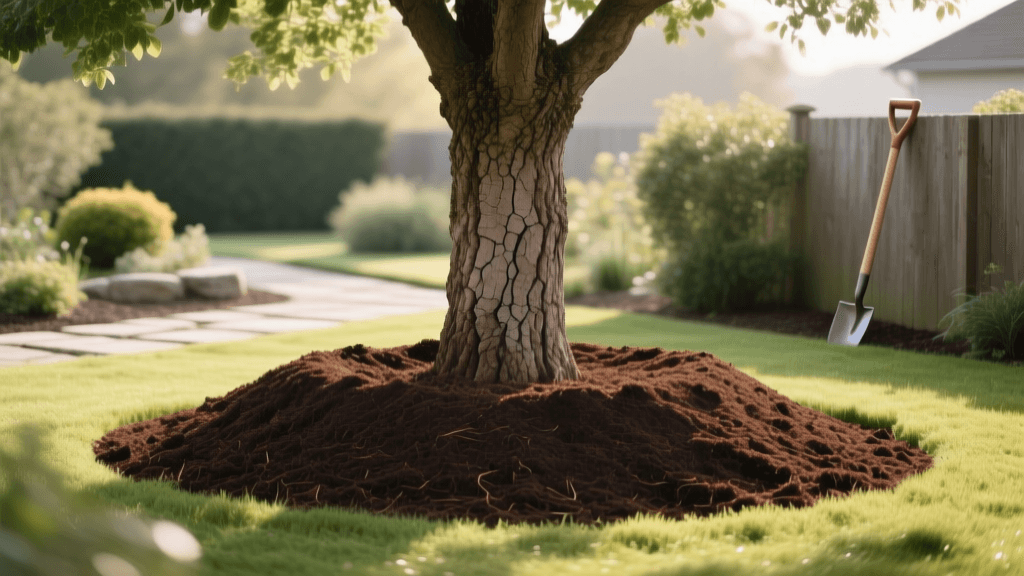
Deep watering is only half the equation. To lock in that moisture and regulate soil temperature, you must apply mulch correctly. The practice of “volcano mulching”—piling mulch high against the tree trunk—is a fatal error that invites trunk rot, girdling roots, and rodent damage.
Expert Mulching Best Practices:
- The 3-3-3 Rule: Apply a 3-inch layer of organic mulch (like shredded hardwood or pine bark), in a 3-foot radius minimum (ideally out to the dripline), and keep it 3 inches away from the trunk flare.
- Material Matters: Avoid dyed mulches or rubber mulch, which do not break down to feed soil microbes. Coarse wood chips are superior for moisture retention and gas exchange.
- Refresh, Don't Pile: Before adding new mulch in the spring, break up the crust of the old mulch and only add enough to maintain the 3-inch depth.
Conclusion
Protecting mature trees during summer droughts requires a shift in perspective from treating the landscape as a single entity to understanding the specific hydrological needs of deep-rooted woody plants. By calculating your tree's DBH, utilizing slow-delivery deep root irrigation tools like soaker hoses or root probes, and synergizing your watering with proper, trunk-safe mulching, you safeguard your property's most valuable natural assets. Implement these expert best practices today, and your trees will continue to provide shade, beauty, and ecological benefits for decades to come.