Tree Care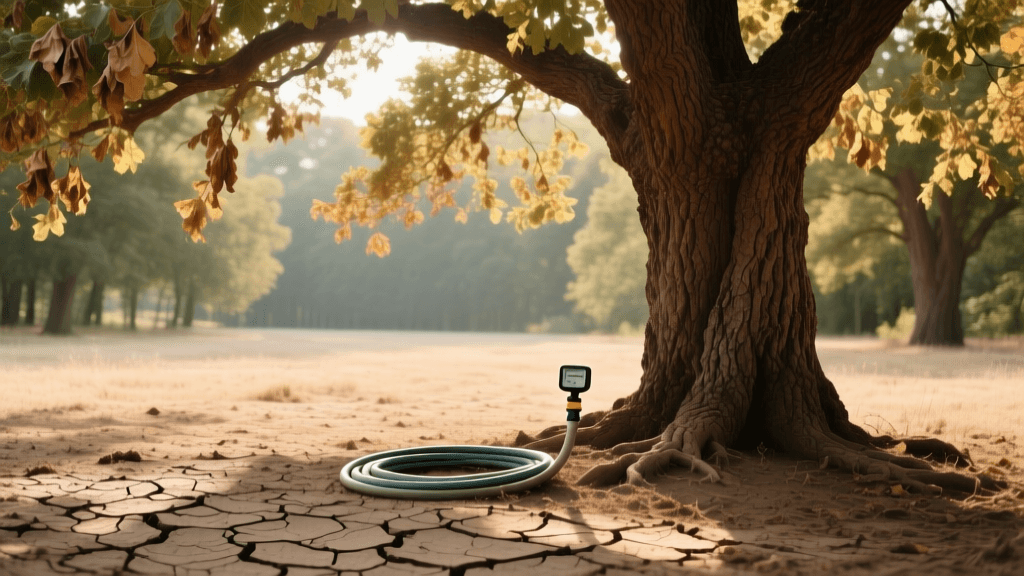
How to Deep Water Mature Trees During Summer Drought
The Importance of Deep Watering for Mature Trees
Summer droughts pose a severe threat to the health and longevity of mature shade trees. While established trees are often perceived as self-sufficient, prolonged periods without significant rainfall can deplete deep soil moisture reserves, leading to irreversible canopy dieback, increased susceptibility to borers, and eventual tree death. Deep watering is the most effective intervention a homeowner can perform to protect their landscape investment during dry spells.
Unlike shallow watering, which only moistens the top inch or two of soil, deep watering delivers moisture directly to the critical root zone. This practice encourages roots to grow downward rather than upward, anchoring the tree more securely and making it more resilient to environmental stressors. In this comprehensive guide, we will cover the exact techniques, tools, and measurements required to deep water your mature trees effectively.
Why Standard Lawn Irrigation Falls Short
One of the most common misconceptions in lawn care is that running the standard sprinkler system is sufficient for tree hydration. Standard pop-up lawn sprinklers are designed to deliver frequent, light applications of water to sustain shallow-rooted turfgrass. This typically results in only the top one to two inches of soil receiving moisture.
Trees, however, require moisture in the top 12 to 18 inches of soil, where the majority of their fine, water-absorbing feeder roots reside. When you rely solely on lawn sprinklers, the water evaporates before it ever reaches the tree's root zone. Furthermore, frequent shallow watering encourages tree roots to grow upward toward the surface in search of moisture, leading to surface roots that can damage sidewalks, mowers, and the tree's own structural stability.
Understanding the Tree Root Zone
To water a tree effectively, you must understand where its roots are located. The absorbing roots of a mature tree are rarely found directly against the trunk. Instead, they extend outward, often reaching well past the tree's canopy.
The Drip Line and Beyond
The 'drip line' is the imaginary circle on the ground directly beneath the outermost circumference of the tree's branches. While many roots reside near the drip line, a mature tree's root system can extend up to two or three times the width of the canopy. Therefore, your deep watering strategy should focus on the area starting a few feet away from the trunk and extending several feet past the drip line.
Essential Tools for Deep Watering
Before you begin, gather the proper equipment. You do not need expensive commercial gear, but specialized tools make the process vastly more efficient.
- Soaker Hoses: A porous soaker hose (such as those made by Gilmour or Dramm) allows water to 'sweat' out slowly along its entire length, preventing runoff and ensuring deep penetration.
- Root Waterer Probes: Tools like the Ross Root Waterer attach to your garden hose and feature a metal spike that injects water directly into the soil profile, bypassing compacted surface layers.
- Soil Moisture Probe or Screwdriver: A simple 12-inch flathead screwdriver or a dedicated soil probe is essential for testing moisture depth.
- Hose Timer: A digital hose timer ensures you deliver the exact volume of water needed without wasting municipal water or over-saturating the soil.
Step-by-Step Guide to Deep Watering
Step 1: Test the Current Soil Moisture
Never water blindly. Before turning on the hose, perform the screwdriver test. Push a 12-inch screwdriver into the soil near the tree's drip line. If it slides in easily and comes out with damp soil clinging to it, the soil has adequate moisture. If it meets heavy resistance or comes out completely dry and dusty, it is time to deep water. According to the University of Minnesota Extension, checking soil moisture manually is the best way to prevent both underwatering and root-rot-inducing overwatering.
Step 2: Position Your Soaker Hose
Lay the soaker hose in a spiral pattern around the tree. Start about 2 feet away from the trunk (to prevent trunk rot and fungal issues) and spiral outward until you reach the drip line and slightly beyond. Avoid piling the hose in a single tight circle, as this will create a localized mud pit rather than an evenly moistened root zone.
Step 3: Calculate Flow Rate and Set the Timer
To know how long to run the water, you must know your hose's output. Place a 1-gallon bucket under your soaker hose or standard hose, turn it on to your desired low-flow setting, and time how many seconds it takes to fill. If it takes 60 seconds to fill 1 gallon, your flow rate is 1 Gallon Per Minute (GPM). If it takes 30 seconds, your flow rate is 2 GPM.
Watering Schedule and Volume Chart
A general rule of thumb recommended by arborists is to provide 10 gallons of water per inch of trunk diameter (measured at 4.5 feet above the ground) during a drought period. Below is a practical chart to help you calculate your watering time based on a standard 1 GPM soaker hose setup.
| Tree Trunk Diameter (at 4.5 ft) | Estimated Gallons Needed | Soaker Hose Time (at 1 GPM) | Frequency During Severe Drought |
|---|---|---|---|
| 4 inches | 40 gallons | 40 minutes | Every 7-10 days |
| 8 inches | 80 gallons | 80 minutes | Every 10-14 days |
| 12 inches | 120 gallons | 120 minutes (2 hours) | Every 14 days |
| 18 inches | 180 gallons | 180 minutes (3 hours) | Every 14-21 days |
| 24+ inches | 240+ gallons | 240+ minutes (4+ hours) | Every 21 days |
Note: If using a root waterer probe, insert the spike at 10-15 locations evenly spaced around the drip line, leaving the water running at each spot for 2 to 3 minutes.
The Critical Role of Mulch in Moisture Retention
Deep watering is only half the battle; retaining that moisture is equally important. Applying a proper layer of organic mulch can reduce soil water evaporation by up to 70%. However, improper mulching can kill a tree just as surely as a drought.
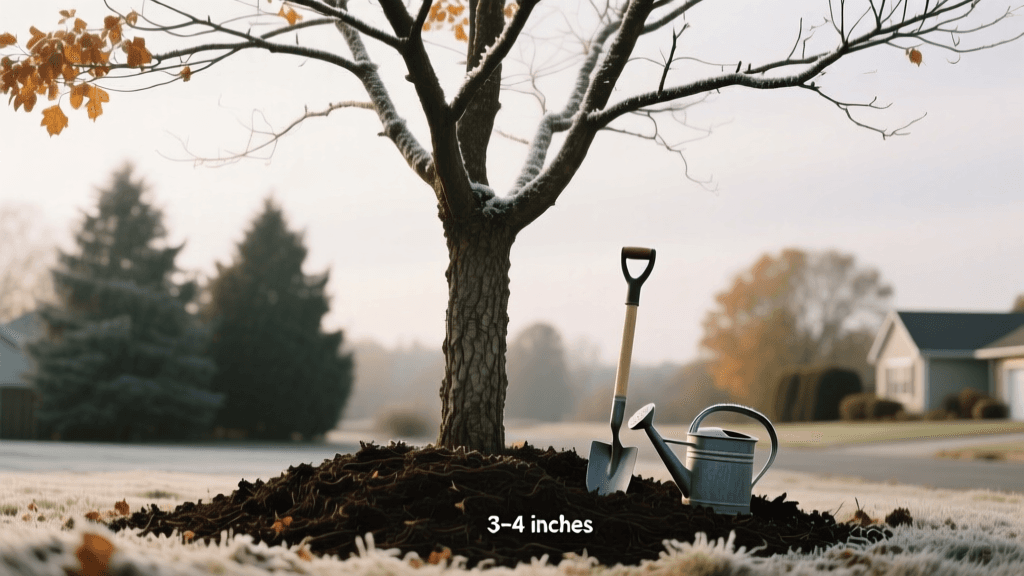
The Morton Arboretum strongly advises against 'volcano mulching,' where mulch is piled high against the tree trunk. This traps moisture against the bark, inviting fungal pathogens and rodent damage. Instead, apply a 2-to-4-inch layer of shredded hardwood bark or wood chips in a wide 'donut' shape. Keep the mulch at least 3 inches away from the actual trunk flare, and extend the mulch ring out to the drip line if possible.
Identifying Drought Stress vs. Overwatering
It is vital to monitor your trees for signs of stress, but be aware that the symptoms of underwatering and overwatering can look remarkably similar. Both can cause leaf wilting, yellowing, and premature leaf drop.
- Signs of Drought Stress: Leaves may curl inward, develop scorched or crispy brown margins, and drop prematurely starting from the top of the canopy and outer branches. The soil will be hard and cracked.
- Signs of Overwatering: Leaves may turn pale yellow or brown but remain soft and limp. The soil will feel spongy, smell sour, or have standing water. Fungal mushrooms may appear at the base.
'A deep, thorough watering is far more beneficial than frequent, shallow sprinklings. Shallow watering encourages surface roots, making trees more vulnerable to drought, heat scorch, and physical damage from lawn equipment.'
Seasonal Adjustments and Winter Prep
Deep watering is not exclusively a summer task. If autumn is unusually dry, trees need deep watering right up until the ground freezes. Evergreens, in particular, continue to lose moisture through their needles during winter winds. A deep watering in late November ensures they enter winter dormancy fully hydrated, preventing 'winter burn' and browning of needles in early spring.
Conclusion
Protecting mature trees during summer droughts requires a shift in mindset from lawn care to targeted arboriculture. By abandoning shallow sprinkler reliance in favor of calculated, deep-soak methods using soaker hoses or root probes, you ensure that vital moisture reaches the feeder roots. Combine this with proper soil testing and a wide, flat ring of organic mulch, and your trees will not only survive the harshest summer droughts but will continue to provide shade, beauty, and property value for decades to come.