Tree Care
Strategic Tree Placement for Energy Efficiency and Shade
The Intersection of Landscape Design and Energy Efficiency
When homeowners envision landscape design, they often focus on curb appeal, colorful perennial beds, and pristine lawn care. However, one of the most powerful tools in a landscape architect's arsenal is often overlooked for its functional benefits: the strategic placement of trees. Trees are not merely ornamental features; they are living, breathing infrastructure that can dramatically alter the microclimate of your property. By understanding solar angles, wind patterns, and species-specific growth habits, you can design a landscape that naturally cools your home in the summer and shields it from harsh winter winds.
According to the U.S. Department of Energy, carefully positioned trees can save up to 25% of a household's energy consumption for heating and cooling. This is not just a marginal reduction; it translates to hundreds of dollars in annual utility savings while simultaneously increasing your property value and sequestering carbon. Planning your tree layout requires a shift from purely aesthetic thinking to a holistic, four-season approach to environmental design.
Mapping Your Property: Solar Angles and Summer Shade
To maximize energy efficiency, you must first understand how the sun interacts with your home throughout the year. In the Northern Hemisphere, the summer sun sits high in the sky, bearing down heavily on your roof and south-facing windows. Conversely, the winter sun hangs low on the horizon, allowing its warming rays to penetrate deep into your living spaces. Your tree placement strategy must capitalize on this celestial geometry.
South-Facing Shade
For the south side of your home, the goal is to block the intense summer sun while allowing the low-angle winter sun to pass through and provide passive solar heating. Deciduous trees are the perfect solution here. During the summer, their dense canopies act as a natural awning, reducing indoor temperatures by up to 10 degrees Fahrenheit. In the winter, once they drop their leaves, they allow sunlight to warm your home. Plant large, broad-canopied deciduous trees approximately 15 to 25 feet away from south-facing walls. This distance ensures the shade falls on the house during the peak heat of the afternoon without the root system compromising your foundation.
West-Facing Shade
The west side of a home receives intense, low-angle afternoon sun during the hottest part of the day in late summer. This late-day solar gain is a primary culprit for overworked air conditioning systems. To combat this, plant trees with lower, denser crowns on the west side of your property. Because the sun is lower in the sky in the late afternoon, you need foliage that reaches closer to the ground to effectively block the glare and heat.
Designing Windbreaks for Winter Protection
While summer cooling is a major benefit, winter heating costs can skyrocket due to cold winds stripping heat from your home's exterior and forcing drafts through tiny cracks in your building envelope. A well-designed windbreak can reduce wind speed and lower heating bills by 10% to 25%.
According to Penn State Extension, an effective windbreak should be planted on the north and northwest sides of your property, where prevailing winter winds originate. The ideal windbreak consists of dense, multi-row evergreen plantings. The 'wind shadow'—the area of reduced wind speed on the leeward side of the trees—typically extends for a distance equal to two to five times the mature height of the trees. Therefore, if you plant an evergreen species that matures at 50 feet, you can expect significant wind protection up to 250 feet downwind. For maximum effectiveness, plant your windbreak at a distance of one to two times the tree's mature height away from your home to block the wind before it hits the house, while avoiding excessive shading on your roof.
Best Tree Species for Strategic Shade and Privacy
Selecting the right species is critical to your design plan. You must consider mature height, canopy spread, growth rate, and hardiness zone. Below is a comparison chart of top-performing species for energy-efficient landscape design.
| Species | Type | Mature Height | Canopy Spread | Best Placement & Use |
|---|---|---|---|---|
| Red Maple (Acer rubrum) | Deciduous | 40 - 60 ft | 30 - 40 ft | South/West shade; brilliant fall color |
| Bur Oak (Quercus macrocarpa) | Deciduous | 70 - 80 ft | 60 - 80 ft | Large south lawns; extreme drought tolerance |
| Eastern Red Cedar (Juniperus virginiana) | Evergreen | 40 - 50 ft | 15 - 20 ft | North windbreaks; dense wildlife cover |
| Green Giant Arborvitae (Thuja standishii x plicata) | Evergreen | 30 - 50 ft | 12 - 15 ft | Privacy screens; fast-growing windbreaks |
Red Maple: A staple in North American landscaping, the Red Maple offers a moderately fast growth rate and a sprawling canopy that provides excellent high-roof shade. Its shallow, fibrous root system requires ample mulch and moisture but rewards the homeowner with spectacular crimson foliage in autumn.
Bur Oak: If you have a massive property and need monumental shade, the Bur Oak is unmatched. It develops a deep taproot, making it incredibly resilient to drought and urban pollution once established. It is a legacy tree, meaning it will take decades to reach full maturity, but it will serve generations.
Eastern Red Cedar: A native evergreen that thrives in poor soils, this tree is the backbone of many rural windbreaks. Its dense, scale-like foliage cuts through biting winter winds effectively.
Green Giant Arborvitae: For suburban privacy and wind deflection, this hybrid is a powerhouse. Growing 3 to 5 feet per year under optimal conditions, it forms a thick, deer-resistant green wall that requires minimal pruning compared to other hedge species.
Infrastructure, Spacing, and the 'Right Tree, Right Place' Rule
A common mistake in landscape planning is planting trees based on their size at the nursery rather than their mature dimensions. The Arbor Day Foundation heavily promotes the 'Right Tree, Right Place' initiative to prevent conflicts with infrastructure. Tree roots can extend outward 1.5 to 2 times the width of the canopy. Planting large shade trees too close to your home can lead to foundation cracks, damaged underground septic lines, and clogged gutters.
- Large Trees (Over 40 ft tall): Plant at least 20 to 25 feet away from foundations, driveways, and sidewalks.
- Medium Trees (20 to 40 ft tall): Plant at least 10 to 15 feet away from hardscaping and structures.
- Under Power Lines: Only plant small, understory trees (under 25 ft mature height) such as Dogwoods, Redbuds, or Japanese Maples directly beneath or near utility lines to prevent hazardous arcing and costly utility pruning.
Actionable Planting and Maintenance Guidelines
Even the most meticulously planned tree placement will fail if the installation and early care are poorly executed. To ensure your living infrastructure thrives, follow these precise planting specifications:
Digging and Placement
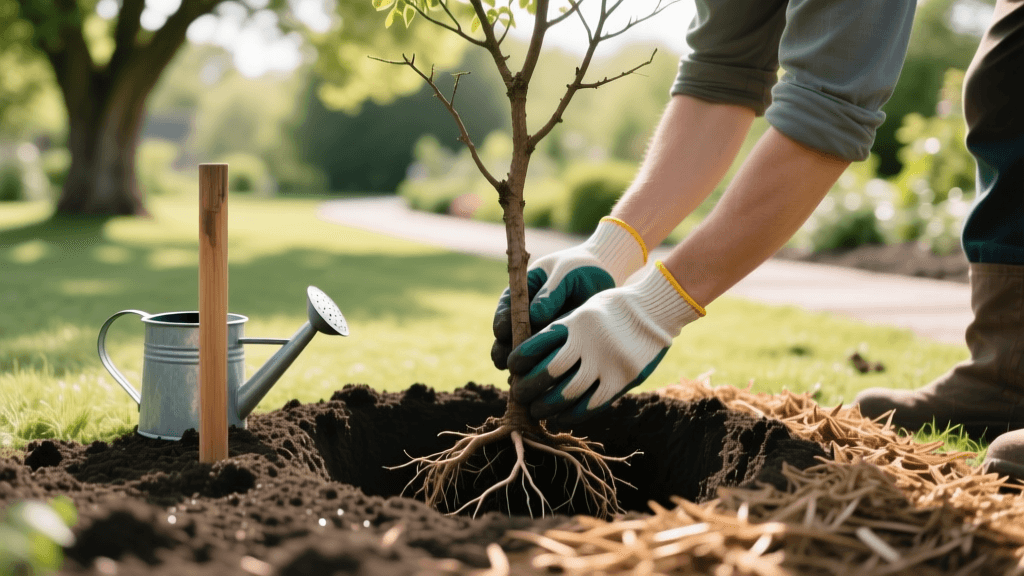
Dig a hole that is two to three times wider than the root ball, but no deeper. The most critical step is locating the trunk flare—the point where the trunk widens at the base and transitions into roots. This flare must sit slightly above the surrounding soil grade. Planting a tree too deep is the number one cause of premature tree death in residential landscapes, as it suffocates the root system and invites trunk-rotting pathogens.
The 3-3-3 Mulching Rule
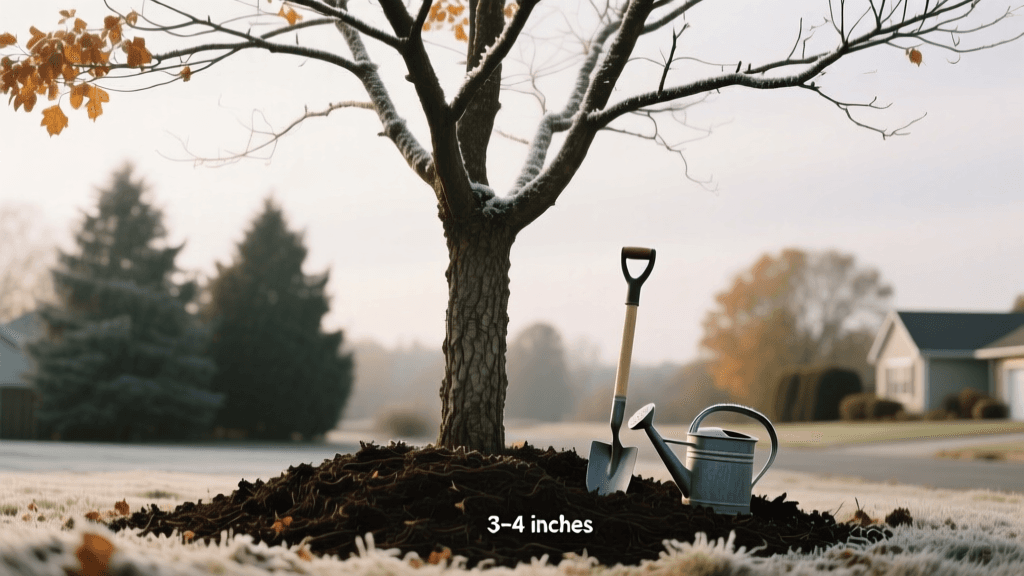
Apply a high-quality hardwood or pine bark mulch in a 'donut' shape around the base of the tree. The mulch layer should be 3 inches deep, extend in a 3-foot radius from the trunk, and be kept 3 inches away from the actual bark of the trunk. Never practice 'volcano mulching,' where mulch is piled high against the trunk, as this traps moisture and harbors pests.
Watering Schedule
Newly planted trees require deep, infrequent watering to encourage roots to grow downward rather than lingering near the surface. A general rule of thumb is to provide 10 gallons of water per inch of trunk caliper (measured at knee height) every week during the first two growing seasons. Use a slow-drip soaker hose or a specialized tree watering bag (like a Treegator) to allow the water to penetrate deeply into the clay or loam soil without running off.
Cost Analysis and Return on Investment
Investing in mature, high-quality trees requires upfront capital, but the return on investment is substantial. A 15-gallon nursery tree (typically 6 to 8 feet tall) costs between $150 and $250, while a 30-gallon or 2-inch caliper tree (10 to 14 feet tall) can range from $400 to $800, excluding professional planting fees. However, when you factor in the 15% to 25% reduction in annual HVAC costs, the payback period for strategic shade trees is typically between 5 and 8 years. Beyond the energy savings, mature, well-placed trees can increase overall property values by 7% to 15%, making strategic tree placement one of the most financially sound landscape design decisions a homeowner can make.