Tree Care
How to Deep Water and Mulch Trees for Drought Survival
The Critical Role of Deep Watering and Mulching
Trees are remarkably resilient organisms, but prolonged drought conditions can severely compromise their structural integrity and immune systems. When a tree experiences water stress, it closes its stomata to conserve moisture, effectively halting photosynthesis and growth. This weakened state makes the tree highly susceptible to secondary invaders, such as bark beetles, borers, and fungal pathogens. To safeguard your landscape investments, implementing a strategic deep watering and proper mulching regimen is non-negotiable. This practical guide will walk you through the exact measurements, tools, and techniques required to drought-proof your trees, ensuring they thrive even in the harshest conditions.
Understanding the Tree Root Zone
One of the most common mistakes homeowners make is watering the base of the trunk. The trunk is primarily a transport and storage organ, not an absorption organ. According to The Morton Arboretum, the vast majority of a tree's fine, water-absorbing roots are located in the top 12 to 18 inches of soil and extend outward to the drip line (the outer edge of the tree's canopy) and often well beyond it.
For mature trees, the root system can extend up to three times the width of the canopy. Therefore, your watering and mulching efforts must be targeted at this expansive peripheral zone rather than the immediate base of the tree. Applying water directly to the trunk not only wastes resources but also promotes basal rot and encourages the growth of adventitious roots that can eventually girdle and strangle the tree.
Step-by-Step Guide to Deep Watering
Deep watering encourages roots to grow downward into the soil profile, where moisture levels remain more stable during dry spells. Shallow, frequent watering, on the other hand, promotes a shallow root system that is highly vulnerable to heat and drought.
Calculating Your Tree's Water Needs
A widely accepted rule of thumb among certified arborists is to provide 10 gallons of water per inch of trunk diameter (measured at breast height, or DBH) during each watering session. For example, a tree with a 3-inch diameter trunk requires approximately 30 gallons of water per session.
- Newly Planted Trees (1-2 years): Root balls dry out quickly. Water every 2 to 3 days during the growing season, focusing directly on the root ball and the immediate surrounding soil.
- Established Trees (3+ years): Water deeply every 7 to 14 days during periods of little to no rainfall, targeting the drip line and beyond.
Soil Type Considerations
The rate at which you apply water depends heavily on your soil composition:
- Clay Soils: Clay has a slow percolation rate. If you apply water too quickly, it will run off the surface. Use a low-flow soaker hose and water for longer durations to allow the moisture to penetrate deeply.
- Sandy Soils: Sand drains rapidly and holds very little moisture. You will need to water more frequently and apply water in shorter, repeated cycles to ensure the root zone is fully saturated without leaching nutrients past the root zone.
- Loam Soils: The ideal soil type, offering a balance of drainage and moisture retention. Standard deep watering protocols apply here.
Watering Tools Comparison
Choosing the right tool is essential for delivering water efficiently to the root zone without wasting it to evaporation. Below is a comparison of common watering methods:
| Watering Tool | Application Rate | Best Use Case | Pros & Cons |
|---|---|---|---|
| Soaker Hose | 1-2 GPH per foot | Established trees, perimeter watering | Highly efficient, low evaporation. Can clog if water is hard. |
| Drip Irrigation | 1-4 GPH per emitter | New plantings, precise targeting | Customizable layout. Requires initial setup and winterization. |
| Deep Root Waterer | 10-15 GPM (with hose) | Severe drought, compacted soils | Bypasses surface tension, aerates soil. Labor-intensive, requires manual operation. |
| Standard Sprinkler | Variable (High volume) | Lawns (Not recommended for trees) | Wets foliage (promotes disease), high evaporation, poor root penetration. |
The Art and Science of Proper Mulching
Mulch is a tree's best defense against drought, temperature extremes, and mechanical damage from string trimmers. However, improper mulching can be just as deadly as drought. The International Society of Arboriculture (ISA) strongly advocates for organic mulches, such as shredded hardwood bark, pine straw, or composted wood chips, which break down over time to improve soil structure and microbial activity.
The 3-3-3 Rule of Mulching
To achieve optimal moisture retention and root health, follow the industry-standard 3-3-3 rule:
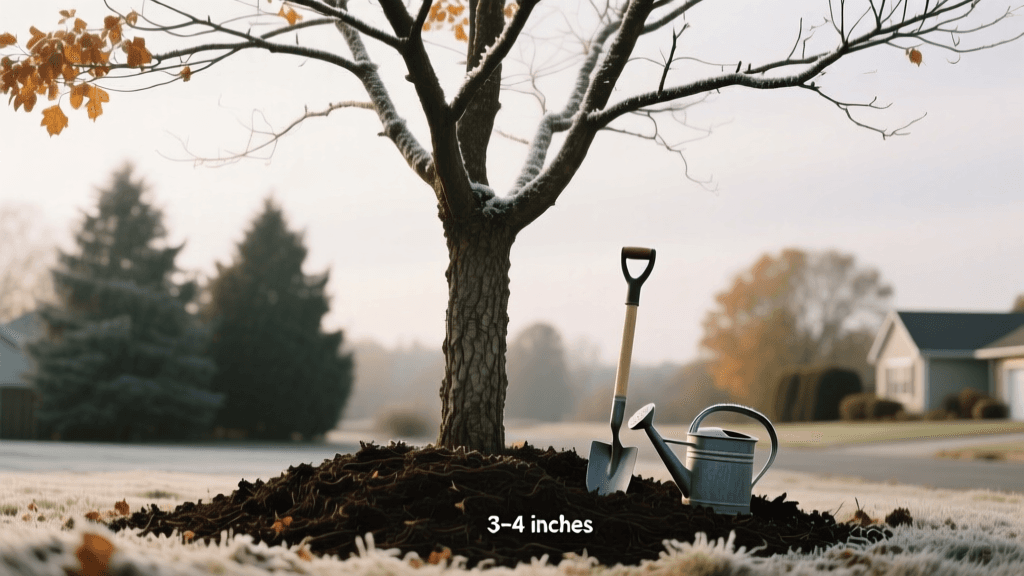
- 3 Inches Deep: Apply a layer of mulch no deeper than 2 to 4 inches. Anything thicker will restrict oxygen exchange to the soil, suffocating the fine feeder roots and creating a haven for anaerobic bacteria.
- 3 Feet Radius: Extend the mulch ring at least 3 feet outward from the trunk in all directions. For mature trees, extending the mulch ring to the drip line is highly beneficial, as it reduces competition from turfgrass, which is a heavy consumer of water and nutrients.
- 3 Inches Away from the Trunk: This is the most critical step. Mulch must never touch the bark of the tree. Leave a 3-inch gap around the base of the trunk to prevent moisture buildup, which leads to fungal cankers, bark decay, and rodent damage during winter months.
Avoiding the 'Volcano Mulching' Trap
Volcano mulching—the practice of piling mulch high against the trunk in a cone shape—is a pervasive and damaging landscaping trend. According to Penn State Extension, this practice traps moisture against the bark, causing the cambium layer to rot. Furthermore, it encourages the growth of secondary roots into the mulch mound. These roots can eventually wrap around the main trunk (girdling roots), cutting off the tree's vascular system and leading to a slow, inevitable death. Always maintain a flat, donut-shaped mulch ring.
'Mulch should resemble a donut, not a volcano. Keeping mulch away from the trunk flare is essential for preventing basal rot and ensuring the long-term structural stability of the tree.' — Urban Forestry Best Practices
Seasonal Care Schedule for Drought Resistance
Drought preparation is a year-round endeavor. Adjust your watering and mulching practices based on the seasonal demands of your trees.
Spring (March - May)
As trees break dormancy and push new foliage, their water demand increases exponentially. Refresh your mulch layer if it has decomposed to less than 2 inches over the winter. Begin deep watering if spring rains are insufficient, aiming for 1 inch of supplemental water per week.
Summer (June - August)
This is the period of highest drought stress. Water deeply every 7 to 10 days. Water in the early morning (between 4:00 AM and 8:00 AM) to minimize evaporation and allow foliage that may have been accidentally wetted to dry before nightfall, reducing the risk of fungal diseases.
Fall (September - November)
Do not stop watering when the leaves change color or drop. Deciduous trees continue to grow roots and store carbohydrates well into the late fall. Continue deep watering every 10 to 14 days until the ground freezes. A well-hydrated tree entering winter is far less susceptible to winter desiccation and frost cracking.
Winter (December - February)
During prolonged winter dry spells with no snow cover, evergreen trees and newly planted deciduous trees require supplemental watering. Water on days when the air temperature is above 40°F (4°C) and the soil is not frozen, applying water mid-day so it can absorb before nighttime freezes.
Common Mistakes to Avoid
- Using Fresh Wood Chips: Uncomposted wood chips can tie up nitrogen in the soil as they decompose. Always use aged or composted arborist chips for the immediate root zone.
- Over-Mulching: More is not better. Piling mulch deeper than 4 inches creates an impermeable barrier to water and gas exchange.
- Fertilizing During Drought: Applying high-nitrogen synthetic fertilizers during a drought forces the tree to push new, tender growth that it cannot support with its limited water supply, exacerbating stress and burning the roots.
- Ignoring the Drip Line: Focusing all water and mulch at the base of the trunk ignores the active absorbing roots located at the periphery of the canopy.
Conclusion
Successfully guiding your trees through periods of severe drought requires a shift from passive observation to active, science-based management. By understanding the true architecture of the tree root zone, calculating precise water volumes based on trunk diameter, and applying organic mulch using the strict 3-3-3 donut method, you create a resilient microenvironment that buffers against environmental extremes. Implement these practical steps today to ensure your shade trees remain healthy, structurally sound, and beautiful for generations to come.