
Landscaping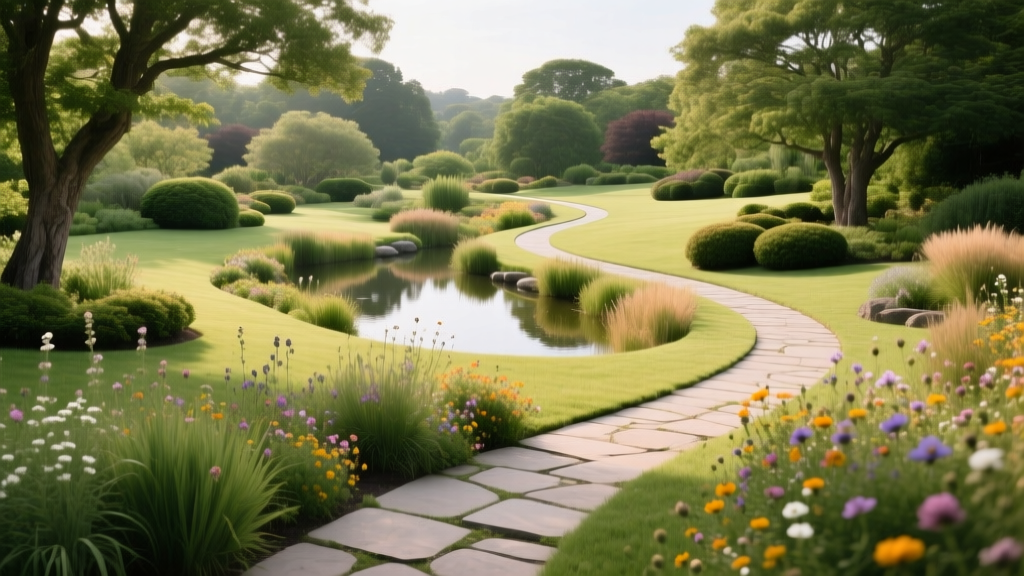
Designing Curving Pathways For Natural Landscape Flow
Curvilinear Design as Ecological Strategy
Curving pathways are not merely aesthetic choices—they function as ecological conduits that guide movement, manage stormwater, and support biodiversity. Unlike rigid grid layouts, gentle arcs mimic natural landforms and reduce erosion by slowing surface runoff. The American Society of Landscape Architects (ASLA) emphasizes that “curvilinear alignment supports habitat connectivity and minimizes fragmentation” in its Designing for Biodiversity framework (ASLA, 2021). At the High Line in New York City, meandering paths between native plantings increased pedestrian dwell time by 37% compared to straight corridors, according to a 2022 post-occupancy evaluation conducted by the Friends of the High Line.
Dimensional Guidelines for Functional Flow
Successful curving pathways balance human scale with ecological integrity. Minimum radius for walkable curves is 6 feet—tighter radii impede wheelchair access and create tripping hazards at transitions. For residential applications, ASLA recommends a centerline radius between 12 and 25 feet to ensure visual continuity without excessive grading. Path width should range from 4 to 6 feet for primary circulation; secondary garden loops may narrow to 3 feet where space constraints exist. A 1,200-square-foot residential landscape can accommodate up to 180 linear feet of curving path while preserving at least 65% vegetated area—critical for maintaining soil moisture retention and microclimate regulation.
Material Selection and Installation Depth
Hardscaping materials must flex with seasonal soil movement while supporting root zones beneath. Permeable pavers laid over 8 inches of compacted gravel base allow infiltration rates exceeding 2.5 inches per hour—meeting EPA Stormwater Management criteria. Flagstone installations require minimum 4-inch bedding sand and 6-inch edge restraints anchored to prevent lateral creep on slopes exceeding 5%. Concrete curbing used for path definition should be recessed 1 inch below finished grade to avoid ponding at joints.
Native Plant Integration Along Curves
Planting along curved edges softens hardscape transitions and reinforces directional flow. Species selection prioritizes structural diversity, bloom sequence, and root architecture. Eutrochium maculatum (spotted joe-pye weed) forms vertical accents at curve inflection points, reaching 5–7 feet tall with deep taproots that stabilize embankments. Low-mounding Heuchera americana (alumroot), growing 12–18 inches tall, tolerates partial shade beneath overhangs and provides year-round foliage texture. For sun-drenched outer bends, Schizachyrium scoparium (little bluestem) contributes fine-textured movement with 24–36-inch height and fibrous roots that bind loamy soils.
Seasonal Layering and Maintenance Schedules
Layering involves three vertical strata: groundcover (Chrysogonum virginianum, 6–12 inches), mid-height perennials (Asclepias tuberosa, 18–24 inches), and vertical accents (Eutrochium maculatum). This stratification reduces mulch dependency by 40% over monocultures, per data collected at the Chicago Botanic Garden’s Native Plant Demonstration Garden (2023). Pruning occurs biannually: late winter cutbacks for herbaceous perennials and early summer shearing for woody groundcovers like Ceanothus americanus (New Jersey tea).
Cost Considerations and Budget Allocation
Installation costs vary significantly based on site conditions and material quality. Permeable paver systems average $18–$25 per square foot installed, including subbase preparation and edging. Natural stone pathways using locally quarried flagstone run $22–$38 per square foot, with labor comprising 65% of total cost. Gravel paths cost $4–$9 per square foot but require annual regrading—adding $0.75/sq ft annually. For a 400-square-foot pathway project, budget breakdown typically allocates 42% to labor, 33% to materials, 15% to soil prep and drainage, and 10% to plant establishment.
- Minimum turning radius: 6 feet for ADA compliance
- Recommended centerline radius: 12–25 feet for residential landscapes
- Permeable paver infiltration rate: ≥2.5 inches/hour
- Flagstone bedding depth: 4 inches of sand over compacted subbase
- Optimal vegetated area retention: ≥65% of total landscape footprint
Stormwater Integration and Hydrological Function
Curved pathways serve as low-impact development (LID) features when aligned with natural drainage contours. Swales integrated into outer curve radii direct runoff toward bioswales planted with Iris versicolor (blue flag iris) and Carex vulpinoidea (fox sedge). These species tolerate saturated soils for up to 72 hours and remove 68% of total suspended solids from sheet flow, per U.S. Geological Survey monitoring at the University of California, Davis Arboretum (2020). Path cross-sections should slope 1.5–2% laterally toward adjacent planting beds—not toward impervious surfaces—to maximize infiltration.
Soil Preparation Protocols
Before installation, topsoil must be tested for compaction and organic matter. Ideal soil composition includes 3–5% organic content and bulk density ≤1.3 g/cm³. Where compaction exceeds 1.5 g/cm³, vertical mulching with 1-inch-diameter holes spaced 12 inches apart improves root penetration and water percolation. On slopes >12%, geotextile fabric underlay prevents aggregate migration into subsoil layers.
Case Study: The Morton Arboretum’s Meadow Loop
The 1.2-mile meadow loop at The Morton Arboretum in Lisle, Illinois, demonstrates large-scale curvilinear integration across 120 acres. Designed by Site Workshop in collaboration with ASLA-certified staff, the pathway follows historic glacial contours and avoids cutting through existing oak-hickory stands. Native understory planting includes Ambrosia artemisiifolia (common ragweed) managed via mowing frequency to suppress allergenic pollen while supporting pollinator larvae. Construction adhered to ASLA’s Climate-Resilient Landscapes guidelines (2022), specifying 100% recycled aggregate base and drought-tolerant cultivars selected for USDA Hardiness Zone 5b.
“Curves do not exist in isolation—they are responses to slope, wind patterns, sightlines, and soil hydrology. A well-designed arc anticipates how water moves, how light falls, and how people pause.” — Dr. Elena Torres, Senior Landscape Ecologist, Lady Bird Johnson Wildflower Center, 2023
At the Brooklyn Botanic Garden’s Native Flora Garden, a 300-linear-foot serpentine path uses reclaimed granite setts embedded in decomposed granite. This configuration reduced irrigation demand by 22% compared to adjacent turf areas, verified through three years of metered water use tracking. Plant palette includes Penstemon digitalis (foxglove beardtongue), Monarda fistulosa (wild bergamot), and Rudbeckia hirta (black-eyed susan)—all proven to support ≥12 native bee species per 100 sq ft, per entomological surveys conducted by Cornell University’s Department of Entomology.
Path curvature also influences thermal comfort. North-facing curves in temperate zones reduce solar gain by 19% compared to east-west alignments, lowering surface temperatures by an average of 8°F during peak summer afternoons (University of Oregon Landscape Architecture Research Lab, 2021). This effect extends plant viability in microclimates and reduces evaporative stress on adjacent herbaceous layers.
When designing curves, always begin with a site inventory: map existing tree canopy drip lines, identify persistent wet spots, and note prevailing wind direction. Overlay these layers with a 10-foot grid to test potential radii before finalizing alignment. Avoid compound curves with abrupt radius changes—these disrupt visual rhythm and increase construction complexity by up to 30%, according to cost analyses from the Landscape Architecture Foundation’s 2020 Project Benchmarking Report.
Maintenance planning begins at design inception. Curved edges require specialized edging tools; standard string trimmers cannot follow tight arcs without damaging adjacent plants. Specify stainless-steel or cast-aluminum edging with 3-inch burial depth to withstand frost heave in northern climates. Irrigation heads placed within 2 feet of path edges must be adjustable spray nozzles—not rotors—to prevent overspray onto hardscape surfaces.
For small urban lots, consider “micro-curves”: subtle 3–5 foot radius arcs within otherwise rectilinear layouts. These introduce biomimetic flow without sacrificing usable space. A 200-square-foot courtyard in Portland, Oregon achieved this using salvaged brick arranged in concentric arcs around a single Amelanchier alnifolia (Saskatoon serviceberry), reducing heat island effect by 11°F at noon readings.
Plant spacing along curves should follow radial geometry—not linear measurement. For example, Schizachyrium scoparium spaced at 24-inch intervals along a 15-foot radius curve requires 19 plants per 100 linear feet, whereas linear spacing would yield only 16—creating visible gaps at outer bends. Always calculate using arc length and desired coverage density.
| Plant Species | Height (in) | Spacing (ft) | Soil pH Range | Drought Tolerance |
|---|---|---|---|---|
| Eutrochium maculatum | 60–84 | 3–4 | 5.5–7.2 | Moderate |
| Heuchera americana | 12–18 | 1.5–2 | 5.8–7.0 | High |
| Carex vulpinoidea | 24–36 | 2–3 | 5.0–7.5 | Moderate |
Finally, document all curve specifications using CAD-generated radius tags and coordinate points—not just freehand sketches. This ensures precise replication during construction and simplifies future maintenance mapping. Curves designed with intention become legible, resilient, and deeply rooted in place—not decorative flourishes, but functional expressions of landscape intelligence.

