Lawn Care
How to Diagnose and Fix Yellow Spots in Your Lawn Grass
Why Is Your Grass Turning Yellow?
There are few things more frustrating for a dedicated homeowner than waking up to find unsightly yellow spots scattered across an otherwise pristine, emerald-green lawn. Yellowing grass is a universal distress signal from your turf, indicating that something in its environment, soil, or biological makeup is out of balance. However, the instinct to immediately dump fertilizer or water heavily on these patches often exacerbates the underlying problem. Accurate diagnosis is the critical first step in lawn care problem-solving.
Turfgrass can turn yellow for a multitude of reasons, ranging from fungal pathogens and nutrient lockouts to environmental stressors like soil compaction and pet urine burns. Applying a high-nitrogen fertilizer to a lawn suffering from a fungal infection, for example, will only feed the fungus and cause the disease to spread rapidly. Conversely, treating a simple nitrogen deficiency with expensive fungicides is a waste of time and money. In this comprehensive guide, we will break down the exact symptoms, diagnostic tests, and actionable solutions for the most common causes of yellow lawn spots.
The Ultimate Diagnostic Chart for Yellow Lawn Spots
Before purchasing any treatments, use the diagnostic table below to narrow down the primary suspect causing your lawn distress. Cross-reference the visual symptoms with the pattern of the damage to identify the root cause.
| Primary Cause | Visual Symptoms | Pattern and Shape | Recommended Solution |
|---|---|---|---|
| Fungal Disease | Lesions on blades, cobweb-like mycelium in morning dew | Circular rings, expanding patches, or silver-dollar spots | Apply systemic fungicide (e.g., Azoxystrobin) |
| Iron Chlorosis | Yellow blades with distinctly green veins | Random patches, often in high-pH or alkaline soil areas | Foliar spray of chelated liquid iron |
| Nitrogen Deficiency | Uniform pale yellow, thin blades, slow growth | Broad, generalized areas rather than isolated spots | Apply high-nitrogen granular or liquid fertilizer |
| Dog Urine Burns | Bright yellow or brown dead center with a dark green outer ring | Isolated 6 to 12-inch circular spots | Flush with water, apply calcium sulfate (gypsum) |
| Soil Compaction | Thin, yellowing, easily uprooted grass | High-traffic zones, pathways, or areas near driveways | Core aeration and compost topdressing |
Fungal Diseases: The Most Common Culprits
Fungal diseases are notoriously deceptive. They often lie dormant in the thatch layer and soil until environmental conditions—specifically high humidity, warm nights, and prolonged leaf wetness—trigger an outbreak. The two most frequent fungal offenders that cause yellow spotting in cool-season and warm-season grasses are Brown Patch and Dollar Spot.
Identifying Brown Patch and Dollar Spot
Brown Patch, caused by the pathogen Rhizoctonia solani, typically manifests as circular patches of yellow-to-brown grass that can range from a few inches to several feet in diameter. A hallmark sign is the 'smoke ring'—a dark, wilted border at the edge of the patch that is most visible in the early morning. If you inspect individual grass blades at the margin of the patch, you will notice distinct tan lesions with dark brown borders.
Dollar Spot, caused by Clarireedia jacksonii, presents as much smaller, straw-yellow spots roughly the size of a silver dollar. These spots can merge into larger irregular areas if left untreated. In the early morning, when dew is heavy, you may see a white, cobweb-like mycelium covering the affected grass blades. Dollar spot thrives when daytime temperatures are warm (70°F to 85°F) but nighttime temperatures drop, especially in lawns lacking adequate nitrogen.
Fungicide Treatments and Application
To halt a fungal outbreak, you must use a systemic fungicide that is absorbed by the plant and stops the pathogen from within. Products containing active ingredients like Azoxystrobin (found in Scotts DiseaseEx Lawn Fungicide) or Propiconazole are highly effective. Expect to spend between $15 and $35 per application for an average-sized yard.
- Timing: Apply fungicides at the very first sign of disease or preventatively when weather forecasts predict prolonged periods of high humidity and rain.
- Application Rate: Follow the manufacturer's label strictly. A standard curative rate for Azoxystrobin is typically 2 to 4 ounces per 1,000 square feet.
- Watering Rule: Water your lawn deeply but infrequently, aiming for 1 to 1.5 inches per week. Always water in the early morning (between 4:00 AM and 6:00 AM) so the grass blades dry quickly in the sun, depriving fungal spores of the moisture they need to germinate.
Nutrient Deficiencies: Iron Chlorosis and Nitrogen Starvation
Turfgrass requires a precise balance of macro and micronutrients to maintain its deep green color through chlorophyll production. When the soil lacks specific nutrients, or when the soil pH prevents the roots from absorbing them, the grass will inevitably turn yellow.
Solving Iron Chlorosis
Iron chlorosis is incredibly common in soils with a high pH (alkaline soils above 7.0). In these conditions, iron becomes chemically locked in the soil and unavailable to the grass roots. The defining visual symptom of iron chlorosis is interveinal chlorosis: the grass blades turn bright yellow, but the central veins remain distinctly green. This often appears in random patches or in areas where the soil is heavily compacted or overly alkaline.
The Solution: Bypass the soil entirely by applying a foliar spray of Chelated Liquid Iron. Chelation prevents the iron from binding to soil particles, allowing the grass blades to absorb it directly. Apply the liquid iron according to the label (usually 2 to 3 ounces per gallon of water per 1,000 square feet). You should see a dramatic greening effect within 24 to 48 hours. For a long-term fix, conduct a soil test and apply elemental sulfur to gradually lower your soil pH to the ideal range of 6.0 to 6.8.
Correcting Nitrogen Deficiency
Nitrogen is the primary driver of vegetative growth and green color in turfgrass. A nitrogen-deficient lawn will not show isolated spots; instead, it will exhibit a generalized, uniform pale yellowing across large areas, accompanied by stunted growth and thinning turf.
The Solution: Apply a high-quality, slow-release nitrogen fertilizer. Products like Milorganite (which contains 6% nitrogen and 4% iron) are excellent for providing a steady, burn-free nutrient release over several weeks. Apply at a rate that delivers 1 pound of actual nitrogen per 1,000 square feet. To calculate this, divide 100 by the first number on the fertilizer bag's N-P-K ratio. For a 32-0-4 fertilizer, you would apply roughly 3.1 pounds of product per 1,000 square feet.
Environmental Stressors and Cultural Mistakes
Sometimes the problem is not biological or chemical, but physical. Environmental stressors can severely restrict root growth and nutrient uptake, leading to localized yellowing.
Dog Urine Burns
If you have a dog, you are likely familiar with the dreaded 'urine burn.' Dog urine contains high concentrations of nitrogen salts. In small amounts, nitrogen acts as a fertilizer (resulting in a dark green ring around the spot). However, the concentrated center acts like a chemical burn, killing the grass and leaving a bright yellow or brown dead zone.
The Solution: Immediately after your pet urinates, flush the area with a gallon of water to dilute the salts. For existing yellow spots, rake out the dead grass and apply Gypsum (Calcium Sulfate) at a rate of 2 pounds per 100 square feet. Gypsum helps to neutralize the salts and improve soil structure. Water it in deeply, and overseed the patch with a matching grass seed blend.
Soil Compaction and Poor Drainage
Lawns subjected to heavy foot traffic, children playing, or parking vehicles suffer from soil compaction. Compacted soil lacks the pore space necessary for oxygen, water, and nutrients to reach the root zone. The grass in these high-traffic zones will turn yellow, thin out, and become highly susceptible to weed invasion and drought stress.
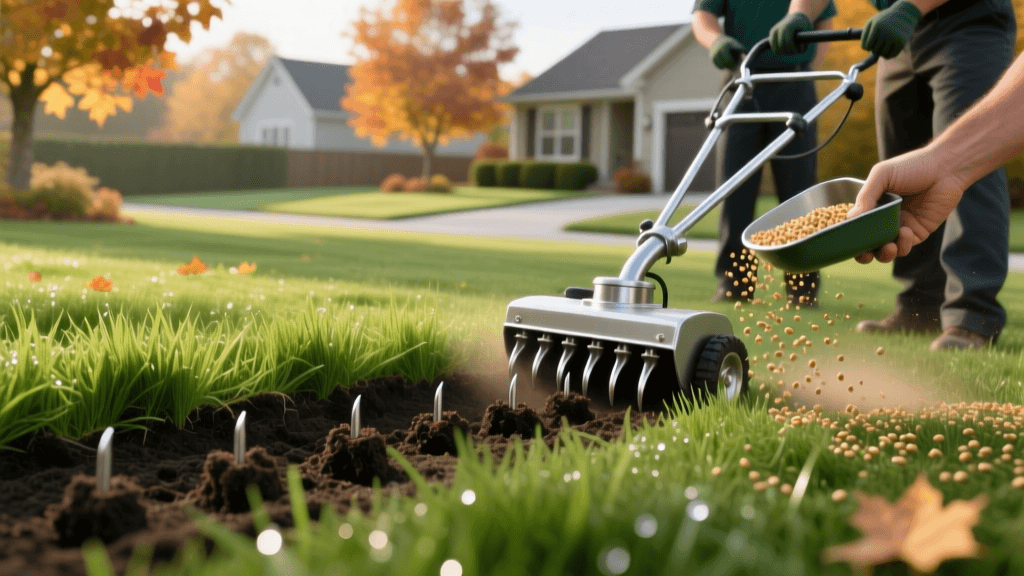
The Solution: Perform core aeration during the grass's peak growing season (early fall for cool-season grasses, late spring for warm-season grasses). Renting a walk-behind core aerator typically costs between $60 and $90 for a half-day. The machine will pull 2-to-3-inch plugs of soil from the ground, relieving compaction. Follow up immediately by topdressing the lawn with a quarter-inch layer of screened compost to introduce beneficial microbes and improve soil structure.
Expert Insights and Preventative Maintenance
Preventing yellow spots is always more cost-effective and less labor-intensive than curing them. Establishing a rigorous, seasonally appropriate lawn care routine builds a deep root system that can naturally fend off stressors.
'The most effective defense against turfgrass diseases and environmental stress is a thick, vigorously growing lawn. Proper mowing heights, deep and infrequent irrigation, and balanced fertilization based on annual soil tests create an environment where the grass outcompetes pathogens and weeds.' — Penn State Extension, Turfgrass Management Guidelines
To maintain a spot-free lawn, never remove more than one-third of the grass blade height during a single mowing session. Scalping the lawn exposes the soil to excess sunlight, increases water evaporation, and stresses the grass, making it highly vulnerable to yellowing. Keep your mower blades razor-sharp; dull blades tear the grass tips, leaving them ragged, white, and eventually yellow as the tissue dies back. Finally, commit to testing your soil every two to three years. A $15-$20 laboratory soil test from your local university extension office will provide a precise, custom roadmap for your fertilization and lime/sulfur applications, ensuring your lawn stays vibrantly green year-round.