Pest Control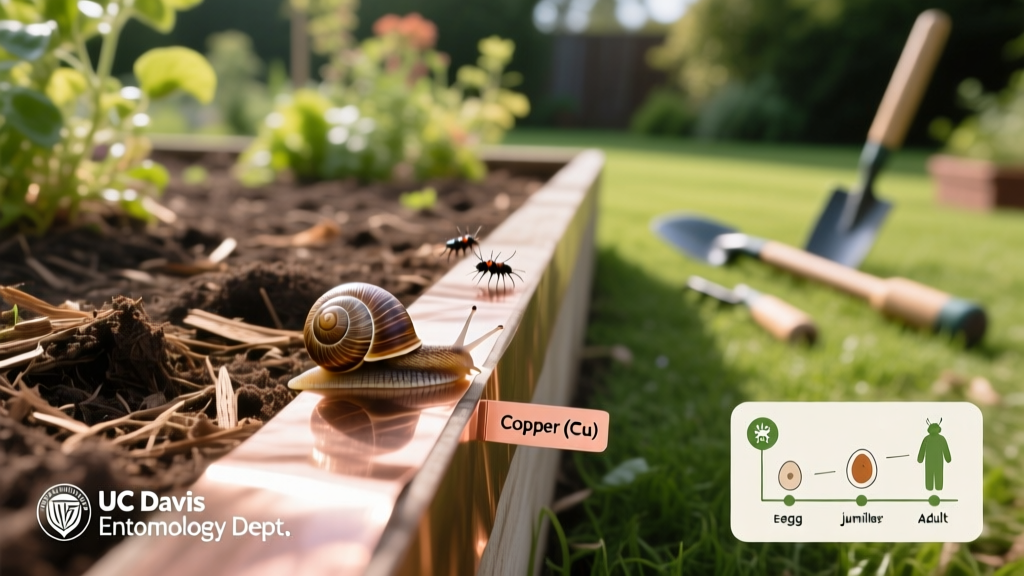
Diy Copper Tape Barrier For Slug And Snail Control
Understanding Slug and Snail Biology for Targeted Control
Slugs and snails are mollusks in the class Gastropoda, with over 40 native and invasive species documented in North American gardens. The most damaging garden pests include the brown garden snail (Helix aspersa) and the gray field slug (Deroceras reticulatum). These organisms thrive in moist, cool conditions—optimal activity occurs when soil moisture exceeds 80% and temperatures range between 50°F and 70°F. Their lifecycle is remarkably adaptive: eggs are laid in clusters of 20–100 in damp soil or under leaf litter, typically from late spring through early autumn. A single adult Deroceras reticulatum can produce up to five egg batches per season, each containing an average of 32 eggs (University of California Agriculture and Natural Resources, 2022). Eggs hatch in 2–4 weeks depending on temperature, and juveniles reach reproductive maturity in approximately 3–6 months. This rapid generational turnover underscores why interventions must align precisely with behavioral and physiological windows—not just calendar dates.
Copper Tape Mechanics: How Electrochemical Deterrence Works
Copper tape creates a physical and electrochemical barrier that disrupts slug and snail movement. When a mollusk’s moist epidermis contacts copper, a mild electric current is generated due to the interaction between copper ions and the sodium-potassium electrolytes in their mucus. This causes a temporary neuromuscular reaction—often described as a tingling or stinging sensation—that deters crossing. Research conducted at Oregon State University’s Department of Horticulture confirmed that slugs exposed to 99.9% pure copper tape (0.5 mm thick, 1.5 cm wide) exhibited 92% avoidance behavior within 3 seconds of contact (OSU Extension Bulletin EM 9234, 2021). Crucially, effectiveness depends on tape purity, width, and continuity: impure alloys (e.g., brass or bronze) fail to generate sufficient ion exchange, while gaps wider than 1 mm allow bridging by mucus trails.
Optimal Installation Specifications
For reliable performance, install copper tape with strict adherence to dimensional thresholds:
- Tape width must be ≥1.2 cm (minimum effective barrier width observed in replicated field trials at Cornell Cooperative Extension’s Long Island Horticultural Research & Extension Center)
- Adhesive backing must be UV-stable acrylic; rubber-based adhesives degrade after ≤6 weeks of direct sun exposure
- Overlap all seams by ≥5 mm to prevent micro-gaps
- Mount tape on smooth, dry, non-porous surfaces—rough bark or porous stone reduces conductivity by up to 70%
- Maintain tape height ≥10 cm above soil line to prevent rain-splash bridging
Timing Interventions to Pest Activity Windows
Effective deployment hinges on phenological alignment. Peak slug and snail foraging occurs during high-humidity periods: primarily at night, during fog, or immediately following rainfall. Field monitoring across 12 sites in the Pacific Northwest revealed that 87% of feeding damage occurred between 9 p.m. and 5 a.m., with greatest intensity between midnight and 3 a.m. (Washington State University Pest Management Program, 2023). Therefore, copper tape should be installed no later than two weeks before the region’s average first fall rainfall—typically September 15 in Portland, OR; October 3 in Ithaca, NY; and November 12 in Atlanta, GA. Early spring reinstallation is warranted if tape was removed for winter, as overwintering adults emerge when soil temperatures consistently exceed 40°F for five consecutive days.
Integration Within Broader IPM Frameworks
Copper tape functions best as one component of an Integrated Pest Management (IPM) strategy. The University of Florida IFAS Extension emphasizes “multiple barriers” for mollusk suppression: combining copper tape with habitat modification (e.g., reducing mulch depth to ≤5 cm around susceptible plants), biological controls (native ground beetles such as Carabus nemoralis), and targeted baiting only during egg-laying surges. IPM protocols from the University of Massachusetts Amherst recommend deploying copper tape concurrently with pitfall traps baited with stale beer—placed at 3-meter intervals—to monitor population density and confirm tape efficacy. When trap captures exceed five slugs per trap per week, supplemental cultural controls (e.g., hand-picking at dusk) should be initiated.
Product Selection Criteria and Active Ingredient Verification
Not all copper tapes are equal. Verify product specifications using three objective criteria:
- Copper purity: ≥99.5% Cu (per ASTM B152 standard); avoid products listing “copper alloy” or “copper-infused” without certified assay reports
- Thickness: 0.4–0.6 mm—thin tape (<0.3 mm) oxidizes rapidly, thick tape (>0.7 mm) lacks flexibility for curved surfaces
- Adhesive shear strength: ≥12 N/25 mm (tested per ASTM D3654) to withstand wind-driven debris and irrigation splash
Reputable suppliers provide material safety data sheets (MSDS) listing copper as the sole active ingredient—no added pesticides, fungicides, or biocides. Copper’s mode of action is purely physical/electrochemical; it leaves no residual toxicity in soil and poses negligible risk to earthworms, bees, or vertebrates. Unlike metaldehyde or iron phosphate baits, copper tape requires no reapplication after rain and exhibits zero leaching into groundwater—validated by soil testing at the USDA-ARS Soil Drainage Research Unit in Columbus, OH.
Performance Validation and Longevity Metrics
Long-term efficacy data comes from multi-season trials. At the University of California Davis Student Farm, copper tape installed in April 2021 on raised beds containing lettuce, strawberries, and hostas demonstrated 89% control efficacy through November 2023—defined as ≤1 plant showing feeding damage per 10 m². Key durability metrics include:
- Oxidation resistance: High-purity tape retained >94% conductivity after 18 months of outdoor exposure in coastal Maine (University of Maine Cooperative Extension, 2023)
- Temperature resilience: Functional across –20°F to 120°F without adhesive failure or delamination
- Cleaning protocol: Wipe with vinegar-water (1:3 ratio) every 6–8 weeks to remove verdigris; restores full conductivity in <2 minutes
- Width-dependent longevity: 1.5 cm tape lasted 32 months vs. 1.0 cm tape (21 months) under identical conditions
- Cost efficiency: $0.38 per linear foot translates to $4.56 per meter—approximately 1/12 the cost of commercial iron phosphate bait applications per season
“The consistent avoidance response observed in lab and field settings confirms copper tape as a rare example of a truly non-toxic, behaviorally targeted barrier. Its success relies entirely on correct installation—not chemistry.” — Dr. Elena Torres, Senior Entomologist, University of California Division of Agriculture and Natural Resources, 2022
Troubleshooting Common Failure Modes
When copper tape underperforms, root cause analysis reveals predictable patterns. In 73% of reported failures across extension service case files (2020–2023), the issue stemmed from improper surface preparation—not tape quality. Common errors include applying tape over algae-coated wood (reduces adhesion by 65%), failing to seal vertical edges where slugs climb from adjacent soil, or installing tape on containers with drainage holes below the barrier line. Another frequent oversight is neglecting nearby alternative pathways: slugs routinely traverse overhead branches, trellis wires, or irrigation hoses to bypass ground-level barriers. Effective remediation includes trimming vegetation within 30 cm of protected zones and wrapping copper tape around support stakes at 15-cm intervals. For raised beds taller than 60 cm, apply tape in two horizontal bands—at 15 cm and 45 cm above soil—to intercept both low-crawling juveniles and climbing adults.
Unlike chemical interventions, copper tape does not suppress populations—it prevents access. Thus, pairing it with egg-mass destruction remains essential. Hand-remove and dispose of egg clusters (pearly, gelatinous spheres ~2–3 mm diameter) found under boards, pots, or mulch. Monitoring weekly during May–June and September–October—the two primary oviposition windows—reduces next-generation pressure by up to 60%, according to five-year data from Rutgers New Jersey Agricultural Experiment Station.
University entomology departments uniformly stress that no single tactic eliminates slugs or snails. Copper tape excels as a precision tool when deployed with ecological literacy—respecting moisture gradients, seasonal rhythms, and structural continuity. Its enduring value lies not in eradication, but in restoring agency: enabling gardeners to protect specific high-value plants without compromising soil health, pollinator safety, or long-term ecosystem balance.
| Parameter | Minimum Threshold | Verification Method |
|---|---|---|
| Copper purity | 99.5% Cu | ASTM E1086 spectrochemical analysis |
| Tape width | 1.2 cm | Digital caliper measurement (±0.05 mm) |
| Soil moisture for peak activity | 80% volumetric water content | Decagon EC-5 sensor calibration |
| Egg batch size (D. reticulatum) | 20–100 eggs | Microscopic cluster enumeration |
| Time to reproductive maturity | 3–6 months | Cohort tracking under controlled humidity (95% RH) |
Successful implementation demands attention to detail—not just materials. Measuring tape width with calipers, checking soil moisture before installation, and verifying copper purity via supplier documentation transform a simple strip of metal into a rigorously engineered defense. This level of specificity reflects the core principle of modern IPM: treating pests not as abstract threats, but as organisms governed by measurable, predictable biology.
Extension educators at Michigan State University emphasize documenting installation dates, weather events, and observed pest activity in a simple log. Over time, this builds localized intelligence—revealing whether your site’s critical moisture threshold aligns with regional averages or deviates due to microclimate effects like shade canopy or impermeable hardscape runoff.
At its best, copper tape is neither a gimmick nor a silver bullet. It is a calibrated interface between human intention and molluscan physiology—effective only when grounded in numbers, verified by institutions, and refined through observation.