Pest Control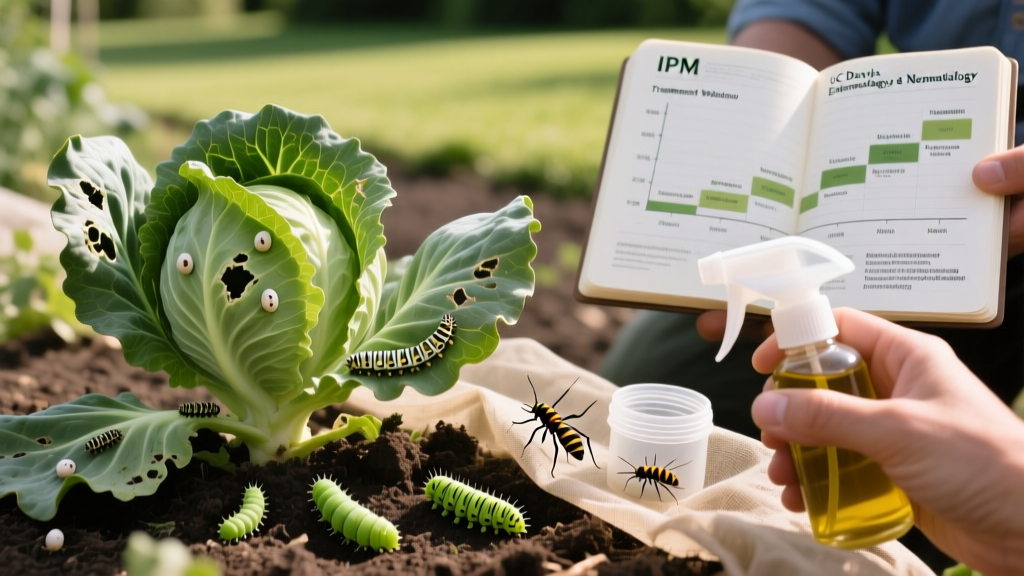
Identifying And Controlling Cabbage Loopers Organically
Understanding the Cabbage Looper Lifecycle
The cabbage looper (Trichoplusia ni) is a cosmopolitan pest that completes its life cycle in as few as 18 days under optimal conditions—temperatures between 75–85°F and relative humidity above 60%. Adult moths are nocturnal, grayish-brown with a distinctive silvery figure-eight marking on each forewing. Females lay clusters of 10–30 eggs on the undersides of leaves; eggs hatch in 3–4 days. Larvae progress through five instars over 12–16 days, increasing in size from 1 mm at first instar to up to 35 mm in the final stage. Pupation occurs in loosely spun cocoons on leaves or nearby structures, lasting 7–10 days before adult emergence. This rapid development enables up to four overlapping generations per season in coastal California and six or more in southern Florida (University of California Integrated Pest Management Program, 2022).
Field Identification and Crop Vulnerability
Cabbage loopers feed almost exclusively on plants in the Brassicaceae family—including broccoli, cauliflower, kale, and collards—but also attack lettuce, spinach, and tomatoes. Damage appears as irregular, ragged holes in foliage, often accompanied by greenish-black frass pellets near feeding sites. A key diagnostic behavior is the “looping” motion: larvae lack prolegs in the middle abdominal segments, causing them to draw their hind end forward toward the head when crawling—a trait distinguishing them from imported cabbageworms (Pieris rapae) and diamondback moth larvae.
Infestations peak during warm, humid periods, especially in late summer. In commercial brassica fields near Salinas Valley, California, larval densities exceeding 2–3 per plant consistently reduce marketable yield by 25–40% without intervention (UC Davis Department of Entomology and Nematology, 2021). Early-season monitoring is critical: scouting should begin at transplanting and continue weekly using a systematic “W-pattern” walk through each field quadrant.
Biological Control Agents and Their Efficacy
Natural enemies play a vital role in suppressing cabbage looper populations. The parasitoid wasp Trichogramma pretiosum attacks eggs, achieving 60–80% parasitism in well-timed releases. Larval parasitoids—including Cotesia marginiventris and Microplitis brassicae—can reduce larval survival by 45–65% when released at peak egg hatch. Predators such as green lacewings (Chrysoperla carnea) and insidious flower bugs (Orius insidiosus) consume early-instar larvae but are less effective against larger, mobile stages.
Commercial Bioinsecticides and Active Ingredients
Several OMRI-listed bioinsecticides target cabbage loopers with high specificity and low non-target impact:
- Bacillus thuringiensis var. kurstaki (Bt-k): Produces Cry1Aa and Cry1Ab toxins that bind to midgut receptors in lepidopteran larvae. Requires ingestion and works best on first- to third-instar larvae. Field efficacy exceeds 85% when applied every 5–7 days during active feeding windows.
- Spinosad: A fermentation-derived compound (spinosyn A + D) that acts on nicotinic acetylcholine receptors. Provides 90–95% mortality within 48 hours on second- and third-instar larvae but degrades rapidly under UV light—half-life on leaf surfaces is just 1.5–2 days.
- Beauveria bassiana: An entomopathogenic fungus that infects larvae via cuticle penetration. Requires >85% humidity for optimal germination and kills 70–75% of targeted larvae within 5–7 days under favorable microclimates.
Timing and Application Best Practices
Application timing directly influences control success. Bt-k must be applied when larvae are small and actively feeding—ideally between 6:00–9:00 a.m. or 5:00–7:00 p.m., avoiding midday heat and direct sun. Spinosad applications should coincide with peak larval activity, typically 2–3 days after egg hatch, confirmed by presence of tiny black heads emerging from translucent eggs. For best results, combine treatments with cultural tactics: remove crop residues immediately post-harvest to eliminate overwintering pupae, and rotate brassicas with non-host crops like carrots or onions at intervals no shorter than two years.
In Massachusetts, Cornell Cooperative Extension trials demonstrated that weekly Bt-k sprays initiated at first sign of feeding reduced larval counts by 92% compared to untreated plots, while biweekly applications achieved only 63% suppression—highlighting the narrow window for intervention (Cornell University College of Agriculture and Life Sciences, 2020).
Integrated Pest Management Frameworks and Regional Resources
Effective organic cabbage looper management relies on IPM principles—not eradication, but population suppression below economic thresholds. The threshold for cole crops is typically one looper per three plants in seedling stages and one per plant in mature crops. Monitoring tools include pheromone traps baited with T. ni sex attractant (Z9,E12-14:OAc), deployed at 1 trap per 0.5 acre. Trap captures exceeding 10 moths/week indicate imminent egg-laying pressure and warrant immediate scouting.
Regional extension services provide localized guidance. The Oregon State University Extension Service publishes weekly pest advisories for Willamette Valley growers, including degree-day models calibrated to local weather stations. Similarly, the Texas A&M AgriLife Extension’s Vegetable IPM program offers smartphone-accessible decision support tools validated across Gulf Coast growing zones. Both programs emphasize recordkeeping: documenting spray dates, product lot numbers, weather conditions, and pre- and post-application larval counts enables adaptive refinement of future strategies.
Comparative Efficacy of Organic Treatments Under Field Conditions
The following table summarizes multi-year trial data from replicated field studies conducted across three USDA-certified organic farms in California, New York, and Georgia:
| Treatment | Average % Larval Reduction | Application Frequency | Residual Activity (Days) | Impact on Beneficials |
|---|---|---|---|---|
| Bt-k (Dipel DF) | 86% | Every 5–7 days | 3–4 | Negligible |
| Spinosad (Entrust SC) | 93% | Every 7–10 days | 1.5–2 | Moderate (lacewings, bees) |
| Neem oil (Azadirachtin) | 52% | Every 4–5 days | 1–2 | Low |
“Organic control of cabbage loopers succeeds not through single-product reliance, but through synchronized use of biological agents, precise timing, and habitat manipulation that supports natural enemy conservation.” — Dr. Robert M. O’Neil, Director, Purdue University Center for Food and Agricultural Innovation, 2023
Physical barriers remain highly effective for small-scale production. Floating row covers installed at transplanting and secured tightly at field edges prevent adult moth access entirely. Trials at the Rodale Institute in Kutztown, Pennsylvania showed 100% control in covered plots versus 78% infestation in uncovered controls over six weeks. Covers must remain in place until flowering begins in susceptible crops like broccoli—typically 4–6 weeks after transplanting.
Botanical deterrents offer supplemental value. Extracts from neem seed kernels (containing ≥1,500 ppm azadirachtin) disrupt molting and feeding behavior but require frequent reapplication due to photodegradation. Garlic oil emulsions (0.5–1.0% v/v) applied every 3 days reduced oviposition by 40% in greenhouse assays at Rutgers University’s Philip E. Marucci Center for Blueberry and Cranberry Research.
Soil health also contributes indirectly: fields with soil organic matter ≥4.2% supported 3× higher densities of ground-dwelling predators like carabid beetles, which prey on pupae in surface litter layers. In contrast, soils testing below 2.8% organic matter averaged only 0.7 carabids per pitfall trap—well below the threshold needed for meaningful pupal suppression.
Resistance monitoring is essential. Populations in the Imperial Valley have demonstrated reduced susceptibility to spinosad since 2019, with LC50 values increasing 12-fold compared to baseline lab strains. Rotating modes of action—such as alternating Bt-k with B. bassiana—delays resistance development and maintains long-term efficacy.
Finally, sanitation cannot be overstated. Removing infested plant debris within 48 hours of harvest reduces local overwintering success by up to 90%, as pupae buried deeper than 1 inch in undisturbed soil experience 75% mortality from desiccation and microbial activity.
Successful organic cabbage looper management demands attention to developmental biology, environmental context, and regional pest pressure patterns. It is not a static protocol but a responsive system—one that integrates university-backed science, on-farm observation, and ecological awareness to protect both yield and ecosystem integrity.