
Landscaping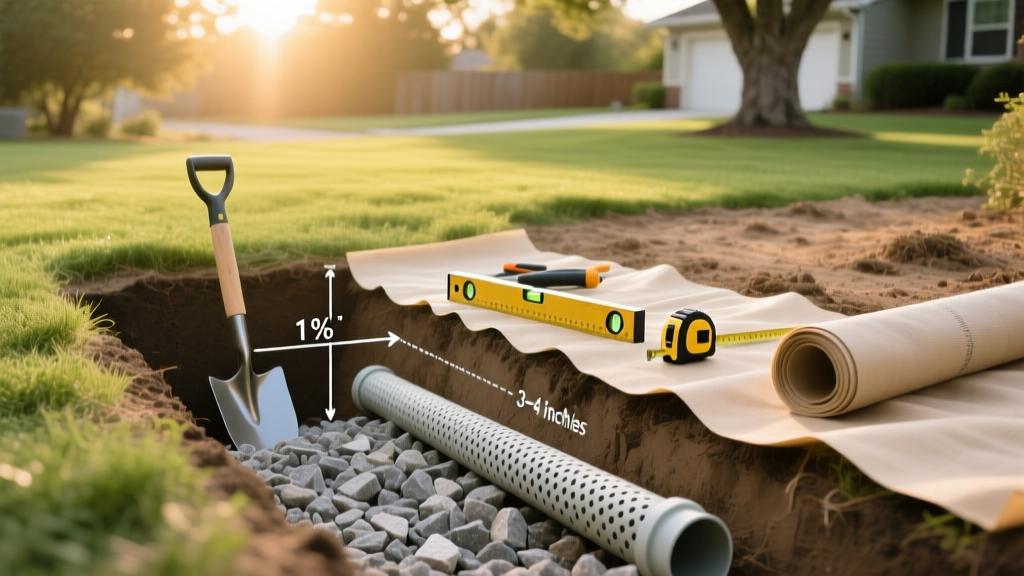
Expert Tips for DIY French Drain Installation Success
David ParkPublished
Why Your Yard Needs a Subsurface Drainage Solution
Standing water in your yard is more than just a nuisance; it is a direct threat to your home's foundation, your lawn's root system, and your overall landscape investment. When surface grading fails to move water away from your property, a French drain becomes the ultimate subsurface drainage solution. Unlike a simple surface swale, a French drain captures groundwater and surface runoff, channeling it safely away from vulnerable areas. As a landscaping expert, I have seen countless properties transformed from swampy messes into dry, usable outdoor living spaces simply by applying the correct French drain installation best practices.
However, a French drain is only as effective as its design and execution. Digging a random trench and tossing in some gravel will result in a clogged, failed system within a single season. To achieve long-term success, you must understand soil percolation, hydraulic gradients, and material selection. This comprehensive guide will walk you through the expert tips, precise measurements, and material choices required to build a professional-grade French drain on your own property.
Planning Your Drainage Route and Permits
Before you pick up a shovel, you must map out the hydrology of your yard. Water follows the path of least resistance, and your goal is to intercept it before it reaches your foundation or low-lying garden beds. Identify the primary water source: is it roof runoff from undersized downspouts, surface flow from a neighbor's elevated lot, or a high water table emerging in the spring?
The 811 Mandate
The very first step in any hardscaping or drainage project is calling 811 (the national 'Call Before You Dig' hotline). Utility companies will mark underground gas, water, and electrical lines for free. Striking a utility line can result in catastrophic injury and tens of thousands of dollars in fines. Always wait the mandated 48 to 72 hours for marks to be completed before breaking ground.
Choosing the Termination Point
A French drain must have a legal and physical place to discharge water. You cannot legally drain water onto a neighbor's property or into municipal sewer systems in most jurisdictions. Your termination options include:
- Daylighting: Exiting the pipe at a lower elevation on your property, such as a street curb or drainage ditch.
- Dry Well: Discharging into a subterranean chamber (like the NDS Flo-Well) that slowly percolates water back into the native soil, provided your soil has adequate percolation rates.
- Pop-Up Emitter: Using a pressure-activated emitter that remains flush with the lawn but pops up to release water when the pipe is full.
Material Selection: Corrugated vs. PVC Pipe
One of the most debated topics in landscape drainage is the choice of pipe. While big-box stores heavily promote flexible corrugated black pipe, professional landscapers and civil engineers overwhelmingly prefer rigid PVC for permanent subsurface installations.
| Feature | Corrugated Black Pipe (HDPE) | SDR 35 Rigid PVC Pipe |
|---|---|---|
| Cost | $0.75 - $1.25 per linear foot | $2.50 - $4.00 per linear foot |
| Durability | Low; prone to crushing under soil load | High; withstands heavy soil and vehicular loads |
| Interior Surface | Ridged; traps sediment and roots easily | Smooth; allows water to flush out debris |
| Maintenance | Difficult to snake or jet clean | Easy to snake, jet, and inspect with cameras |
| Expert Verdict | Use only for temporary or shallow garden beds | The industry standard for permanent yard drainage |
For the gravel bed, never use rounded river rock. River rock shifts and settles, which can alter your pipe's slope over time. Instead, use 3/4-inch washed crushed stone (often called #57 stone). The angular edges lock together to create a stable, highly permeable matrix that resists compaction.
Step-by-Step Installation Best Practices
1. Trenching to the Proper Dimensions
For a standard residential yard drain, your trench should be 12 to 18 inches wide and 18 to 24 inches deep. This depth ensures the pipe sits below the frost line in many climates and intercepts water before it reaches the root zones of your turfgrass. If you are installing a drain near a foundation, the trench must be deep enough to sit below the basement floor slab or crawlsight grade, but never so deep that it undermines the foundation's structural footer.
2. Lining with Non-Woven Geotextile Fabric
This is the step most DIYers skip, leading to system failure. You must line the trench with a high-quality non-woven geotextile fabric (such as Mirafi 140N or US Fabrics 4oz). Non-woven fabric acts as a filter, allowing water to pass through while blocking fine silt and clay particles. Woven fabrics (often sold as cheap weed barriers) will clog with soil within a year, effectively turning your French drain into an underground dam. Leave at least 18 inches of excess fabric hanging over the sides of the trench to wrap over the top of the gravel later.
3. Establishing the Base and Slope
Add a 2-inch base layer of crushed stone and compact it. The slope, or 'fall', of your trench is non-negotiable. Water requires gravity to move efficiently through a perforated pipe.
4. Pipe Placement and Gravel Backfill
Lay your SDR 35 PVC pipe on the gravel base. Ensure the perforations are facing downward. This is a common point of confusion; water enters the pipe from the bottom up as the gravel bed fills, which keeps sediment from washing directly into the top of the pipe. Cover the pipe with washed crushed stone until you have 2 to 3 inches of clearance below the topsoil grade. Finally, fold the excess geotextile fabric over the stone, creating a 'gravel burrito'. This prevents topsoil from migrating down into the stone matrix. Top the trench with native soil and sod.
Calculating the Correct Slope
The golden rule of drainage is a minimum slope of 1/8 inch per linear foot (approximately a 1% grade). While 1/4 inch per foot is ideal, 1/8 inch is the absolute minimum required to prevent water from stagnating in the pipe.
To calculate this over a 50-foot run: 50 feet x 0.125 inches = 6.25 inches of total drop from the start of the trench to the termination point. Do not rely on the 'eyeball' test. Use a rotary laser level or a string line with a torpedo level to mark your grade stakes every 10 feet before you begin digging. If your yard is entirely flat, you may need to incorporate a sump basin and a submersible utility pump to mechanically lift the water to a discharge point.
Cost Estimates: DIY vs. Professional
Understanding the financial commitment helps you budget appropriately. A professional landscape drainage contractor will typically charge between $30 to $50 per linear foot for a French drain installation. This includes labor, heavy machinery (like a Ditch Witch trencher), materials, and waste removal. For a 100-foot system, expect quotes ranging from $3,000 to $5,000.
A DIY installation significantly reduces costs. By renting a mini-excavator or walk-behind trencher ($150-$250 per day) and purchasing your own PVC, stone, and fabric, your material and rental costs will drop to roughly $10 to $15 per linear foot. However, factor in the intense physical labor of moving several tons of gravel and soil by wheelbarrow if you choose to dig by hand.
Long-Term Maintenance and Expert Insights
Even a perfectly installed French drain requires minimal maintenance to ensure longevity. Every two to three years, flush the system using a garden hose or a high-pressure sewer jetter to clear any accumulated biofilm or fine silt. Ensure that your termination points (like pop-up emitters or dry wells) are free of debris, leaves, and rodent nests.
According to the University of Minnesota Extension in their comprehensive guidelines on yard and garden drainage, 'subsurface drainage systems must be designed with respect to the soil's natural infiltration rate and the site's topography to prevent the lateral movement of water into structural foundations.' They emphasize that combining subsurface French drains with proper surface grading and downspout extensions yields the highest success rate for residential water management.
By prioritizing rigid PVC, non-woven geotextiles, and precise slope calculations, your DIY French drain will perform flawlessly for decades, protecting your home and restoring the beauty and utility of your landscape.

