
Landscaping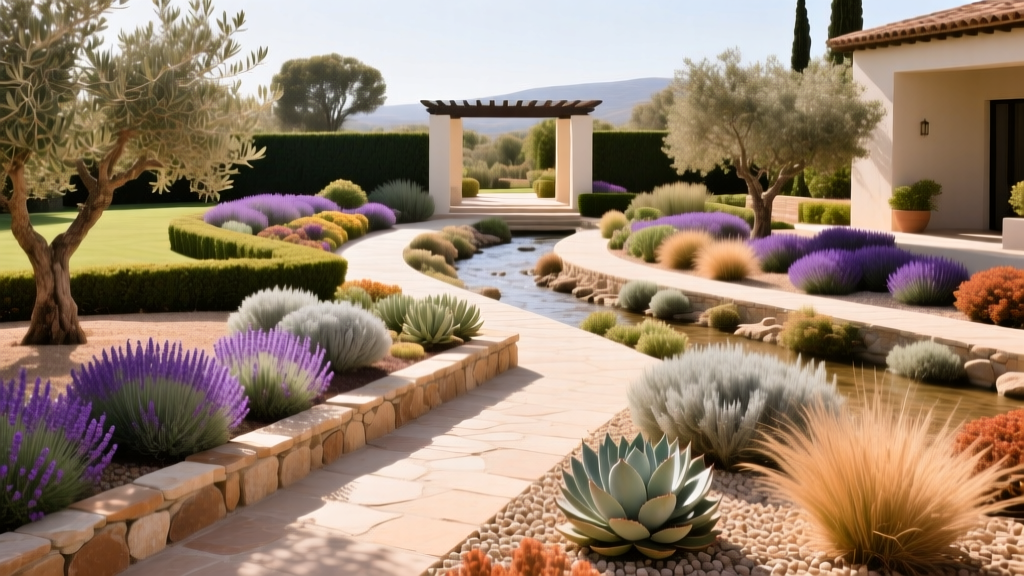
Drought Tolerant Mediterranean Style Landscape Design Plan
Foundational Principles for Mediterranean Drought-Tolerant Landscaping
Mediterranean-style landscapes prioritize water conservation, structural clarity, and regional authenticity—principles deeply aligned with the American Society of Landscape Architects (ASLA) 2023 Water-Wise Design Guidelines. These guidelines emphasize reducing potable water use by at least 50% compared to conventional turf-based designs while maintaining ecological function and human comfort. A successful implementation begins not with plant selection alone, but with site analysis: slope, soil permeability, sun exposure, and microclimate must inform every decision. At the University of California Santa Cruz Arboretum, a 1.8-acre demonstration garden reduced irrigation demand by 72% over five years through layered canopy structure, strategic hardscape shading, and native-compatible plant communities.
Soil Preparation and Hydrozoning Strategy
Soil amendment is non-negotiable in Mediterranean design. Most regional soils—especially in coastal California and Arizona’s Sonoran Basin—are low in organic matter and prone to compaction or rapid drainage. Amend native soil with 3–4 inches of composted green waste blended at a 1:3 ratio (compost to soil) before planting. This increases moisture retention without compromising drainage—a critical balance for Salvia mellifera and Lavandula angustifolia, both sensitive to prolonged saturation.
Hydrozoning—the grouping of plants by irrigation needs—is mandated under ASLA’s Sustainable Sites Initiative (SITES™ v2, 2022). In a typical residential lot of 2,400 sq ft, divide the landscape into three zones: Zone 1 (high-water need, ≤10% of total area) for focal trees like Olea europaea var. ‘Swan Hill’; Zone 2 (moderate, ~30%) for shrubs such as Cistus x pulverulentus; and Zone 3 (low, ≥60%) for groundcovers like Teucrium chamaedrys. This zoning reduces overall water use by up to 40% compared to uniform irrigation.
Soil Testing Protocol
- Conduct a professional soil test prior to installation (e.g., UC Davis Analytical Lab)
- Target pH range: 6.0–7.5 for optimal nutrient uptake in Rosmarinus officinalis
- Minimum infiltration rate: 0.5 inches/hour for clay-loam mixes
- Organic matter content post-amendment: ≥5% by weight
- Maximum sodium adsorption ratio (SAR): <6 to prevent leaf burn on Phlomis fruticosa
Hardscaping Materials and Thermal Management
Permeable hardscapes serve dual roles: stormwater infiltration and heat mitigation. ASLA recommends limiting impervious surfaces to ≤25% of total site area. Use decomposed granite (DG) stabilized with polymer binders for pathways—tested at the Desert Botanical Garden in Phoenix, AZ, DG surfaces averaged 22°F cooler than adjacent asphalt at 3 p.m. on summer days. For patios, specify 2-inch-thick, thermally broken concrete pavers laid on 6 inches of compacted ¾-inch crushed aggregate base. This configuration supports load-bearing capacity while allowing 95% infiltration.
Retaining walls built with dry-stack limestone or reclaimed brick provide visual rhythm and reduce erosion on slopes exceeding 12%. At the Getty Center in Los Angeles, 1,200 linear feet of dry-stack stone walls stabilize a 22% grade while directing runoff into subsurface gravel trenches that recharge groundwater.
Material Cost Benchmarks (2024 USD)
- Decomposed granite: $1.85–$2.40 per sq ft installed
- Thermally broken concrete pavers: $14.20–$19.60 per sq ft
- Dry-stack limestone wall (4-ft height): $42–$58 per linear foot
- Reclaimed brick veneer: $28–$36 per sq ft
- Subsurface gravel trench (12-in wide × 18-in deep): $11.50 per linear foot
Plant Selection Framework and Ecological Function
Plant selection must satisfy aesthetic continuity, pollinator support, fire resilience, and drought survival. Prioritize species with proven performance in USDA Hardiness Zones 8–10 and Sunset Climate Zones 14–24. The following species are vetted for low water use (<15 inches annual precipitation), high heat tolerance, and minimal fertilizer requirements:
| Common Name | Latin Name | Mature Height/Width | Water Need (inches/yr) | Notes |
|---|---|---|---|---|
| California Sagebrush | Artemisia californica | 3–5 ft × 4–6 ft | 10–12 | Host plant for 12+ native butterfly species; deer resistant |
| Southern California Lilac | Ceanothus ‘Concha’ | 6–8 ft × 8–10 ft | 12–15 | Fixes nitrogen; avoid summer watering after establishment |
| Blue Palo Verde | Parkinsonia florida | 20–30 ft × 20–25 ft | 14–18 | Provides dappled shade; trunk temperature remains 18°F cooler than Tamarix spp. |
Layering is essential: combine canopy trees (e.g., Quercus ilex), understory shrubs (Lavandula dentata), and creeping perennials (Coreopsis gigantea) to suppress weeds, reduce evaporation, and create habitat complexity. The ASLA’s 2023 Biodiversity Toolkit specifies minimum plant diversity thresholds: ≥25 species per acre for residential-scale projects to support functional insect and avian populations.
Avoid invasive taxa such as Acacia cyclops and Lantana camara, which are prohibited under California’s AB 362 regulations and banned from sale by the California Department of Food and Agriculture.
Irrigation System Design and Maintenance Protocol
Drip irrigation remains the gold standard, delivering water directly to root zones at 0.5–1.0 gallons per hour (gph) emitters. For mature Myrtus communis, space emitters at 12-inch intervals along drip lines; for Yucca filamentosa, use single 2-gph emitters per plant. Install pressure-compensating emitters rated for 25–50 psi to ensure uniform distribution across elevation changes exceeding 5 feet.
Smart controllers synced with local weather stations (e.g., CIMIS network in California) adjust run times daily. At Stanford University’s campus landscape renewal project, this integration reduced seasonal water use by 38% versus timer-based systems. Schedule irrigation only between 3 a.m. and 5 a.m. to minimize evaporation loss—research from the University of Arizona Cooperative Extension confirms this timing improves efficiency by 22%.
Annual maintenance includes flushing lines every March, replacing clogged emitters, and pruning root intrusion from emitter outlets. Budget $120–$180 per year for system upkeep on a 2,400-sq-ft property.
Establishment Watering Timeline
Proper establishment ensures long-term drought resilience:
- Weeks 1–2: Water daily (1 inch depth)
- Weeks 3–6: Water every other day (0.75 inch)
- Months 2–4: Water twice weekly (0.5 inch)
- Month 5 onward: Transition to monthly deep watering (1.5 inches) until fully established at 12 months
Post-establishment, most Mediterranean species require zero supplemental irrigation in coastal climates with ≥15 inches annual rainfall. Inland sites with <12 inches may need one deep soak (2 inches) in late May and early October—timing aligned with natural phenology cues for Cistus ladanifer and Rosmarinus officinalis.
Monitoring soil moisture with tensiometers placed at 6- and 12-inch depths prevents overwatering. Data from the UC Master Gardener Program in San Diego County shows that tensiometer-guided irrigation cuts water use by an average of 31% without compromising plant health.
The design process must integrate regulatory compliance, ecological science, and spatial intentionality—not merely substitute plants. When executed rigorously, Mediterranean drought-tolerant landscapes deliver measurable reductions in water consumption, energy demand, and maintenance labor while elevating sensory richness and habitat value. As affirmed by the ASLA’s 2023 Climate Action Plan, such landscapes are no longer optional aesthetics—they are infrastructural necessities for resilient urban and suburban environments.

