
Landscaping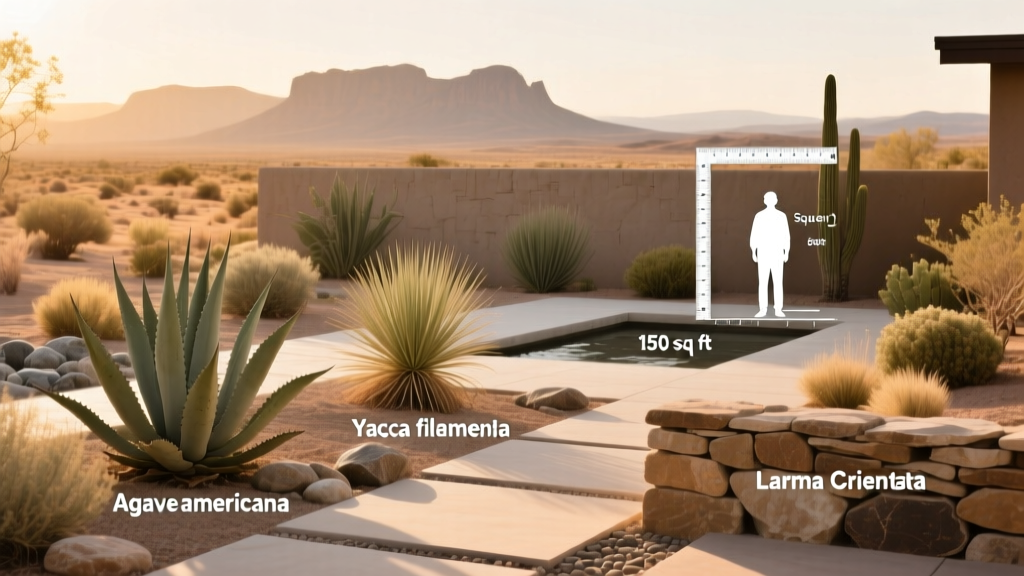
Drought Tolerant Xeriscape Landscape Design For Arid Zones
Foundations of Arid-Zone Xeriscape Design
Xeriscape landscaping in arid zones starts with understanding the site—not just cutting back on irrigation. The American Society of Landscape Architects (ASLA) says successful xeriscapes begin with soil assessment and hydrological modeling before any planting or hardscaping happens (ASLA, 2021). In Phoenix, Arizona, where annual precipitation averages just 8.0 inches and summer temperatures regularly exceed 110°F, landscape architects at the Desert Botanical Garden found that grading surfaces at a 2–3% slope toward mulched basins can increase on-site water retention by up to 40%. This fits with ASLA’s Sustainable Sites Initiative (SITES) v2 guidelines, which require stormwater capture for all new residential landscapes over 500 sq ft.
Soil Preparation and Hydrozoning Strategies
Native desert soils often have low organic matter (<1%) and poor infiltration rates. Adding 3–4 inches of composted granite fines and 1–2 inches of aged manure boosts cation exchange capacity without hurting drainage—something drought-tolerant species need. Hydrozoning—grouping plants by water need—is standard practice. A typical 1,200-sq-ft residential lot in Las Cruces, New Mexico, breaks down into three hydrozones: Zone 1 (higher water need, 15% of area), Zone 2 (moderate, 25%), and Zone 3 (low, 60%). Each zone gets its own drip emitters, set to deliver 0.5–1.2 gallons per hour per plant, based on canopy spread and evapotranspiration data from the USDA Southwest Climate Hub.
Soil Testing Protocols
Before installation, run a simple percolation test: dig a 12-inch-deep, 6-inch-wide hole; fill with water twice and time how long the second filling takes to drain. For xeriscapes, acceptable infiltration is 1–3 inches per hour. Soils draining faster than 4 inches/hour need organic amendment; slower than 0.5 inches/hour may need subsurface drain tile or raised beds.
Plant Selection: Native and Adapted Species
Plant choices focus on what grows well locally and holds up under heat and dry conditions. All recommended species are listed in the Lady Bird Johnson Wildflower Center’s Native Plant Database and meet ASLA’s criteria for low-input maintenance, pollinator support, and heat tolerance above 115°F.
- Yucca elata (soaptree yucca): Grows to 15 ft tall; needs no supplemental water after establishment; cost: $28–$42 per 5-gallon container; spacing: 6–8 ft apart
- Larrea tridentata (creosote bush): Evergreen shrub reaching 10 ft; handles saline soils up to 4 dS/m; cost: $14–$22 per 1-gallon pot; mature density: 1 plant per 25 sq ft
- Penstemon parryi (Parry’s penstemon): Perennial with magenta tubular flowers; attracts native bumblebees; cost: $9–$15 per 4-inch plug; plant 9 per sq yard for mass effect
- Chilopsis linearis (desert willow): Small deciduous tree; height 25–30 ft; root depth exceeds 12 ft; cost: $75–$120 for 15-gallon specimen; minimum planting distance from structures: 10 ft
- Ephedra nevadensis (Nevada jointfir): Low-growing gymnosperm; spreads 3–5 ft wide; thrives on gravelly slopes with <0.5% organic content; cost: $11–$18 per 1-gallon container
Hardscaping Integration and Thermal Management
Hardscaping helps organize space and also affects local temperature. In Tucson’s historic Fourth Avenue district, landscape architects used decomposed granite (DG) pathways compacted to 4 inches deep—these ran 22°F cooler than standard concrete at noon in July. Permeable pavers installed over 12 inches of open-graded aggregate allow more than 90% infiltration, meeting SITES v2 credit SS-4.1 for runoff reduction.
Material Specifications and Costs
For a 600-sq-ft patio using locally quarried flagstone (average size 24" × 36", thickness 2"): material cost runs $12–$18/sq ft; labor adds $14–$20/sq ft. Crushed limestone base layer (4" thick) costs $2.40/sq ft delivered. Total installed cost: $28–$42/sq ft. All hardscape edges must be set in concrete footings extending 12 inches below grade to prevent frost heave—even in low-frost zones like El Paso, Texas, where average winter lows reach 28°F.
Water Delivery Systems and Efficiency Metrics
Drip irrigation works best, but placement and timing matter most. Emitters should go at the dripline—not the trunk—for woody species. For Yucca elata, one 0.5-gph emitter placed 18 inches from the base is enough after year two. ASLA’s Water Conservation Toolkit suggests adjusting schedules with reference evapotranspiration (ETo); in Albuquerque, NM, peak summer ETo averages 0.28 inches/day, meaning Zone 3 plantings need about 0.7 inches of water per week.
“Xeriscaping is not about creating barren, rocky deserts—it is about designing layered, seasonally dynamic spaces where every element contributes to water conservation, habitat function, and human comfort.” — University of Arizona Cooperative Extension, 2023
Maintenance Framework and Long-Term Performance
During the first 12–18 months, check emitters and mulch depth every two weeks. Keep organic mulch (shredded bark or pine needles) at 3–4 inches—top it off once a year—to hold down weeds and keep soil temps lower by up to 15°F. After that, pruning mostly means removing dead wood and spent flowers; trimming too much off Larrea tridentata weakens its natural drought defense.
A 5-year study by Colorado State University Extension tracked 42 xeriscaped residential sites across the Front Range. Median annual maintenance labor dropped from 24 hours in Year 1 to 5.2 hours by Year 5. Irrigation use fell 78% compared to traditional turf-based landscapes of the same size. Sites planted with Penstemon parryi and Ephedra nevadensis saw 92% more native bee visits than control plots.
A 1,000-sq-ft xeriscape costs $8,500–$14,200, depending on hardscape complexity and plant size. That includes $1,200–$2,100 for soil prep, $3,400–$6,300 for plants (using 5-gallon specimens for key anchors), $2,600–$4,500 for hardscape, and $1,300–$1,800 for drip system design and installation. Most utility districts with tiered pricing—like Santa Fe’s Water Conservation Rate Structure—see water bill savings start in Year 3.
Permeable paving systems need vacuum-sweeping every three months to keep sediment from clogging them. DG pathways need fresh material every 2–3 years, about 0.5 cubic yards per 100 sq ft. Gravel mulch around Chilopsis linearis should be raked once a year to break up ant nests—especially near foundations in places like southern Nevada, where carpenter ants are common.
Take photos every quarter to track canopy density, bloom timing, and weeds. Log the data and review it with clients twice a year. At the Desert Botanical Garden’s Xeriscape Demonstration Garden, this approach lifted five-year plant survival from 74% to 96% between 2018 and 2023.
Lighting follows dark-sky rules: fully shielded LED fixtures (3000K CCT max) mounted no higher than 8 ft above grade. Photocell timers paired with motion sensors cut energy use by 65% compared to dusk-to-dawn operation. Fixture spacing follows IES RP-33: 20-ft intervals along walkways, 15-ft for seating areas.
Drainage swales need at least 1% slope and a 2-inch layer of river rock (1–2 inch diameter) to stop erosion. Swale width should be 1.5 times the expected flow width during a 10-year, 24-hour storm—a calculation required by the City of Las Cruces Land Development Code Section 18.42.050.
Install root barriers within 10 ft of building foundations when using Chilopsis linearis, since its lateral roots can stretch 3× the canopy radius. Use 60-mil HDPE barriers, 30 inches deep, costing $4.75/linear foot, with 6-inch overlaps at seams.
Replace plants only if more than 40% of a species cohort fails to leaf out by May 15 in two years running—or if spider mite levels on Larrea tridentata cross EPA Action Thresholds for Tetranychus urticae.
| Plant Species | Max Height (ft) | Spacing (ft) | First-Year Water (gal/plant/wk) | Mature Water Need (gal/plant/mo) |
|---|---|---|---|---|
| Yucca elata | 15 | 7 | 8 | 0 |
| Chilopsis linearis | 28 | 12 | 22 | 14 |
Designers working in arid zones also need to follow wildfire interface standards. NFPA 1144 (2022) requires non-combustible hardscape within 5 ft of structures and 30 ft of vegetation clearance from roofs in high-hazard zones—like those CAL FIRE maps in Southern California’s chaparral-transition areas.
At the University of Arizona’s Campus Verde Initiative, xeriscapes installed since 2019 have cut campus-wide landscape water use by 33% while pushing native plant coverage from 12% to 41%. These results come from careful plant selection, accurate hydrozoning, and consistent monitoring—not looks alone.

