Tree Care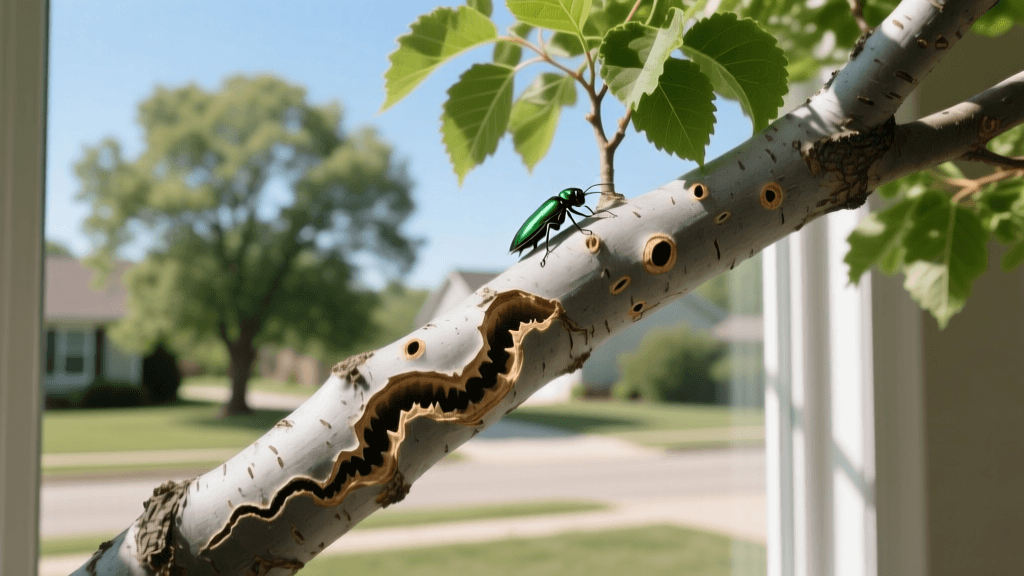
Emerald Ash Borer: Diagnosis and Treatment Solutions
The Threat of the Emerald Ash Borer (EAB)
The Emerald Ash Borer (EAB), scientifically known as Agrilus planipennis, is an invasive wood-boring beetle that has decimated ash tree populations across North America. Since its initial discovery in Michigan in 2002, this destructive pest has killed hundreds of millions of ash trees. For homeowners and property managers, early diagnosis and the implementation of targeted treatment solutions are the only ways to preserve these valuable landscape specimens. This comprehensive guide focuses on diagnosing EAB infestations and deploying effective, science-backed treatment protocols.
Diagnosing an EAB Infestation: Key Symptoms
Because EAB larvae feed beneath the bark, early-stage infestations are notoriously difficult to detect. By the time visible symptoms appear in the canopy, the tree has often been under attack for two to three years. Accurate diagnosis requires a systematic inspection of the trunk, bark, and foliage.
Canopy Thinning and Dieback
The earliest visible sign of EAB damage is progressive canopy thinning, typically starting in the upper third of the tree. Leaves may appear smaller than usual, turn yellow prematurely, and drop out of season. As the larvae girdle the tree's phloem and xylem tissues, water and nutrient transport is severed, leading to branch dieback.
D-Shaped Exit Holes
Adult EAB beetles emerge from the bark in late spring, leaving behind distinct, D-shaped exit holes that are approximately 1/8 inch (3-4 mm) in diameter. Unlike the round holes left by native borers, these flat-sided holes are a definitive hallmark of EAB. Inspect the lower trunk and major scaffold branches for these tiny openings.
Epicormic Sprouting and Bark Flecking
Stressed ash trees often produce epicormic shoots—also known as water sprouts or suckers—along the trunk or at the base of the tree. Additionally, look for 'bark flecking,' a condition where woodpeckers strip away the outer bark to feed on EAB larvae, exposing the lighter inner wood and giving the trunk a patchy, mottled appearance.
S-Shaped Larval Galleries
If you carefully peel back a section of loose or dead bark, you may find the larval galleries. EAB larvae create serpentine, S-shaped tunnels packed with fine, sawdust-like frass. These galleries disrupt the tree's vascular system, ultimately causing its demise.
Assessing Tree Health: Is It Worth Saving?
Before investing in chemical treatments, you must evaluate the tree's current health. Treatment is only viable for trees that still have a functioning vascular system to distribute the insecticide. The Purdue University Extension recommends using the percentage of canopy dieback as the primary metric for deciding whether to treat or remove an ash tree.
| Canopy Dieback | Tree Health Status | Recommended Action | Estimated Cost Implication |
|---|---|---|---|
| Less than 30% | Good / Fair | Highly recommended to treat. Excellent chance of recovery. | Standard treatment cost ($150 - $300 per tree). |
| 30% to 50% | Marginal / Declining | Treatment may work, but recovery is slow. Consult an arborist. | High risk of treatment failure; removal may be more cost-effective. |
| Greater than 50% | Poor / Severe | Do not treat. Vascular system is too damaged to transport chemicals. | Schedule immediate removal ($500 - $1,500+ depending on size). |
Proven Treatment Solutions for EAB
If your tree is a viable candidate for treatment, you have several chemical options. The choice of active ingredient and application method depends on the tree's size, the severity of the infestation, and whether you are applying it yourself or hiring a professional.
1. Trunk Injections (Emamectin Benzoate)
Emamectin benzoate (commonly sold under the trade name TREE-äge) is widely considered the gold standard for EAB control. It is a restricted-use pesticide applied by licensed professionals via direct trunk injection. It provides up to two years of residual control and is highly effective even in moderately infested trees. The cost typically ranges from $15 to $20 per inch of Diameter at Breast Height (DBH).
2. Soil Drenches (Imidacloprid)
For homeowners looking for a DIY solution, imidacloprid is available in products like Bayer Advanced 12 Month Tree & Shrub Protect & Feed. This systemic insecticide is mixed with water and poured around the base of the tree. The roots absorb the chemical and translocate it to the canopy. It must be applied annually and is generally only recommended for smaller trees (under 22 inches in circumference or 7 inches DBH) due to soil absorption limitations.
3. Basal Trunk Sprays (Dinotefuran)
Dinotefuran (trade name Safari) is a highly water-soluble neonicotinoid that can be sprayed directly onto the lower 5 to 6 feet of the trunk. It penetrates the bark rapidly and moves upward. While it offers faster uptake than soil drenches, it typically requires annual reapplication and is best used as a supplementary treatment or for trees where soil conditions (e.g., heavy clay, compaction) prevent root uptake.
Treatment Comparison Chart
| Active Ingredient | Application Method | Frequency | Best For | DIY or Pro? |
|---|---|---|---|---|
| Emamectin Benzoate | Trunk Injection | Every 2 Years | All sizes, high efficacy | Professional Only |
| Imidacloprid | Soil Drench / Injection | Annually | Small to medium trees | DIY (Drench) / Pro |
| Dinotefuran | Basal Trunk Spray | Annually | Fast uptake, poor soils | Professional / DIY |
| Azadirachtin | Trunk Injection | Annually | Organic/eco-sensitive areas | Professional Only |
Step-by-Step Application Guide: Soil Drench (Imidacloprid)
If you opt for a homeowner-friendly soil drench, precise timing and measurement are critical for success.
- Measure the Tree: Using a flexible measuring tape, measure the circumference of the trunk at exactly 4.5 feet above the ground (Breast Height). If the circumference is greater than 22 inches, consult a professional for trunk injection instead.
- Calculate the Dosage: Read the product label carefully. A standard concentration requires mixing 1 ounce of imidacloprid concentrate per 1 inch of trunk circumference in a gallon of water.
- Prepare the Soil: Remove any mulch, rocks, or landscape fabric from the base of the tree. The soil must be bare and slightly moist to facilitate absorption.
- Apply the Drench: Pour the mixture evenly in a continuous circle around the base of the trunk, keeping it within 12 inches of the bark to target the active feeder roots.
- Water It In: Lightly water the area with a hose for 5 to 10 minutes to push the insecticide into the root zone. Avoid heavy runoff.
Optimal Timing for EAB Treatments
Timing your application correctly is just as important as choosing the right chemical. Systemic insecticides rely on the tree's natural transpiration stream to move the active ingredient from the roots or trunk into the canopy. Therefore, treatments should be applied in the spring or early summer (typically May through June), after the leaves have fully expanded but before the peak summer heat causes the tree to slow its water uptake. Applying treatments in the fall or winter is ineffective, as the tree is dormant and will not distribute the chemical.
Expert Insights and Authoritative Citations
'Homeowners should consider the value of the ash tree to their landscape and the cost of treatment versus removal. Trunk injections of emamectin benzoate provide the highest level of control and are the preferred method for large, high-value trees. Soil applications of imidacloprid are an affordable alternative for smaller trees but must be applied annually.' — Purdue University Extension, Entomology Department.
Furthermore, the United States Department of Agriculture (USDA) Animal and Plant Health Inspection Service (APHIS) emphasizes that while quarantines help slow the spread of EAB, localized management through proactive chemical treatment remains the only viable defense for existing urban and suburban ash canopies.
Conclusion
The Emerald Ash Borer is a formidable adversary, but it does not have to mean the automatic death sentence for your ash trees. By diligently monitoring for D-shaped exit holes, canopy dieback, and bark flecking, you can catch infestations while the tree is still viable. Evaluate the tree's health using the 30% canopy dieback threshold, and select a treatment method—whether a professional emamectin benzoate injection or a DIY imidacloprid soil drench—that matches the tree's size and your budget. With precise timing, accurate measurements, and consistent annual or biennial care, you can preserve the shade, beauty, and ecological benefits of your ash trees for decades to come.