Tree Care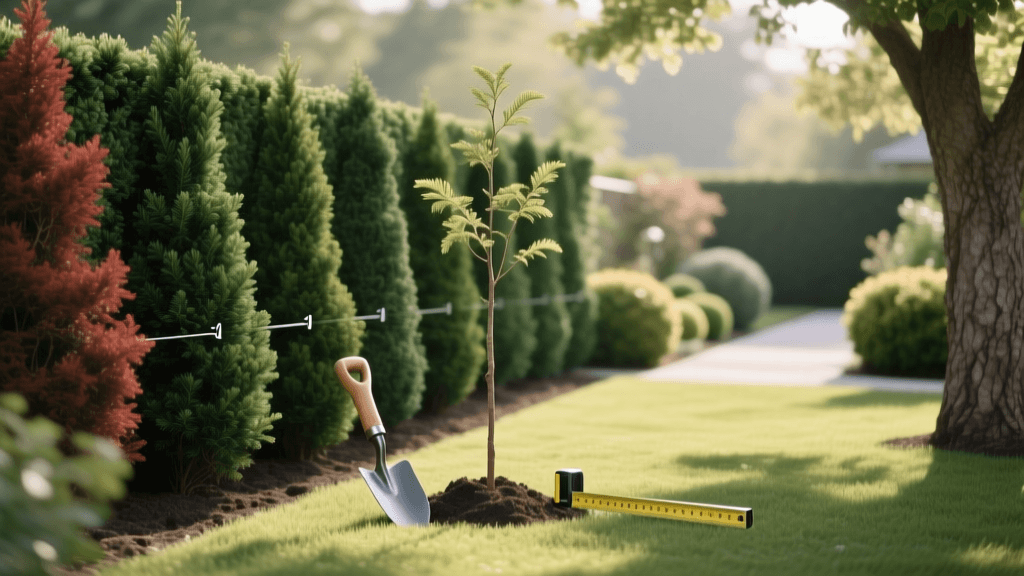
Planning Evergreen Privacy Screens: Spacing and Species Guide
The Advantage of Living Privacy Screens
Designing a landscape that offers both beauty and seclusion requires careful planning. While wooden fences and masonry walls provide immediate privacy, they lack the ecological benefits, wind-breaking capabilities, and aesthetic softness of a living evergreen screen. A well-planned evergreen border acts as a natural sound barrier, filters airborne dust, provides critical winter shelter for local bird populations, and significantly increases property value. However, the success of a privacy screen hinges entirely on the initial design phase. Choosing the wrong species, miscalculating spacing, or ignoring soil conditions can lead to a sparse, disease-ridden, or overly crowded tree line that fails to provide the seclusion you desire.
Step 1: Site Assessment and Boundary Planning
Before purchasing a single tree, you must rigorously evaluate your planting site. The planning phase dictates the long-term health and legal standing of your landscape design.
Mapping Utilities and Property Lines
Always call 811 (the national call-before-you-dig number) at least a few business days before breaking ground. This free service marks underground utilities, preventing costly and dangerous strikes on gas, water, or fiber-optic lines. Additionally, verify your exact property boundaries with a recent land survey. Planting trees directly on a property line can lead to shared ownership disputes and maintenance disagreements with neighbors. A best practice in landscape design is to plant your privacy screen entirely on your own property, typically setting the trunk center at least 3 to 5 feet inside your property line to accommodate mature trunk flare and canopy overhang.
Sunlight and Soil Evaluation
Most evergreen species require full sun (at least 6 hours of direct sunlight daily) to maintain dense, lower-branch foliage. If your planned screen falls in the shadow of a building or larger existing trees, you will need to select shade-tolerant species like the Canadian Hemlock or American Holly, though these grow much slower. Conduct a soil test using a kit from your local university extension office. Most evergreens prefer a slightly acidic to neutral soil pH between 6.0 and 7.0. If your soil is heavy clay, you must plan for wider planting holes and incorporate organic matter to improve drainage, as 'wet feet' will quickly kill most conifers.
Step 2: Selecting the Best Evergreen Species
Not all evergreens are suited for privacy screens. You need species that maintain their lower branches, tolerate close planting, and resist regional pests. Below is a comparison of the top screening trees used in residential landscape design.
| Species | Mature Height | Mature Width | Growth Rate | USDA Zones | Avg Cost (6ft B&B) |
|---|---|---|---|---|---|
| 'Green Giant' Arborvitae | 40 - 60 ft | 12 - 18 ft | Fast (3-5 ft/yr) | 5 - 8 | $120 - $180 |
| Leyland Cypress | 50 - 70 ft | 15 - 20 ft | Very Fast (3-4 ft/yr) | 6 - 10 | $90 - $140 |
| Eastern Redcedar | 40 - 50 ft | 8 - 15 ft | Medium (1-2 ft/yr) | 2 - 9 | $80 - $120 |
| Nellie Stevens Holly | 20 - 30 ft | 10 - 15 ft | Fast (2-3 ft/yr) | 7 - 9 | $150 - $220 |
| American Holly | 15 - 30 ft | 10 - 20 ft | Slow (1 ft/yr) | 5 - 9 | $180 - $250 |
Note: B&B stands for 'Balled and Burlapped', which is the recommended purchasing format for large screening trees to ensure an established root ball.
Step 3: Calculating Spacing and Layout Design
The most common mistake homeowners make when planning a privacy screen is planting trees too closely together. While tight spacing creates an instant screen, it forces the trees to compete aggressively for water, nutrients, and sunlight. This leads to stunted growth, interior needle drop, and a high susceptibility to fungal diseases due to poor air circulation.
The Spacing Formula
For a dense, overlapping privacy screen, the standard landscape architecture rule of thumb is to divide the tree's mature width by two. For example, if you are planting 'Green Giant' Arborvitae with a mature width of 15 feet, you should space the trunks 7 to 8 feet apart. If you prefer a more natural, separated look where each tree's individual form is visible, space them at their full mature width (15 feet apart).
Design Pattern: The Staggered Double Row
If you have the yard depth to accommodate it, a staggered double row (planting in an equilateral triangle pattern) is vastly superior to a single straight line. A single row leaves gaps at the trunk level and is vulnerable to wind damage. A staggered design, with the second row planted 4 to 6 feet behind the first row and offset by half the spacing distance, creates an impenetrable visual and acoustic barrier while allowing better airflow through the canopy.
Step 4: Soil Preparation and Planting Execution
Timing and technique are critical. The optimal time to plant evergreen screens is in early fall (September to October) or early spring (March to April). Fall planting allows the root system to establish in cool, moist soil before the stress of summer heat.
Digging and Amending
Dig a hole that is twice as wide as the root ball, but exactly the same depth. Never plant an evergreen deeper than it was growing in the nursery; burying the root flare invites rot and girdling roots. When backfilling, avoid replacing all native soil with rich potting mix, which creates a 'bathtub effect' where water pools in the loose soil and drowns the roots. Instead, mix the native soil with 20% organic compost.
To accelerate root establishment, incorporate specific biological amendments during planting:
- Mycorrhizal Fungi: Apply a product like Myke Tree & Shrub directly to the root ball. These beneficial fungi form a symbiotic relationship with the roots, expanding their absorption capacity by up to 50 times.
- Starter Fertilizer: Use Espoma Bio-tone Starter Plus (4-3-3), which contains slow-release organic nutrients and beneficial microbes to reduce transplant shock without burning tender new roots.
Step 5: Irrigation Planning and Long-Term Care
A newly planted privacy screen requires consistent moisture for the first two growing seasons. Hand-watering a row of twenty 6-foot trees is impractical and often leads to under-watering. Integrate a drip irrigation system into your design plan from day one.
Run a mainline poly-tube along the screen and use Netafim drip-line tubing with emitters spaced every 12 inches. Lay the tubing in a zig-zag pattern across the root zones of the trees and cover it with 2 to 3 inches of hardwood mulch. This delivers water directly to the root zone, minimizing evaporation and keeping the foliage dry, which is crucial for disease prevention.
Mulching Best Practices
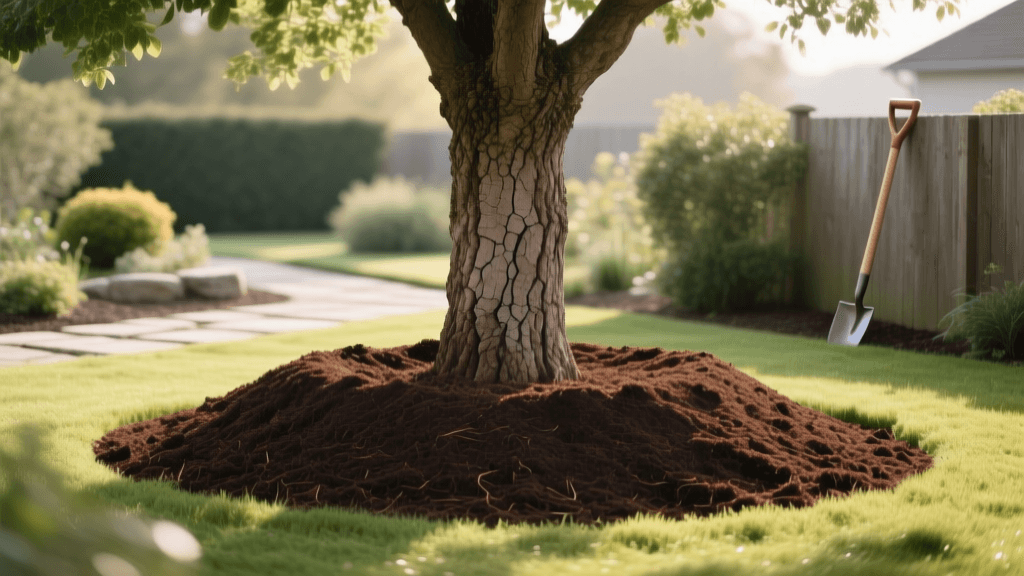
Apply a 3-inch layer of natural wood chip mulch in a 3-foot radius around each tree. Crucially, keep the mulch at least 3 inches away from the trunk itself. 'Volcano mulching'—piling mulch against the trunk—traps moisture against the bark, leading to collar rot and inviting boring insects.
Maintenance and Disease Prevention
While evergreens require less pruning than deciduous trees, strategic maintenance is required to maintain a dense screen. Avoid severe shearing, which creates a thick outer shell of foliage that blocks sunlight from reaching the interior branches, eventually causing the inside of the tree to die off.
Instead, use hand pruners to selectively thin out crossing branches and dead wood once a year in late winter. This improves light penetration and air circulation. This airflow is especially critical for species like the Leyland Cypress, which is highly prone to fungal issues in humid climates.
'Leyland cypress is susceptible to several diseases, including Seiridium canker and Botryosphaeria canker, which are exacerbated by environmental stress and poor air circulation. Proper spacing, avoiding overhead irrigation, and selective pruning to open the canopy are the most effective cultural controls for maintaining a healthy privacy screen.'
— Clemson Cooperative Extension, Home & Garden Information Center
Conclusion
Planning an evergreen privacy screen is a long-term investment in your property's aesthetic and functional value. By carefully assessing your site, selecting regionally appropriate species, calculating precise spacing, and installing proper irrigation and soil amendments, you will cultivate a thriving, dense living wall that provides beauty and seclusion for decades to come.