Tree Care
Evergreen Trees For Year Round Privacy Screening
Choosing the Right Evergreen for Your Privacy Goals
A well-placed row of evergreen trees can block sightlines, muffle road noise, and define property boundaries without the seasonal gaps that deciduous hedges leave behind. But not every evergreen works equally well as a privacy screen. Growth rate, mature width, root behavior, and how well the tree handles your local soil and climate all affect whether it becomes a reliable green wall—or turns into a headache within a decade.
Before selecting a species, measure the space you have available. Most privacy screens fail not because the trees die, but because homeowners underestimate how wide the canopy will get and plant too close to structures, utilities, or the property line. The International Society of Arboriculture (ISA) recommends checking local utility maps and keeping at least 15 feet of horizontal clearance from overhead lines for medium-sized evergreens, and 25 feet or more for large-canopy species (ISA, 2022).
Top Evergreen Species for Privacy Screening
The species profiles below cover the trees most commonly recommended by certified arborists across USDA Hardiness Zones 4 through 9. Each entry includes typical growth rates, mature dimensions, and root spread data relevant to siting decisions.
Thuja Green Giant (Thuja standishii × plicata)
Thuja Green Giant is probably the most popular privacy screen tree planted in the eastern and central United States over the past 30 years. It grows 3 to 5 feet per year under good conditions, reaching a mature height of 30 to 40 feet with a spread of 12 to 20 feet. The dense, scale-like foliage stays rich green through winter without much bronzing, unlike many arborvitae cultivars.
Root spread on established Green Giants typically extends 1.5 to 2 times the canopy radius, meaning a tree with a 15-foot spread may have lateral roots reaching 11 to 15 feet from the trunk. Plant at least 6 to 8 feet from hardscape and 10 feet from foundations. For a solid screen, space trees 5 to 6 feet apart on center; they’ll fill in gaps within 3 to 4 years at normal growth rates.
Leyland Cypress (× Cuprocyparis leylandii)
Leyland Cypress became widely used in the Southeast and Pacific Northwest because it grows fast—up to 4 feet per year in its first decade. Mature specimens reach 60 to 70 feet tall with a 15- to 25-foot spread, making them one of the fastest large-scale screens around. The North Carolina State University Extension Service has documented Leyland Cypress as the most commonly planted privacy tree in the Piedmont region, with millions of specimens established since the 1980s.
The trade-off is structural vulnerability. Leyland Cypress develops a shallow, wide root system that rarely goes deeper than 18 to 24 inches, making mature trees more likely to tip over in storms. The species is also prone to Seiridium canker and Botryosphaeria canker, both of which can kill large sections of the canopy. The University of Georgia Extension recommends against planting Leyland Cypress in rows longer than 50 feet without mixing in other species, specifically to slow disease spread across the whole screen (UGA Extension, 2019).
Eastern White Pine (Pinus strobus)
Eastern White Pine offers a softer, more naturalistic screen than columnar arborvitae or cypress. It grows 2 to 3 feet per year and reaches 50 to 80 feet at maturity, with a spread of 20 to 40 feet. The long, flexible needles create a layered, feathery texture that moves in wind rather than acting as a rigid wall—a quality that makes it well-suited to rural and semi-rural properties where a formal hedge look isn’t needed.
Root architecture matters before planting. White Pine starts with a taproot when young, then shifts to a wide lateral root system as it matures. Lateral roots can extend 2 to 3 times the canopy radius in open soil. Avoid planting within 20 feet of septic systems or drain fields. White Pine is also sensitive to road salt and compacted soils; the Morton Arboretum in Lisle, Illinois, advises against using it within 50 feet of heavily salted roadways.
Spacing, Planting Depth, and Establishment
Correct planting depth is one of the most common mistakes people make when installing trees. ANSI A300 Part 6 standards say the root flare—the point where the trunk visibly widens at the base—must be at or just above finished grade. Planting too deep is a leading cause of long-term decline in privacy screen trees, because buried root flares promote crown rot, girdling roots, and less oxygen in the root zone (ANSI A300, 2017).
When installing balled-and-burlapped stock, remove all wire baskets, burlap, and twine from the top two-thirds of the root ball after the tree is set in the hole. Synthetic burlap doesn’t break down and will hold back root growth for the life of the tree. Container-grown stock should have any circling roots cut or straightened before backfilling.
- Dig the planting hole 2 to 3 times the width of the root ball, but no deeper than the root ball height.
- Backfill with native soil rather than amended mixes; amendments in the planting hole can discourage roots from growing into surrounding soil.
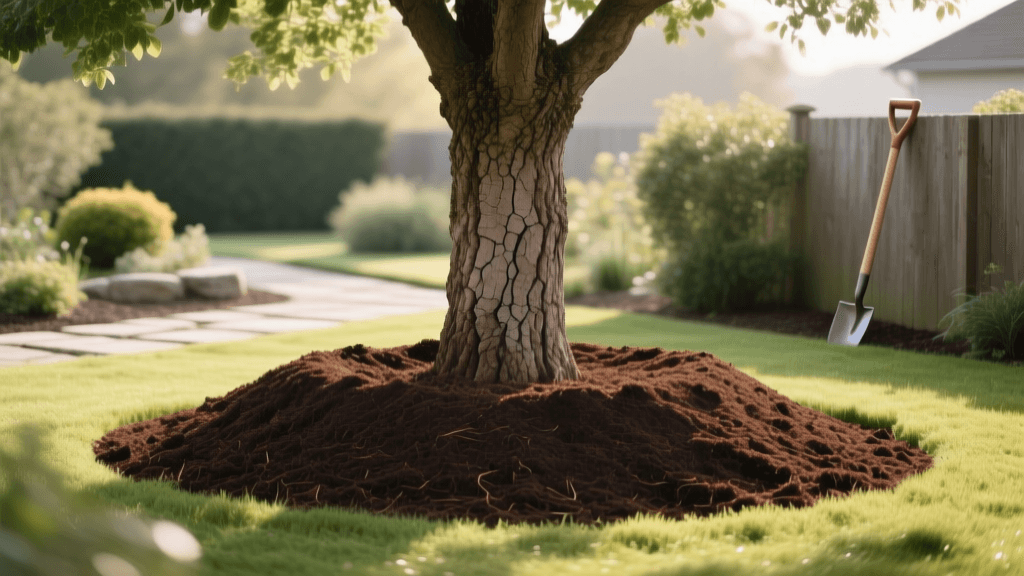
- Apply 3 to 4 inches of organic mulch in a ring extending to the drip line, keeping mulch 3 to 4 inches away from the trunk.
- Water deeply at planting and keep the soil consistently moist for the first two growing seasons—typically 10 to 15 gallons per inch of trunk diameter per week during dry periods.
- Stake only if the site has persistent high winds; unstaked trees develop stronger trunk taper and better root anchorage.
Pruning Standards and Timing
Privacy screen trees need less pruning than ornamental specimens, but occasional structural work improves density, lowers storm damage risk, and helps the planting last longer. All pruning on established trees should follow ANSI A300 Part 1 pruning standards, which define where to cut, how much to remove, and what not to do—like topping or flush cutting (ANSI A300, 2017).
For most columnar evergreens used as screens—arborvitae, Leyland Cypress, Italian Cypress—light shearing in late spring after the first flush of growth encourages lateral branching and increases density. Remove no more than one-third of the current year’s growth in a single session. Avoid shearing in late summer or fall; new growth stimulated by late-season cuts may not harden off before frost.
Pines and spruces shouldn’t be sheared. Instead, selectively remove or shorten individual branches to manage size and shape. On Eastern White Pine, “candling”—pinching or cutting the new spring growth (candles) by half before needles fully extend—reduces annual elongation and keeps the tree denser without creating the brown stubs that shearing produces.
Deadwood Removal and Hazard Assessment
Deadwood builds up naturally inside dense privacy screens where light doesn’t reach well. Branches larger than 2 inches in diameter that are dead or dying should be removed to lower failure risk and slow the spread of wood-decay fungi. ISA Best Management Practices for Tree Risk Assessment recommend looking over mature screen trees every 3 to 5 years, and more often after major storms or droughts (ISA, 2022).
Species Comparison at a Glance
Note on growth rate data: Annual growth figures represent averages under optimal conditions—full sun, well-drained loam, adequate moisture. Trees planted in clay soils, partial shade, or drought-prone sites may grow 30 to 50 percent slower. All mature height ranges reflect documented specimens in USDA Zones 5–8 unless otherwise noted.
| Species | Annual Growth | Mature Height | Mature Spread | Root Spread | Best Zones |
|---|---|---|---|---|---|
| Thuja Green Giant | 3–5 ft/yr | 30–40 ft | 12–20 ft | 1.5–2× canopy radius | 5–9 |
| Leyland Cypress | 3–4 ft/yr | 60–70 ft | 15–25 ft | Shallow, 18–24 in deep | 6–10 |
| Eastern White Pine | 2–3 ft/yr | 50–80 ft | 20–40 ft | 2–3× canopy radius | 3–8 |
| Norway Spruce (Picea abies) | 1.5–2 ft/yr | 40–60 ft | 25–30 ft | 1–1.5× canopy radius | 3–7 |
| American Holly (Ilex opaca) | 0.5–1 ft/yr | 15–30 ft | 10–20 ft | Equal to canopy spread | 5–9 |
Managing Long-Term Health in Dense Plantings
Privacy screens planted in tight rows create microclimates that differ from open-grown conditions. Less air movement between trees raises humidity inside the canopy, which encourages fungal diseases like Phytophthora root rot, needle cast, and various canker pathogens. Keeping enough space between trees—even if it means waiting longer for full coverage—is the most effective way to prevent disease over time.
Soil compaction is another concern in high-traffic landscapes. Foot traffic, vehicle parking, and construction activity in the root zone compress soil pores, cutting off oxygen and slowing water movement. The critical root zone (CRZ)—defined under ANSI A300 standards as a circle with a radius of 1 foot per inch of trunk diameter—should stay protected from compaction for the life of the planting. For a 10-inch diameter trunk, that means protecting a 10-foot radius around the tree.
- Watch for early signs of Seiridium canker on Leyland Cypress: sunken, discolored bark with resin soaking, usually appearing first on branches in the upper third of the canopy.
- Test soil pH every 3 to 5 years. Most privacy screen conifers prefer a pH of 5.5 to 6.5; alkaline soils above 7.0 can cause iron and manganese deficiencies that lead to yellowing and weak growth.
- Apply a slow-release, low-nitrogen fertilizer in early spring if soil tests show a deficiency—avoid high-nitrogen formulas that push fast, weak growth.
- Remove and dispose of diseased material off-site instead of chipping it into mulch, which can bring pathogens back into the root zone.
When Removal Becomes Necessary
Even well-maintained privacy screens eventually include trees that need removal—whether due to disease, structural failure, or crowding nearby structures. Removing trees from dense rows brings specific challenges: adjacent trees limit felling direction, root competition may have weakened neighbors, and the gap left behind is immediately obvious. A certified arborist should review removal options before work begins, especially for trees over 30 feet tall or near buildings.
Stump grinding to 6 to 8 inches below grade is standard after removal. For species susceptible to Armillaria root rot—including many conifers—removing the stump and major roots entirely is better than grinding, since Armillaria can live in leftover wood and spread to nearby trees through root contact. The ISA’s Tree Risk Assessment Qualification (TRAQ) program gives arborists a consistent way to weigh these decisions before and after removal (ISA, 2022).
Replanting in the same spot after disease-related removal usually means waiting and sometimes treating the soil. For Phytophthora-affected sites, the University of California Cooperative Extension recommends improving drainage and waiting at least one full growing season before replanting with a resistant species. Choosing a species from a different genus than the one removed also lowers the chance of reinfection from leftover soil organisms.