
Landscaping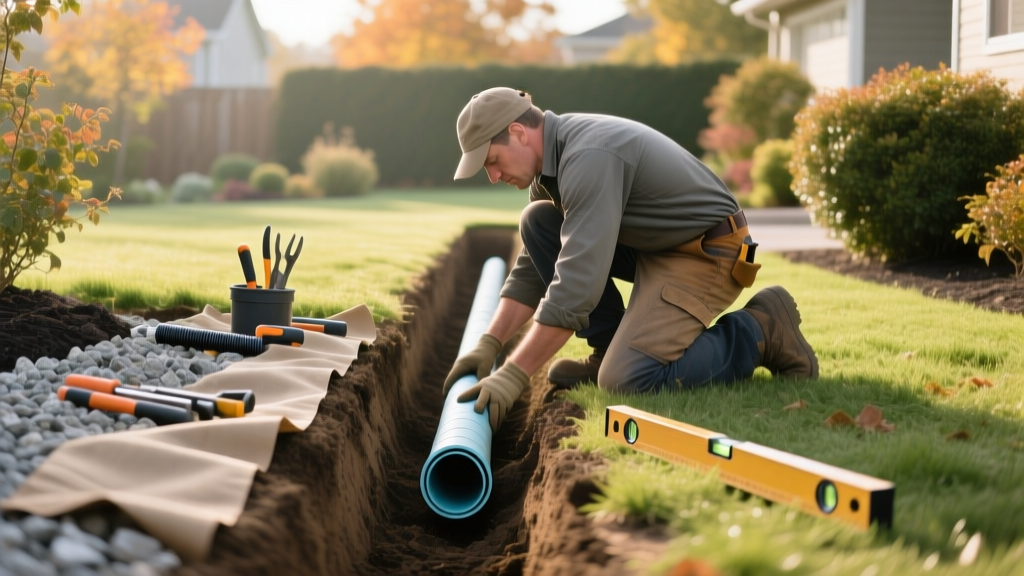
Expert Guide to French Drain Installation and Yard Drainage
Sarah ChenPublished
Mastering Yard Drainage: The Expert's Approach to French Drains
Standing water in your yard is more than just a nuisance—it can weaken your home’s foundation, drown grass roots, and damage years of landscape work. When surface grading and swales don’t move water away from your property, a subsurface drainage system is the next logical step. Of all the options, the French drain is still the go-to method for handling groundwater and surface runoff.
As landscaping professionals, we’ve seen many DIY drainage attempts fall short—usually because of slope errors, wrong materials, or shallow or uneven trenches. This guide walks through what actually works, based on real jobs and long-term results.
Diagnosing Your Yard's Drainage Issues
Before you dig, take time to watch how water moves across your yard. Water always takes the easiest path, and your job is to give it a better one. Stand outside during a heavy rain. See where puddles form, how water runs off, and where it finally stops.
- Surface Water Issues: If water pools right after rain and lingers for hours or days, your soil may be compacted or your grading too flat—or even sloping toward the house. A French drain with a surface catch basin usually fixes this.
- Subsurface Water Issues: If your yard stays spongy two or three days after a storm, or if moisture shows up in your basement or crawl space, you’re likely dealing with a high water table or clay-heavy soil that won’t let water soak through. In those cases, a deeper French drain helps intercept water moving sideways underground.
According to the Clemson University Cooperative Extension, good home drainage means combining roof gutter management, surface grading (at least a 2% slope away from the foundation), and subsurface drains. Installing a French drain without fixing poor grading near the house will just overload the system.
Step-by-Step French Drain Installation: Best Practices
A French drain is basically a gravel-filled trench with a perforated pipe inside. What makes one last and another fail isn’t the idea—it’s the details.
1. Planning the Route and Calculating Slope
Slope matters most. Without it, water won’t flow. The standard minimum is 1%—that’s a 1-inch drop every 8 feet. For clay soils or longer runs, aim for 2% to 3% (1 inch per 4 feet) to keep things moving reliably.
Pick your discharge point carefully. Send water to a storm drain, a dry well, or a spot on your property that’s lower than the drain’s start point. Don’t dump it onto a neighbor’s yard or into a municipal sewer—most local codes prohibit both.
2. Trenching and Geotextile Lining
Dig the trench at least 12 inches wide and 18 to 24 inches deep, depending on how bad the water problem is. Once it’s dug, line the whole thing with non-woven geotextile fabric. Expert Tip: Skip woven weed barrier—it blocks water and clogs fast. Non-woven landscape fabric lets water in while keeping fine soil out of the gravel and pipe (which would otherwise fill with silt and stop working).
Leave at least 12 inches of fabric hanging over each side so you can fold it over the top of the gravel later—this wraps the whole system and keeps dirt from washing in.
3. Pipe Selection and Placement
Start with a 2-inch layer of washed drainage rock at the bottom of the lined trench. Then lay the perforated pipe on top. Important: Put the holes facing down. It feels backwards at first, but water rises from wet soil below, not trickles down from above. With holes up, the trench has to flood before water enters the pipe—slowing things down and adding pressure against nearby walls or foundations.
4. Gravel Filling and Backfilling
Cover the pipe with washed 3/4-inch drainage gravel. Avoid pea gravel—it’s too smooth and doesn’t drain well—and skip crushed limestone, which breaks down and can clog the pipe over time. Fill to about 3–4 inches below grade, fold the fabric over the gravel, then add 2 inches of coarse sand on top, followed by topsoil and sod to match your lawn.
Material Comparison: Corrugated vs. PVC Drain Pipe
Landscapers often debate pipe choice. Here’s how the two main residential options stack up.
| Feature | Corrugated Flexible Pipe (Black) | SDR-35 Rigid PVC Pipe (White/Green) |
|---|---|---|
| Cost | Low ($0.75 - $1.50 per linear foot) | Medium ($2.50 - $4.00 per linear foot) |
| Installation Ease | High (bends easily, fewer fittings) | Moderate (requires cutting and gluing fittings) |
| Durability & Crush Resistance | Low to Medium (can flatten under heavy loads) | High (holds up well under weight) |
| Flow Efficiency | Lower (ridges inside slow flow and trap debris) | Higher (smooth interior moves water faster and resists buildup) |
| Expert Recommendation | Good for shallow garden beds with light foot traffic | Better for deep trenches, driveways, or anywhere long-term reliability matters |
For a system meant to last, most landscapers choose rigid SDR-35 PVC with socketed fittings. Its smooth interior helps keep roots and sediment out, and it routinely lasts 30 years or more.
Cost Estimates and Project Timing
How much a French drain costs depends on your soil, how deep you need to dig, and whether you do it yourself or hire help.
- DIY Installation: Plan on $5–$10 per linear foot for materials—pipe, gravel, fabric, and tool rentals. A typical 50-foot run runs $250–$500. But digging that by hand in heavy clay? That’s a full weekend of hard work.
- Professional Installation: Contractors usually charge $20–$35 per linear foot. With a mini-excavator, a crew can finish a 50-foot drain in one day—for $1,000–$1,750. That price typically includes hauling away the dirt, which is no small task for most homeowners.
Timing: Install during dry weather. Digging in wet soil turns everything to mud, ruins the ground structure, and increases the risk of trench walls collapsing.
Pro Tips for Long-Term Drainage Success
'The most common failure in residential subsurface drainage is the omission of filter fabric and the use of unwashed gravel. Fine silts will infiltrate the void spaces of the aggregate and the perforations of the pipe, rendering the system completely useless within three to five years. Always encapsulate your drain in non-woven geotextile and use strictly washed stone.'
— Best Practices for Residential Stormwater Management, University of Florida IFAS Extension
To keep your French drain working for years, try these practical steps:
- Install Cleanouts: Every 50 feet, and at every sharp turn, add a solid PVC cleanout riser that comes up to the surface. Cap it with a removable lid. If something clogs, you can snake it or flush it with a hose.
- Protect the Outlet: The end of the drain—where water exits—is an easy target for leaves, bugs, and rodents. Cover it with heavy-duty galvanized hardware cloth or a purpose-built grated outlet protector.
- Combine with Dry Wells: If you don’t have a lower spot to send the water, route the French drain into a dry well. That’s a gravel-filled pit—or a plastic chamber—buried underground. It holds water temporarily and lets it soak slowly into deeper soil layers.
Conclusion
A well-built French drain works quietly underground, protecting your lawn and your home’s structure. Stick to the basics: get the slope right, use non-woven geotextile, choose rigid PVC pipe, and fill with washed gravel. That’ll solve most standing water problems and keep your yard healthier. And remember—drainage works best when it’s part of a bigger plan. Pair your French drain with proper grading and clean gutters for real, lasting protection.

