Tree Care
Expert Mulching and Deep Root Watering Guide for Mature Trees
Mature trees are the cornerstone of a well-designed landscape, providing essential shade, improving air quality, and significantly boosting property values. However, even the most established and seemingly invincible trees are highly susceptible to improper cultural practices. As a senior arborist and tree care specialist, I frequently see mature trees decline not from old age, but from chronic stress induced by incorrect mulching and inadequate watering techniques. In this comprehensive guide, we will explore the science behind tree root systems, dismantle the dangerous "volcano mulching" trend, and provide actionable, expert-level strategies for deep root watering and proper mulch application.
The Hidden World of Tree Roots and the Rhizosphere
To understand why expert mulching and watering techniques are critical, we must first look beneath the soil surface. A common misconception among homeowners is that a tree's root system is a deep, mirror image of its canopy. In reality, the vast majority of a tree's fine, water-absorbing roots are located in the top 12 to 18 inches of soil. These roots extend far beyond the drip line (the outermost edge of the canopy), often reaching two to three times the height of the tree.
This shallow root zone, known as the rhizosphere, is a complex ecosystem teeming with mycorrhizal fungi and beneficial microbes that help the tree absorb water and essential nutrients. For this ecosystem to thrive, it requires three critical elements: moisture, organic matter, and oxygen. Improper watering and mulching practices directly disrupt this delicate balance, suffocating roots or leaving them vulnerable to severe drought stress.
The "Volcano Mulching" Epidemic
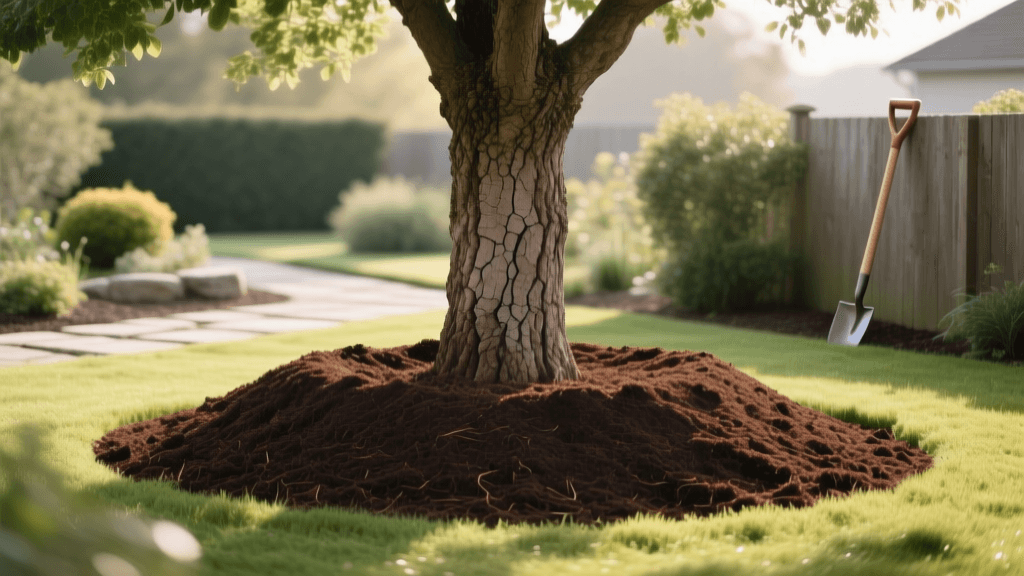
One of the most pervasive and damaging trends in modern landscaping is "volcano mulching"—the practice of piling mulch high against the trunk of a tree in a cone shape. While this may look neat and tidy to an untrained eye, it is a death sentence for mature trees. Tree bark is designed to protect the inner vascular tissues from the elements. When mulch is piled against the trunk, it traps moisture against the bark, leading to tissue maceration, fungal infections, and rot.
Furthermore, the dark, moist environment created by volcano mulching encourages secondary roots to grow upward into the mulch mound. Over time, these roots wrap around the main trunk, creating "girdling roots" that effectively strangle the tree by cutting off the flow of water and nutrients through the phloem and xylem.
"Mulch piled against the trunk keeps the bark excessively moist, leading to fungal infections and encouraging girdling roots that eventually strangle the tree. Mulch should never touch the trunk." — University of Massachusetts Amherst Extension
The 3-3-3 Rule of Expert Mulching
To avoid the pitfalls of volcano mulching and to maximize the benefits of organic ground cover, professional arborists adhere to the "3-3-3 Rule" of mulching. While this is a baseline, expanding the radius to the tree's drip line is always preferred for mature specimens.
- 3 Inches Deep: Apply a uniform layer of mulch no deeper than 3 to 4 inches. Any thicker, and you risk blocking oxygen exchange to the shallow root system, leading to anaerobic soil conditions and root suffocation.
- 3 Feet Radius (Minimum): The mulch ring should extend at least 3 feet from the trunk in all directions. For mature trees, extending the mulch bed to the edge of the canopy (the drip line) is the gold standard, as this covers the primary zone of active water-absorbing roots.
- 3 Inches Away from the Trunk: Keep mulch at least 3 to 6 inches away from the base of the trunk. The root flare (where the trunk widens and meets the roots) must be completely visible and exposed to the air.
Mulch Material Comparison Chart
Not all mulches are created equal. Choosing the right material is vital for long-term tree health. Avoid dyed mulches, rubber mulch, and inorganic plastics or landscape fabrics, which block oxygen and disrupt the soil microbiome.
| Mulch Type | Pros | Cons | Best Application |
|---|---|---|---|
| Shredded Hardwood Bark | Excellent moisture retention, breaks down slowly, adds organic matter. | Can form a hydrophobic crust if left unturned for years. | Ideal for most deciduous trees and general landscape beds. |
| Pine Straw (Needles) | Highly porous, allows excellent water and air penetration, slightly acidifies soil. | Breaks down quickly, requires annual replenishment, can blow away in high winds. | Excellent for acid-loving trees like pines, oaks, and magnolias. |
| Composted Wood Chips | Rich in beneficial microbes, excellent for soil conditioning, free from municipal sources. | Can temporarily tie up nitrogen at the soil surface during initial breakdown. | Best for establishing new trees or rehabilitating neglected, compacted soils. |
| Cocoa Bean Hulls | Pleasant aroma, fine texture, high nutrient content. | Highly toxic to dogs if ingested, molds easily in heavy shade. | Use only in strictly pet-free zones and well-draining areas. |
Deep Root Watering: Beyond the Sprinkler System
Automated lawn sprinkler systems are designed for turfgrass, which has a shallow root zone of about 4 to 6 inches. Running your sprinkler for 20 minutes every other day will barely penetrate the top layer of soil and will never reach the deep, structural roots of a mature tree. In fact, frequent, shallow watering encourages tree roots to grow upward toward the surface in search of moisture, making the tree highly vulnerable to drought and increasing the risk of surface roots destroying your lawn and hardscaping.
Expert tree care requires "deep and infrequent" watering. The goal is to saturate the soil to a depth of 12 to 18 inches. This encourages roots to grow deep into the soil profile, anchoring the tree securely and providing a reservoir of moisture during dry spells.
Calculating Water Volume for Mature Trees
A general rule of thumb recommended by the Arbor Day Foundation and municipal forestry departments is to provide 10 gallons of water per inch of trunk diameter (measured at knee height) during each watering session. For a mature tree with a 20-inch trunk, this means delivering 200 gallons of water slowly over the course of the watering session.
To achieve this without causing surface runoff, you must apply the water slowly. Using a soaker hose coiled in concentric circles under the drip line, or a specialized deep-root watering probe attached to your garden hose, allows water to percolate deeply into the soil profile rather than pooling on the surface.
Tools of the Trade for Expert Tree Care
Investing in the right tools will save you time and ensure your trees receive optimal care:
- Soil Moisture Probe: A 24-inch stainless steel soil probe is an arborist's best friend. By pushing the probe into the ground beneath the mulch, you can pull up a core sample of soil. If the soil crumbles and feels dry at 6 inches deep, it is time to water. If it forms a muddy ball, the soil is saturated, and watering should be delayed.
- Deep Root Watering Feeder: Tools like the Ross Root Feeder attach to your hose and feature a metal spike that injects water directly into the root zone, bypassing dry surface soils and hydrophobic mulch layers.
- Hand Pruning Saw and Loppers: Essential for maintaining the lower canopy and removing deadwood, which improves air circulation and reduces the transpiration load on the tree during drought.
Seasonal Watering and Mulching Schedule
Tree care is not a one-time event; it requires a strategic, year-round approach tailored to the tree's biological cycles and local weather patterns.
- Spring (Bud Break to Full Leaf): Refresh mulch beds, ensuring the 3-3-3 rule is maintained. As soil temperatures rise, begin monitoring soil moisture. Spring rains may be sufficient, but be prepared to supplement if a dry spell occurs during the critical leaf-out phase.
- Summer (Peak Transpiration): This is the most critical time for deep root watering. Water mature trees deeply every 10 to 14 days in the absence of significant rainfall. Apply water in the early morning or late evening to minimize evaporation. Never water the foliage, as wet leaves in summer heat invite powdery mildew and fungal pathogens.
- Fall (Leaf Drop to Dormancy): Continue watering deeply until the ground freezes. Evergreen trees, in particular, require heavy fall watering to store moisture for the winter months when they continue to transpire but cannot draw water from frozen soil.
- Winter (Dormancy): In regions with mild winters or prolonged dry spells without snow cover, water mature trees once a month when temperatures are above 40°F. Winter desiccation is a leading cause of branch dieback in mature evergreens and thin-barked deciduous trees.
Conclusion
Proper mulching and deep root watering are not merely aesthetic landscaping chores; they are vital, science-based arboricultural practices that dictate the longevity and structural integrity of your mature trees. By abandoning the harmful practice of volcano mulching, adhering to the 3-3-3 rule, and utilizing deep, infrequent watering techniques, you protect the delicate rhizosphere and ensure your trees remain resilient against drought, disease, and environmental stress for generations to come. Treat your trees with the expert care they deserve, and they will reward you with a lifetime of shade, beauty, and ecological benefits.