Lawn Care
Fall Lawn Winterization Guide For Cool-Season Grass
Why Fall is the Most Critical Season for Cool-Season Grasses
Cool-season grasses, such as Kentucky Bluegrass, Tall Fescue, and Perennial Ryegrass, thrive in the cooler temperatures of autumn. While spring often gets the lion's share of homeowner attention, turfgrass experts universally agree that fall is the most crucial season for establishing deep root systems, storing carbohydrates, and ensuring vigorous spring green-up. During the fall, soil temperatures remain warm enough to stimulate root growth, while cooler air temperatures reduce shoot growth and minimize heat stress. This unique environmental combination allows the grass to focus its energy downward, building the resilience needed to survive harsh winter freezes and outcompete spring weeds.
The Ultimate Fall Lawn Winterization Schedule
To maximize your lawn's health, timing is everything. Below is a structured timeline for cool-season grass winterization, tailored to the typical Northern and Transition Zone climates.
| Timeframe | Primary Tasks | Product/Tool Recommendations |
|---|---|---|
| Early Fall (Late Aug - Mid Sept) | Core aeration, overseeding, starter fertilizer | Plug aerator, Tall Fescue/KBG seed mix, 10-18-24 Starter Fertilizer |
| Mid Fall (Late Sept - Mid Oct) | Broadleaf weed control, continued watering, leaf mulching | 2,4-D and Dicamba herbicide, mulching mower blades |
| Late Fall (Late Oct - Late Nov) | Winterizer fertilizer application, final mowing height reduction | High-nitrogen fast-release fertilizer (e.g., 32-0-10), lawn rake |
Step 1: Core Aeration and Overseeding
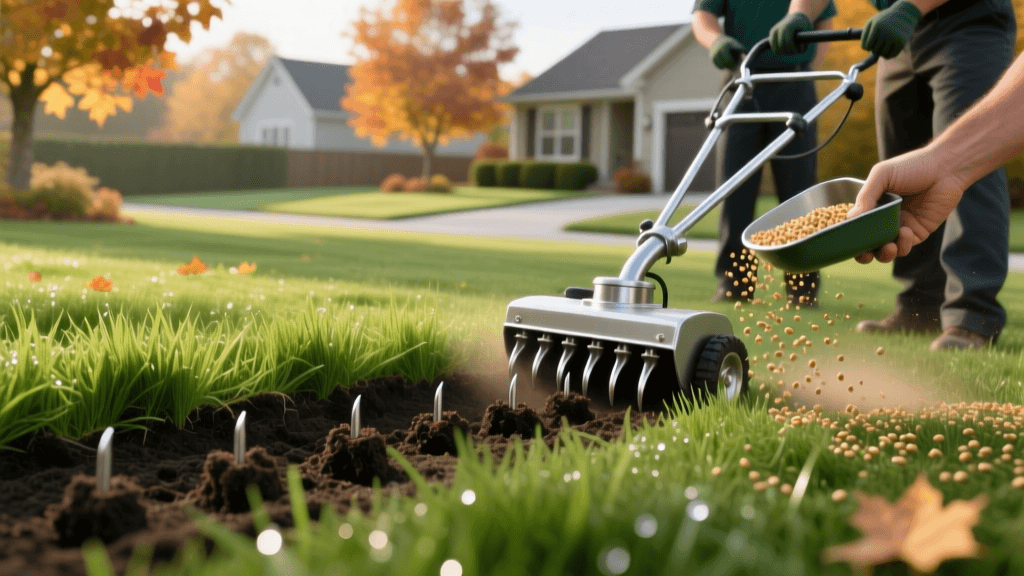
Soil compaction is the silent killer of urban and suburban lawns. Core aeration involves pulling 2 to 3-inch plugs of soil and thatch from the ground, allowing oxygen, water, and nutrients to penetrate the root zone. Early fall is the ideal time to pair aeration with overseeding, as the open soil cavities provide excellent seed-to-soil contact.
Actionable Advice:
- Equipment: Rent a walk-behind core aerator from a local hardware store. Expect to pay between $70 and $100 for a four-hour rental. Avoid spike aerators, as they can actually increase compaction below the spike depth.
- Seed Rates: For Tall Fescue, apply 5 to 8 pounds of seed per 1,000 square feet. For Kentucky Bluegrass, apply 2 to 3 pounds per 1,000 square feet. Always choose certified, weed-free seed with a germination rate above 85%.
- Starter Fertilizer: Apply a phosphorus-rich starter fertilizer (such as a 10-18-24 N-P-K ratio) immediately after seeding to promote rapid root development. Phosphorus is critical for early seedling establishment.
Step 2: Strategic Fall Fertilization
The concept of a 'winterizer' fertilizer has evolved over the years. Historically, homeowners were told to apply high-phosphorus and high-potassium fertilizers to 'harden' the grass for winter. Modern turfgrass science, however, emphasizes late-season nitrogen applications.
'Late fall fertilization is one of the most important practices for cool-season turfgrasses. Nitrogen applied in late October to early December promotes root growth, enhances carbohydrate storage, and leads to an earlier, healthier spring green-up without the excessive shoot growth associated with spring applications.' — Penn State University Extension, Department of Plant Science.
The Late-Fall Nitrogen Application:
Timing your final fertilizer application correctly is vital. You want to apply the fertilizer after the last mowing of the season, but before the ground freezes. The grass blades should be dormant (no longer growing vertically), but the soil must still be unfrozen so the roots can absorb the nutrients.
- Measurement: Apply exactly 1.0 to 1.5 pounds of actual Nitrogen per 1,000 square feet.
- Product Selection: Unlike early fall applications that benefit from slow-release nitrogen, the late-fall winterizer should utilize a fast-release, water-soluble nitrogen source like urea or ammonium sulfate. Because the grass is not actively growing top-growth, the fast-release nitrogen is immediately converted into stored carbohydrates in the root system. A common N-P-K ratio for this application is 32-0-10 or 24-0-10.
- Cost: A 50-pound bag of professional-grade winterizer fertilizer (like those from Lesco or SiteOne) typically costs between $35 and $50 and will cover roughly 12,000 to 15,000 square feet, making it highly cost-effective at roughly $0.003 per square foot.
Step 3: Adjusting Mowing Heights and Leaf Management
As temperatures drop, your mowing routine must adapt. Leaving grass too tall going into the winter invites fungal diseases like snow mold, while cutting it too short exposes the crown to freezing temperatures and desiccation.
Mowing Protocol:
Throughout September and early October, maintain your normal mowing height of 3.0 to 3.5 inches. As growth slows in November, gradually lower your mower deck by half an inch each week until you reach a final cutting height of 2.0 to 2.5 inches. This final cut prevents the grass blades from matting down under heavy snow loads.
Leaf Mulching vs. Bagging:
Do not let a thick layer of wet leaves smother your lawn, as this will block sunlight, trap moisture, and kill the grass beneath. Instead of spending hours raking and bagging, use a mulching mower to shred the leaves into dime-sized pieces. These micro-clippings will filter down to the soil surface, acting as a natural, nitrogen-rich compost that feeds earthworms and beneficial soil microbes throughout the winter. If the leaf cover is so thick that you cannot see the grass blades after mowing, you must alternate between mulching and using a bagger attachment to prevent suffocation.
Step 4: Broadleaf Weed Control and Hydration
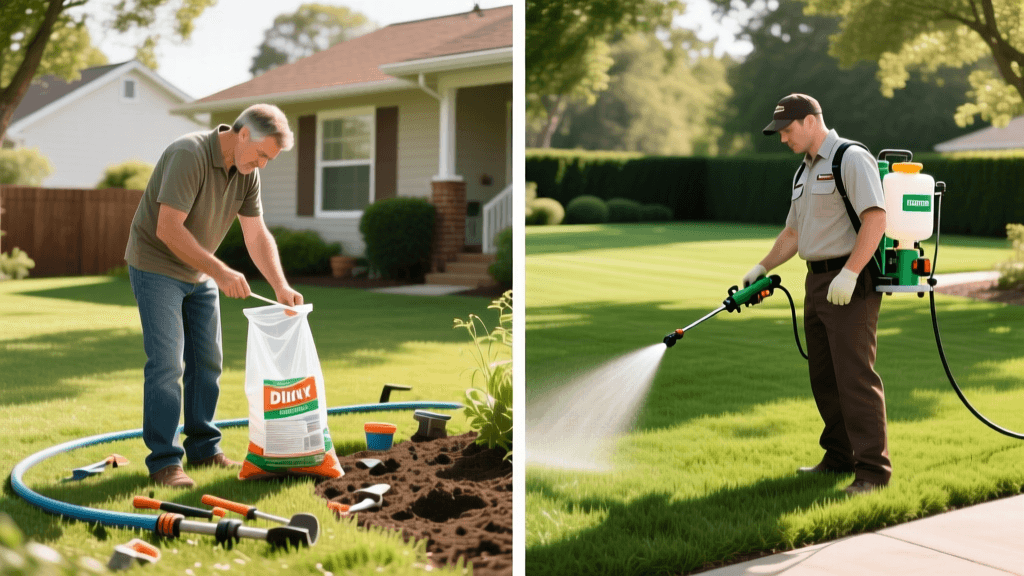
Fall is the absolute best time to eradicate perennial broadleaf weeds like dandelions, clover, and plantain. During the autumn months, these weeds are actively pulling nutrients down into their taproots to prepare for winter. When you apply a liquid post-emergent herbicide during this time, the plant absorbs the chemical and translocates it directly to the root system, ensuring a complete kill rather than just burning off the top growth.
- Herbicide Selection: Look for a three-way herbicide containing 2,4-D, Mecoprop (MCPP), and Dicamba. Products like Trimec or SpeedZone are highly effective and safe for most cool-season turfgrasses when applied at the labeled rates.
- Application Timing: Apply when daytime temperatures are consistently between 55°F and 75°F. Avoid spraying if rain is expected within 24 hours or if a hard freeze is imminent.
Winter Hydration:
A common misconception is that lawns do not need water once the air turns crisp. In reality, turfgrass continues to grow roots and store energy well into late autumn. Winter desiccation occurs when the grass loses more water through its leaves than it can take up through frozen roots. Ensuring the soil profile is fully saturated before the first hard freeze acts as a thermal buffer. Aim for 1 inch of water per week, including rainfall, right up until the ground begins to freeze. A well-hydrated lawn is significantly more resistant to winter desiccation and crown damage than a drought-stressed lawn.
Common Fall Lawn Care Mistakes to Avoid
- Applying Pre-Emergent Herbicides Before Overseeding: Pre-emergents like Prodiamine create a chemical barrier that stops all seeds from germinating, including your expensive grass seed. If you plan to overseed, skip the fall pre-emergent and rely on post-emergent spot treatments instead.
- Fertilizing Too Late: Applying nitrogen after the ground has frozen is a waste of money and an environmental hazard. The fertilizer will not be absorbed by the roots and will simply run off into local waterways during the spring snowmelt.
- Neglecting Soil Testing: Without a soil test from your local university extension office, you are guessing your lawn's pH and micronutrient needs. Fall is the perfect time to apply lime if your soil pH drops below 6.2, as it takes months for lime to alter soil chemistry. Calcitic lime adds calcium, while dolomitic lime adds both calcium and magnesium. A standard application rate is 50 pounds per 1,000 square feet, but always follow your specific soil test recommendations.
By following this comprehensive seasonal maintenance routine, you are not just preparing your lawn for winter survival; you are actively engineering a thicker, greener, and more disease-resistant turf for the following spring. Consistency and precise timing are the hallmarks of professional lawn health.