Lawn Care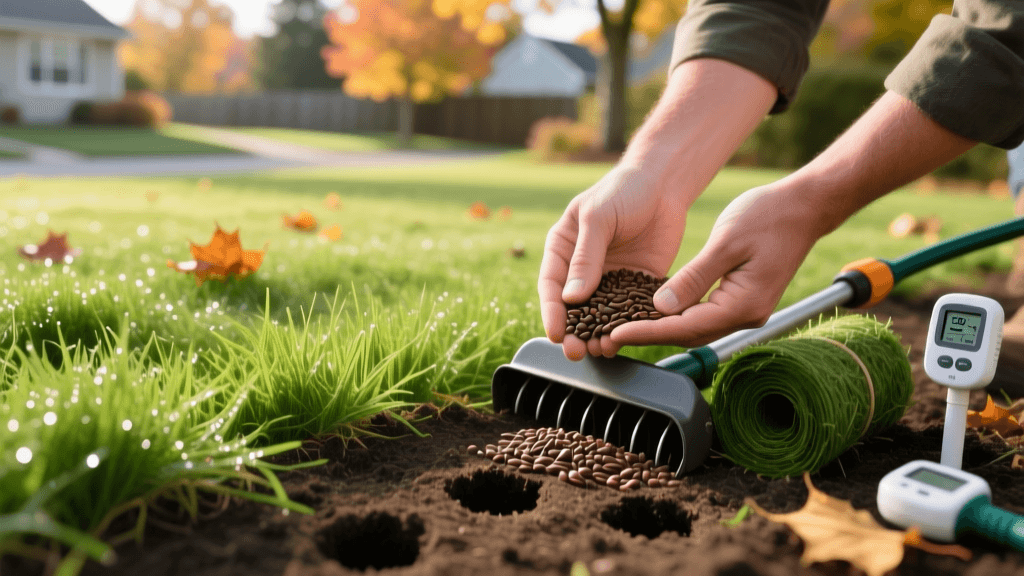
Expert Fall Overseeding Guide for Cool-Season Lawns
The Science of Timing: When to Overseed Cool-Season Grasses
For cool-season grasses like Kentucky Bluegrass, Tall Fescue, and Perennial Ryegrass, fall is not just an alternative to spring seeding; it is the undisputed optimal window. The fundamental reason lies in soil thermodynamics and weed competition. During late summer and early fall, soil temperatures remain warm from the summer heat (ideally between 50°F and 65°F), which accelerates seed germination. Simultaneously, daytime air temperatures begin to drop into the 60°F to 75°F range, reducing heat stress and evaporation rates.
Furthermore, fall seeding drastically reduces competition from aggressive summer annual weeds like crabgrass. According to the Purdue University Extension, late summer to early fall is the best time to establish cool-season lawns because the warm soil promotes rapid germination, while cooling air temperatures reduce environmental stress on young seedlings. Additionally, the root system has two full cool seasons and a spring to establish before facing the brutal heat of its first summer.
Regional Timing Chart for Fall Overseeding
To maximize your success rate, you must align your overseeding schedule with local soil temperatures rather than arbitrary calendar dates. Invest in a simple soil thermometer and measure the temperature at a depth of two inches in the morning.
| Region | Target Soil Temp | Ideal Calendar Window | First Frost Consideration |
|---|---|---|---|
| Northern US & Canada | 50°F - 60°F | Mid-August to Mid-September | Seed at least 45 days before first frost |
| Transition Zone | 55°F - 65°F | Early Sept to Early October | Seed at least 45 days before first frost |
| Pacific Northwest | 50°F - 60°F | Late August to Late September | Align with onset of fall rain cycles |
Step 1: Core Aeration and Soil Preparation
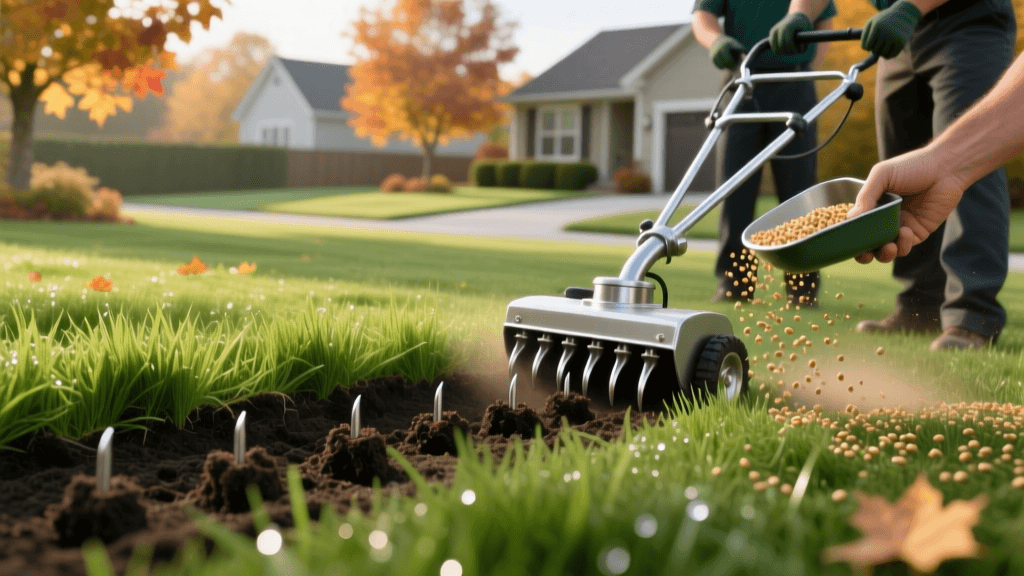
Overseeding directly onto an existing, compacted lawn is a common amateur mistake that leads to poor seed-to-soil contact and wasted money. Core aeration is a non-negotiable prerequisite for heavy clay soils or lawns experiencing high foot traffic.
Best Practices for Aeration
- Moisture Levels: Water the lawn deeply 24 hours before aerating. The soil should be moist but not muddy, allowing the aerator tines to penetrate 2.5 to 3 inches deep.
- Pattern: Make two passes over the lawn in perpendicular directions (e.g., North-South, then East-West) to ensure optimal plug density, aiming for 20 to 40 holes per square foot.
- Leave the Plugs: Do not rake up the soil cores. They will break down naturally over the next two weeks, returning beneficial microorganisms to the surface and helping to break down thatch.
- Cost Expectation: Renting a walk-behind core aerator typically costs between $80 and $120 for a half-day. Hiring a professional lawn care service averages $150 to $250 depending on lot size.
- Utility Check: Always call 811 a few days before aerating to mark shallow utility lines, and manually flag your sprinkler heads and valve boxes to avoid costly damage.
Step 2: Seed Selection and Application Rates
Choosing the correct cultivar and applying it at the proper rate is critical. Avoid cheap, generic seed mixes that contain annual ryegrass or excessive weed seeds. Look for tags indicating 0.00% weed seed and no noxious weeds.
Overseeding Rates by Grass Type
- Tall Fescue: 5 to 6 lbs per 1,000 sq ft. Ideal for high-traffic areas and the transition zone. Cultivar recommendations include Titan Ultra or Jonathan Green Black Beauty.
- Kentucky Bluegrass (KBG): 2 to 3 lbs per 1,000 sq ft. Best for northern climates where rhizomatous spreading is desired for a dense, carpet-like turf.
- Perennial Ryegrass: 4 to 5 lbs per 1,000 sq ft. Excellent for rapid germination (5-7 days) and erosion control, often used in mixtures with KBG.
Expert Tip: Use a broadcast spreader for the majority of the seed, but reserve 10% of your seed to hand-broadcast over bare spots or heavily shaded areas to ensure adequate coverage.
Step 3: Starter Fertilizer and Soil Amendments
Newly germinated seeds require immediate access to phosphorus for robust root development, a nutrient that is often restricted in standard lawn fertilizers due to environmental runoff concerns. Therefore, a specialized starter fertilizer is mandatory unless a recent soil test indicates excessive phosphorus levels.
Apply a high-phosphorus starter fertilizer, such as a 18-24-12 N-P-K blend (e.g., Scotts Turf Builder Starter Food or Lesco Professional Starter), on the exact same day as seeding. Apply at a rate of 1.0 lb of actual nitrogen per 1,000 sq ft. If your soil test from a local university extension indicates a pH below 6.0, incorporate pelletized calcitic lime at a rate of 50 lbs per 1,000 sq ft to optimize nutrient uptake. Incorporating a liquid humic acid or sea kelp supplement during the first watering can also reduce root shock and stimulate early microbial activity in the rhizosphere.
Step 4: The Expert Watering Protocol
Watering is the single most common point of failure in fall overseeding. The goal during the first 21 days is to keep the top one inch of soil consistently moist, not waterlogged.
Phase 1: Germination (Days 1 to 21)
Set your irrigation system to run 3 to 4 times a day for just 5 to 10 minutes per zone. The objective is to prevent the seed from drying out during the heat of the day. If the seed sprouts a root and then dries out, the seedling will die within hours. Morning, midday, and late afternoon cycles are ideal. Avoid watering after 4:00 PM to prevent fungal diseases like Pythium blight or brown patch, which thrive in cool, wet nighttime conditions.
Phase 2: Establishment (Days 22 to 45)
Once the new grass reaches a height of 2 inches, transition to deeper, less frequent watering. Reduce irrigation to once a day, then eventually to every other day, applying roughly 1/2 inch to 3/4 inch of water per session. This encourages the young roots to chase the moisture deeper into the soil profile, building drought resistance for the following summer.
Step 5: Mowing and Weed Control Restrictions
Patience is required when it comes to the first mow. Wait until the new grass reaches approximately 3.5 to 4 inches in height before mowing it down to 3 inches. Never remove more than one-third of the grass blade in a single pass, and ensure your mower blade is freshly sharpened to prevent tearing the delicate new seedlings out of the soil. During the first few mows, it is highly recommended to bag the clippings to prevent them from smothering the newly germinated seedlings and blocking vital sunlight.
Navigating Herbicide Restrictions
If you are dealing with an existing weed problem, you must plan carefully. Most broadleaf weed killers (like 2,4-D or Triclopyr) and pre-emergent crabgrass preventers (like Prodiamine or Dithiopyr) will kill or stunt new grass seed. As a general rule dictated by most chemical manufacturers, you must wait until the new grass has been mowed at least three to four times before applying any post-emergent herbicides. Conversely, if you applied a pre-emergent in the spring, you must wait until the chemical barrier has broken down—typically 60 to 90 days or after a specific accumulation of growing degree days—before overseeding, or utilize a seed-safe pre-emergent like Tenacity (Mesotrione) at the time of seeding.
Conclusion
Successful fall overseeding is a blend of precise timing, aggressive soil preparation, and meticulous watering. By treating your lawn as a living ecosystem and following these expert protocols, you will transform a thin, tired cool-season lawn into a dense, vibrant turf capable of outcompeting weeds and surviving environmental stressors for years to come.