Tree Care
Essential Fall and Winter Tree Care Maintenance Guide
Why Winterizing Trees is Crucial for Long-Term Health
Trees are resilient organisms, but the transition from autumn to winter introduces a unique set of environmental stressors that can severely compromise their health. While deciduous trees enter a state of dormancy and evergreens slow their metabolic processes, both remain highly vulnerable to freezing temperatures, desiccating winds, and drastic soil temperature fluctuations. Proper seasonal maintenance is not merely about aesthetics; it is a critical investment in the structural integrity and longevity of your landscape. In this comprehensive guide, we will explore the precise steps, products, and timing required to winterize your trees effectively, ensuring they emerge vibrant and healthy in the spring.
Late Fall Hydration: The Deep Watering Strategy
One of the most common misconceptions among homeowners is that trees do not need water once the leaves drop or the first frost arrives. In reality, winter desiccation—often called 'winter burn'—is a leading cause of tree mortality, particularly for newly planted specimens and broadleaf evergreens. When the ground freezes, roots are unable to draw moisture, yet harsh winter winds continue to pull water from the branches and needles.
According to the Colorado State University Extension, trees require deep, infrequent watering well into the late fall and even during winter dry spells. The general rule of thumb is to apply 10 gallons of water for every inch of the tree's trunk diameter. For a tree with a 3-inch caliper, this means 30 gallons per watering session.
How and When to Water
- Timing: Water only when the air temperature is above 40°F and there is no snow cover on the ground. Aim for mid-day watering so the moisture has time to soak into the soil before nighttime freezes.
- Equipment: Use a soaker hose (such as the Rain Bird 50-foot soaker hose, approx. $15) or a deep-root watering probe attached to your garden hose. Sprinklers are ineffective as they only wet the surface and promote ice crusting.
- Placement: Apply water at the drip line (the outer edge of the tree canopy) rather than directly at the trunk, as the most active absorbing roots are located in the top 12 inches of soil in this zone.
Mulching Techniques for Temperature Regulation
Mulch acts as an insulating blanket for the soil, moderating temperature extremes and retaining crucial moisture. However, improper mulching can lead to trunk rot and invite rodent damage. The 'volcano mulching' method—piling mulch high against the trunk—is a fatal error that suffocates the root flare and promotes fungal pathogens.
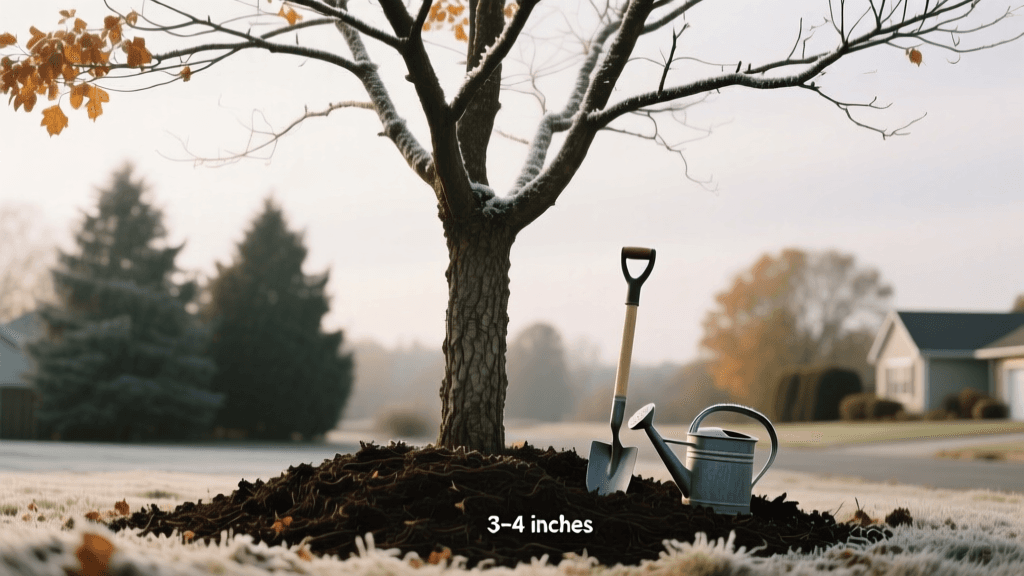
Instead, employ the 'donut' mulching technique. Spread a 2 to 4-inch layer of organic mulch, such as double-shredded hardwood bark or pine straw, extending from the trunk out to the drip line if possible. Crucially, keep the mulch at least 3 inches away from the actual trunk of the tree. A standard cubic yard of premium hardwood mulch costs between $30 and $45 and will cover approximately 100 square feet at a 3-inch depth.
'Proper mulching mimics the natural forest floor, providing a slow release of nutrients while buffering the soil against the freeze-thaw cycles that can heave shallow roots out of the ground.' — International Society of Arboriculture (ISA)
Protecting Trunks from Sunscald and Rodent Damage
Young trees with thin bark, such as maples, ash, crabapples, and honeylocusts, are highly susceptible to 'sunscald.' This occurs on sunny, freezing winter days when the bark on the south and southwest sides of the trunk heats up, activating dormant cells. When the sun sets and temperatures plummet, these cells freeze and burst, resulting in elongated, sunken cankers that can girdle and kill the tree.
To prevent this, wrap the trunks of newly planted and thin-barked trees with a commercial tree wrap or white plastic tree guard. Products like the DeWitt 4-inch by 150-foot tree wrap (approx. $18) or Arborguard corrugated plastic guards ($12-$25 depending on size) reflect sunlight and maintain a stable bark temperature. Wrap the trunk from the base up to the first set of lower branches, overlapping the wrap slightly as you move upward so water sheds off like shingles on a roof.
Crucial Reminder: You must remove these wraps in early spring as soon as the threat of hard freezes has passed. Leaving wraps on year-round traps moisture, encourages disease, and provides a hidden haven for boring insects.
Structural Pruning and Snow Load Management
Winter is the ideal time for structural pruning on most deciduous trees. Without leaves, the branching architecture is fully visible, allowing certified arborists to identify weak crotches, crossing branches, and deadwood. Removing compromised limbs before heavy winter snows and ice storms prevents catastrophic splitting that can tear into the main trunk.
According to the Trees Are Good consumer education platform by the ISA, dormant pruning also minimizes the risk of transmitting diseases like oak wilt or Dutch elm disease, as the insect vectors that carry these pathogens are inactive during the winter. Use sharp, sterilized bypass pruners and make clean cuts just outside the branch collar to promote rapid compartmentalization in the spring. Avoid using wound dressings or pruning paints, which research has shown actually impede the tree's natural healing process.
Comparison Chart: Deciduous vs. Evergreen Winter Care
| Care Aspect | Deciduous Trees (e.g., Oaks, Maples) | Evergreen Trees (e.g., Pines, Spruces) |
|---|---|---|
| Watering Needs | Deep water in late fall before ground freezes; minimal winter watering unless severe drought. | Requires consistent moisture through late fall and winter dry spells to prevent needle desiccation. |
| Pruning Timing | Best pruned during deep dormancy (late winter) to avoid disease and sap bleeding. | Prune lightly in late winter or early spring before new candle growth emerges. |
| Trunk Protection | Thin-barked species require wrapping to prevent sunscald and frost cracks. | Rarely require trunk wrapping; focus on protecting roots and needles. |
| Anti-Desiccants | Not required. | Highly recommended for broadleaf evergreens and newly planted conifers. |
Anti-Desiccant Sprays for Broadleaf Evergreens
Broadleaf evergreens, such as rhododendrons, hollies, and boxwoods, retain their foliage throughout the winter, meaning they continue to lose moisture through transpiration. When the ground is frozen, their roots cannot replace this lost water, leading to severe browning and dieback. The University of Minnesota Extension recommends the application of anti-desiccant sprays to coat the leaves with a protective, breathable polymer film.
Products like Bonide Wilt Stop or Cloud Cover Concentrate (typically $25 to $40 per bottle) are highly effective. These must be applied when the temperature is above freezing (ideally between 40°F and 50°F) and no rain is expected for 24 hours. For maximum protection, apply the first coat in late November or early December, and a second maintenance coat in mid-to-late January. Ensure you thoroughly spray the undersides of the leaves where the majority of the stomata (pores) are located.
Conclusion
Seasonal tree maintenance is a proactive discipline that pays dividends for decades. By implementing a strategic fall and winter care regimen—focusing on deep hydration, proper mulching, trunk protection, and targeted pruning—you shield your landscape from the harshest elements of the cold season. Investing a small amount of time and resources into winterizing your trees today guarantees a safer, more beautiful, and highly resilient canopy for years to come.