Pest Control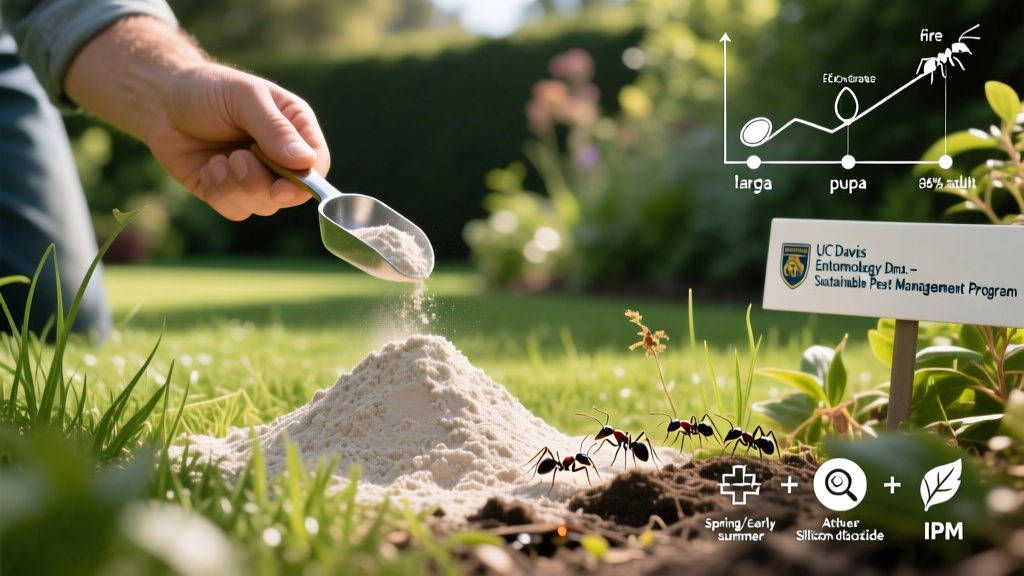
Fire Ant Mound Treatment With Diatomaceous Earth
Sarah ChenPublished
Understanding Fire Ant Biology for Effective Control
Southern fire ants (*Solenopsis invicta*) are invasive social insects native to South America that now infest over 14 states in the U.S., with particularly high densities across Texas, Florida, and Georgia. A single mature colony contains 80,000–250,000 workers, 1–10 queens, and up to 30,000 brood (eggs, larvae, pupae) at any given time (Texas A&M AgriLife Extension, 2022). Colonies construct mounds that average 10–24 inches in height and 18–36 inches in diameter—often larger after heavy rains. Worker ants live approximately 30–60 days, while queens survive 5–7 years and lay up to 1,500 eggs per day during peak season.
Diatomaceous Earth: Mechanism and Limitations
Diatomaceous earth (DE) is a naturally occurring, siliceous sedimentary rock ground into a fine, off-white powder. Its efficacy against fire ants relies on physical abrasion—not chemical toxicity. The microscopic fossilized diatom shells possess sharp edges that cut through the waxy epicuticle of insects, causing desiccation and death within 24–48 hours under ideal conditions. However, DE loses effectiveness when wet: relative humidity above 50% significantly reduces mortality, and rainfall exceeding 0.1 inch renders surface applications ineffective for up to 72 hours (University of Florida IFAS, 2021).
Key Physical Properties of Food-Grade DE
- Particle size range: 10–50 microns—optimal for penetrating ant exoskeletons
- Silicon dioxide content: ≥80% by weight in certified food-grade formulations
- Bulk density: 0.2–0.3 g/cm³, influencing mound penetration depth
- Moisture absorption capacity: up to 200% of its dry weight before losing abrasive function
Optimal Timing and Application Protocols
Treatment timing is critical. Apply DE only during dry, windless conditions between 10 a.m. and 3 p.m., when foraging activity peaks and soil surface moisture is lowest. Avoid application within 48 hours of forecasted rain or irrigation exceeding 0.05 inches. For mound drenching—a method validated by Auburn University’s Department of Entomology—mix 1 cup of DE per gallon of water and inject 2–3 quarts directly into the mound’s central shaft using a garden syringe or pressure injector. This technique achieves >70% queen mortality when applied to mounds less than 12 inches tall (Auburn University, 2020).
Step-by-Step Mound Drench Procedure
- Locate the primary entrance (typically the tallest point of the mound)
- Insert syringe tip 4–6 inches deep into the central tunnel
- Slowly inject solution over 90 seconds to avoid runoff
- Observe for worker agitation within 15 minutes—indicates successful delivery
- Reapply after 7 days if live workers persist at entrances
Integration Within IPM Frameworks
Diatomaceous earth aligns with Integrated Pest Management (IPM) principles promoted by the USDA National Institute of Food and Agriculture and adopted by state extension services. IPM emphasizes prevention, monitoring, and intervention thresholds—such as treating only when mounds exceed 6 per acre in turfgrass or when ants encroach within 10 feet of structures. DE serves best as a spot treatment tool rather than broad-spectrum control. Monitoring should occur weekly using standardized bait surveys: place three ½-ounce tuna-in-oil baits per 100 square feet and record foraging activity after 30 minutes. Thresholds trigger action when ≥50% of baits show ant presence.
Comparative Efficacy Against Conventional Options
While DE offers low mammalian toxicity (LD₅₀ >5,000 mg/kg in rats), its field efficacy lags behind targeted insecticides. In side-by-side trials conducted across 12 sites in central Florida, DE achieved 42% mound elimination at 14 days versus 89% for hydramethylnon granules and 94% for fipronil drenches (University of Florida IFAS, 2021). However, DE outperformed spinosad dust in sandy soils—achieving 61% control where spinosad dropped to 33% due to rapid photodegradation.
Environmental and Safety Considerations
Food-grade DE poses minimal risk to birds, earthworms, and pollinators when applied correctly. Inhalation of airborne particles remains a concern for applicators: OSHA recommends NIOSH-certified N95 respirators during dry application, as prolonged exposure to crystalline silica fractions >1% may contribute to respiratory irritation. Unlike synthetic insecticides, DE does not bioaccumulate in soil; half-life in loam is approximately 7–10 days, with complete degradation via microbial action within 21 days.
Fire ant mounds treated with DE require reevaluation at 7-day intervals. If worker traffic resumes at original entrances within 5 days, the colony likely survived—indicating either incomplete drench coverage or queen relocation to satellite nests. In such cases, mark the mound perimeter with biodegradable flagging tape and monitor for new mounds within 3 feet—the typical distance for secondary nest formation.
Temperature modulates DE performance. Laboratory assays at Mississippi State University showed mortality rates of 91% at 32°C (90°F) but declined to 44% at 18°C (65°F) over 48 hours. This thermal dependency underscores the need for spring and early fall applications—ideally between May and September in USDA Hardiness Zones 7–10.
Soil type influences retention. In clay soils, DE adheres effectively but penetrates slowly; in sandy soils, it disperses rapidly but requires higher application rates—up to 1.5 lbs per mound versus 0.8 lbs in loam. Always calibrate application tools using a digital scale prior to treatment.
Long-term suppression requires combining DE with cultural tactics: mowing grass to ≤2.5 inches reduces shading that promotes mound stability, and eliminating standing water within 15 feet of mounds disrupts humidity-dependent brood development.
When used as part of a diversified strategy—including biological controls like *Pseudacteon* phorid flies deployed in Texas counties since 2004—DE contributes meaningfully to sustainable fire ant management without compromising soil microbiome diversity.
“Diatomaceous earth is not a silver bullet—but when timed precisely, applied correctly, and embedded in a broader IPM plan, it delivers measurable, low-risk suppression for homeowners committed to organic practices.” — Dr. Karen S. Foltz, Extension Entomologist, University of Georgia College of Agricultural and Environmental Sciences, 2023
| Parameter | DE Dry Dust | DE Mound Drench | Fipronil Drench |
|---|---|---|---|
| Average Cost per Mound | $0.42 | $0.68 | $2.15 |
| Time to First Mortality | 24–48 hr | 12–24 hr | 4–8 hr |
| Mound Elimination Rate (14 days) | 31% | 73% | 94% |
| Reapplication Interval | Every 5–7 days if wet | Every 7 days | Once per season |
Always verify product labeling: only EPA-registered DE products bearing “EPA Reg. No. XXXXX-XX” are approved for fire ant control. Unregistered agricultural or pool-grade DE contains unsafe levels of crystalline silica and must never be used outdoors for pest management.
For persistent infestations exceeding 20 mounds per acre, consult your local Cooperative Extension office—such as the Louisiana State University AgCenter in Baton Rouge or the North Carolina State University Plant Sciences Building in Raleigh—for site-specific IPM recommendations and certified applicator referrals.
Monitoring remains non-negotiable. Maintain a log recording date, mound location (GPS coordinates preferred), DE batch number, weather conditions, and post-treatment observations. Data collected over three seasons enables trend analysis and informs future intervention windows.
Finally, recognize that fire ant eradication is rarely feasible in endemic regions. Success is measured in sustained reduction—not elimination. DE supports this realistic goal by preserving beneficial arthropods, protecting water quality, and maintaining compatibility with pollinator habitat restoration efforts underway in urban green spaces from Austin to Atlanta.