Pest Control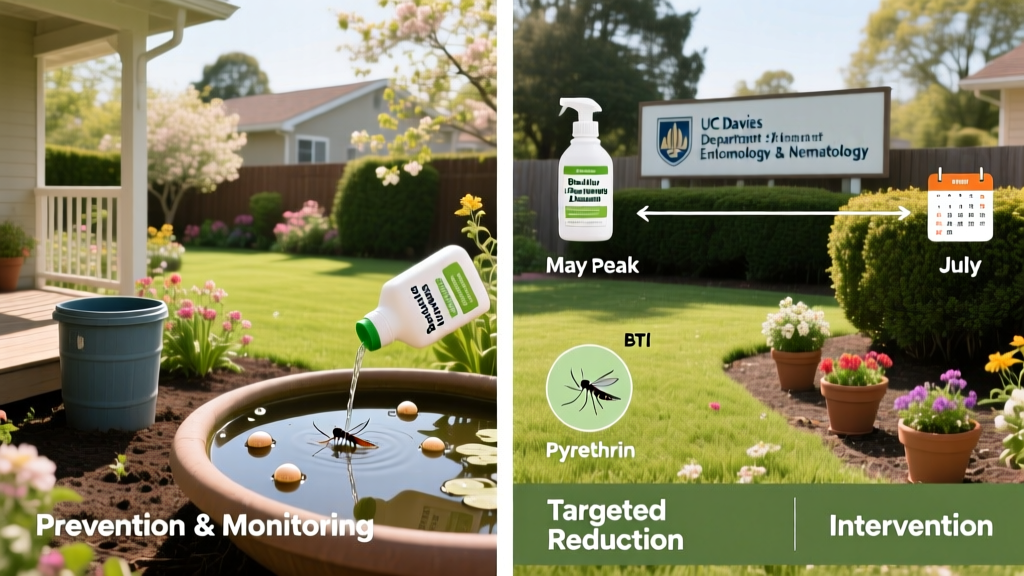
Mosquito Control In Yard With Larvicide And Habitat...
Understanding the Mosquito Lifecycle to Time Interventions Correctly
Mosquitoes undergo complete metamorphosis—egg, larva, pupa, and adult—with each stage lasting a predictable duration under typical summer conditions. Eggs hatch within 24–48 hours after submersion in water; larvae feed on microorganisms for 4–10 days before pupating; pupae remain aquatic for 2–3 days before emerging as adults. In Central Florida, where average July water temperatures reach 28°C (82°F), the entire lifecycle from egg to biting adult can be completed in as few as 7 days—a critical factor when planning control timing (University of Florida IFAS Extension, 2022). This rapid development means that untreated standing water can produce multiple overlapping generations per month during peak season.
Larval development is temperature-dependent: at 20°C, it takes ~12 days; at 30°C, just ~5.5 days. Larvae require oxygenated water surfaces and cannot survive in water deeper than 15 cm without surface access—making shallow depressions especially hazardous. Female Aedes albopictus prefer containers holding ≤ 1 liter of water, while Culex quinquefasciatus favors polluted, stagnant water in ditches or catch basins exceeding 5 cm depth. Understanding these species-specific preferences allows precise targeting of larvicide applications and habitat modifications.
Targeting Breeding Sites Through Habitat Reduction
Habitat reduction remains the most cost-effective and ecologically sound foundation of mosquito management. A 2021 Rutgers University study documented a 68% average reduction in larval density across suburban yards after implementing weekly source reduction protocols—without any chemical intervention. Key actions include eliminating standing water in gutters (which hold an average of 2.3 liters per linear meter when clogged), emptying plant saucers every 3 days, and cleaning roof downspout extensions to prevent pooling in clay soil (which retains water for up to 96 hours post-rainfall).
High-Risk Yard Features and Mitigation Strategies
- Ornamental ponds: Install aerators to maintain dissolved oxygen >5 mg/L—larvae cannot survive below 2 mg/L
- Rain barrels: Fit with fine-mesh screens (≤0.5 mm aperture) to block adult oviposition
- Unused tires: Store upright and covered—tires hold an average of 3.7 liters of water and account for 42% of Aedes breeding sites in urban Atlanta surveys (CDC, 2020)
- Tree holes: Fill cavities ≥2 cm deep with expanding foam or sand; monitor quarterly
Selecting and Applying Larvicides Based on Site Conditions
Larvicides fall into two broad categories: biological agents (e.g., Bacillus thuringiensis israelensis [Bti]) and insect growth regulators (IGRs) like methoprene. Bti produces crystal proteins toxic only to dipteran larvae and degrades within 24–48 hours in sunlight; methoprene mimics juvenile hormone, preventing pupation and persisting up to 30 days in shaded water. Both are EPA-registered and classified as reduced-risk pesticides by the U.S. Environmental Protection Agency.
Application timing must align with larval presence—not rainfall. In coastal South Carolina, monitoring with dip nets reveals peak larval abundance 48–72 hours after rain events, making this the optimal treatment window. Over-application wastes product and increases resistance risk; under-application fails to cover the full surface area. For example, Bti granules (e.g., VectoBac® WG) require 1.0–2.5 g per 10 m² of surface area depending on organic load—exceeding 3 g/10 m² provides no added efficacy but raises environmental loading.
Integrating Larvicides with Broader IPM Protocols
Effective mosquito control follows Integrated Pest Management (IPM) principles outlined by the National Pesticide Information Center and endorsed by land-grant universities including Oregon State University’s Integrated Plant Protection Center. IPM emphasizes monitoring, threshold-based action, and least-toxic interventions first. At the University of California Davis, researchers demonstrated that combining weekly habitat inspection with targeted Bti application reduced adult trap counts by 74% over 12 weeks—significantly outperforming adulticiding alone.
Monitoring Tools and Thresholds
- Dipper sampling: 10 dips per site; action threshold = ≥5 late-instar larvae per dip
- Gravid trap deployment: placed near vegetation; threshold = ≥10 females captured in 24 hours
- Larval bioassays: test local populations annually for Bti sensitivity—resistance is confirmed if LC₅₀ exceeds 1.2 IU/mL (Clemson University Entomology Department, 2023)
Product Comparison and Application Best Practices
Choosing between formulations depends on water volume, exposure, and persistence needs. Liquid Bti (e.g., Aquabac® 200G) works best in small, temporary pools (<50 L), while slow-release briquettes (e.g., Summit® Mosquito Dunks®) suit ornamental ponds up to 100 m². Methoprene liquid (Altosid® XR) is ideal for stormwater basins with fluctuating levels, maintaining efficacy even after 5 cm of rainfall dilution.
Application errors undermine effectiveness. Spraying larvicide onto dry soil or turf—rather than directly onto water surfaces—reduces active ingredient delivery by >90%. Similarly, applying Bti to water with turbidity >100 NTU (common in algae-bloom conditions) cuts larval mortality from 99% to 31% due to particle binding. Always calibrate applicators using graduated cylinders and verify coverage with fluorescent dye tracer tests.
“Larviciding without concurrent habitat reduction is like mopping the floor while the faucet runs. Sustainable control requires stopping production at the source—then suppressing what emerges.” — Dr. Elena Rodriguez, Senior Entomologist, Texas A&M AgriLife Extension Service, 2021
Evaluating Efficacy and Avoiding Resistance Development
Assess control success 72 hours post-application using standardized dip counts. Effective treatment yields ≥95% larval mortality. If mortality falls below 80%, investigate possible causes: incorrect dosage, UV degradation (Bti loses 40% potency after 6 hours of direct sun), or resistance. Rotate larvicide modes of action annually—e.g., alternate Bti one year with diflubenzuron (a chitin synthesis inhibitor) the next—to delay resistance. Field studies in New Jersey documented Bti resistance in Culex pipiens populations after five consecutive years of unrotated use (Rutgers Cooperative Extension, 2022).
Long-term success also depends on community-scale coordination. In the City of Cary, North Carolina, a neighborhood-wide source-reduction program achieved sustained larval reductions of 89% over three seasons—demonstrating that individual efforts multiply when synchronized. Residents received free mesh screens, tire disposal vouchers, and biweekly inspection reports via a GIS-mapped dashboard developed with NC State University’s Vector-Borne Disease Program.
| Active Ingredient | Target Stage | Half-Life in Water | Max Application Rate (per 100 m²) | Re-Entry Interval |
|---|---|---|---|---|
| Bacillus thuringiensis israelensis (Bti) | Larvae only | 24–48 hours | 25 g granular | 0 hours |
| Methoprene | Larvae & pupae | 14–30 days | 10 g granular | 12 hours |
| Diflubenzuron | Larvae only | 7–10 days | 5 g granular | 24 hours |
Organic options such as garlic oil emulsions show limited field efficacy—only 33% larval mortality at labeled rates—and are not recommended for primary control. Meanwhile, copper sulfate, though historically used, poses unacceptable risks to aquatic invertebrates and is prohibited in certified organic landscapes per USDA National Organic Program standards. Always consult your state’s Department of Agriculture for label-compliant use; for instance, California restricts methoprene use within 30 meters of sensitive aquatic habitats, while Minnesota permits broader application in rural zones.
Record-keeping is essential: log date, location, product name, lot number, rate applied, weather conditions, and pre-/post-treatment larval counts. These records support adaptive management and satisfy reporting requirements for municipalities participating in the CDC’s Enhanced Mosquito Surveillance Program. When combined with habitat elimination, properly timed larvicide use reduces reliance on adult-targeted pyrethroids—lowering non-target impacts on pollinators and beneficial insects by up to 62% (University of Vermont Extension, 2023).
Finally, remember that no single tactic eliminates mosquitoes permanently. Consistent monitoring, community engagement, and adherence to university-backed IPM frameworks—from the University of Florida’s Mosquito Management Guidelines to Oregon State’s Pacific Northwest Pest Management Handbook—provide the durable, science-grounded foundation needed for long-term yard-level control.