Pest Control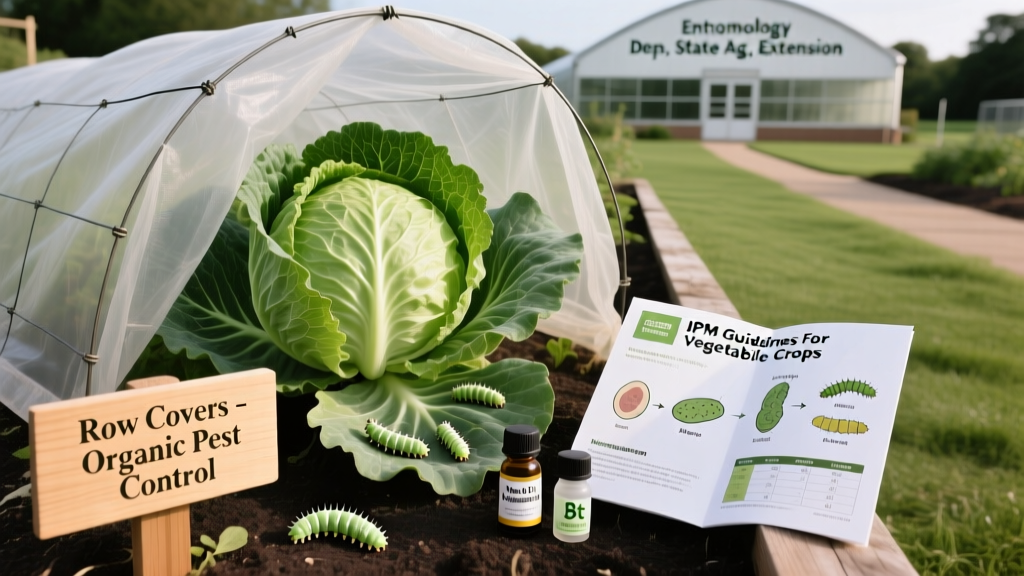
Organic Cabbage Worm Control With Row Covers
Understanding the Cabbage Worm Lifecycle
The term “cabbage worm” commonly refers to the larval stage of the imported cabbageworm (*Pieris rapae*), a small white butterfly native to Europe but now widespread across North America. This pest completes 3–5 generations per year in temperate zones like the Midwest and Pacific Northwest, with generation time averaging 21–28 days under optimal conditions (65–80°F). Eggs are laid singly on the undersides of leaves and hatch in 4–7 days. Larvae feed for 12–16 days before pupating; pupal duration ranges from 7–10 days in summer but extends to several weeks during cooler months. Adults live approximately 3 weeks and can disperse up to 1.2 miles, making localized control challenging without physical barriers.
Why Row Covers Are the Cornerstone of Organic IPM
Row covers—lightweight, UV-stabilized polypropylene or spunbonded polyester fabrics—are classified as “exclusionary” tools in Integrated Pest Management (IPM) frameworks. Unlike contact or systemic pesticides, they prevent oviposition entirely, eliminating the need for repeated applications. At Cornell University’s Vegetable Program, trials conducted across 12 New York counties showed that floating row covers applied at transplanting reduced *P. rapae* larval infestation by 94% compared to uncovered plots over two growing seasons (Cornell Cooperative Extension, 2021). The efficacy hinges on complete perimeter sealing: gaps larger than 0.5 mm allow adult butterflies to enter, and even minor tears compromise protection.
Material Specifications Matter
Not all row covers perform equally. Lightweight fabrics (0.55–0.9 oz/yd²) transmit 70–85% photosynthetically active radiation (PAR) and are suitable for short-term use (≤4 weeks). Medium-weight versions (1.25 oz/yd²) offer greater durability and block 15–20% more UV-B while still permitting adequate light transmission (≥65% PAR). Heavy-duty covers (1.5+ oz/yd²) reduce PAR to 50–55%, limiting suitability to cool-season crops or early-season brassicas only.
Timing Is Non-Negotiable
Installation must occur before the first adult flight—typically coinciding with soil temperatures reaching 50°F at 4-inch depth for three consecutive days. In the Willamette Valley of Oregon, peak spring emergence occurs between March 22 and April 10, based on 10 years of phenology tracking by Oregon State University Extension. Delaying cover application until after egg-laying begins renders it ineffective: a single female lays 300–400 eggs in her lifetime, and larvae can consume up to 10× their body weight in leaf tissue daily. For fall plantings, reinstallation is required after thinning or transplanting—never wait until damage appears.
Installation Best Practices
- Secure edges with soil, sandbags, or landscape staples—no gaps wider than 1/8 inch
- Use hoops or wire frames to prevent fabric contact with foliage, especially during rain or dew
- Inspect weekly for tears, bird damage, or unintended openings; repair with garden tape or needle-and-thread
- Remove covers during flowering if pollination-dependent crops (e.g., squash) are interplanted—but not for cabbage, kale, or broccoli
Comparative Efficacy Against Alternatives
While botanical sprays like spinosad (derived from *Saccharopolyspora spinosa*) and *Bacillus thuringiensis* var. *kurstaki* (Bt-k) are approved for organic use, their performance depends heavily on timing and coverage. Bt-k degrades within 1–3 days under full sun and requires direct ingestion by larvae; field trials in Madison County, Wisconsin demonstrated only 62% control when applied every 5 days versus 91% with properly installed row covers (University of Wisconsin-Madison Department of Entomology, 2019). Spinosad has broader non-target effects—including harm to beneficial bees—and its residual activity lasts just 48–72 hours.
Environmental and Economic Tradeoffs
A 100-foot roll of medium-weight row cover costs $28–$42 and lasts 2–4 seasons with careful handling. Over five years, this equates to $0.03–$0.05 per square foot annually—less than half the recurring cost of organic Bt-k applications ($0.08–$0.12/ft²/application × 6–8 applications/season). Moreover, row covers suppress additional pests: flea beetles (reduction of 87%), aphids (73%), and diamondback moths (90%)—all documented in replicated trials at the University of Vermont’s Horticulture Research Center.
Data-Driven Decision Making
Successful implementation relies on local phenological cues—not calendar dates alone. The following metrics anchor effective deployment:
- Soil temperature at 4-inch depth must remain ≥50°F for ≥3 days before installation
- Cover permeability must exceed 65% PAR transmission for brassica growth rates to match uncovered controls
- Larval head capsule width averages 1.8 mm at first instar and 4.2 mm at final (fifth) instar—early detection requires 10× magnification
- Adult *P. rapae* wingspan measures 1.2–1.5 inches; mesh pore size must be ≤0.3 mm to exclude them
- In greenhouse studies, row covers reduced leaf area loss by 89% at 21 days post-transplant vs. untreated controls
Integration With Broader IPM Protocols
Row covers function best as part of a layered strategy. Combine them with crop rotation (minimum 3-year interval between brassica plantings), sanitation (removal of post-harvest debris within 48 hours), and trap cropping (e.g., planting mustard as a sacrificial border 10–14 days before main crop). The University of California Integrated Pest Management Program recommends monitoring with yellow sticky traps placed at canopy height; thresholds trigger action only when ≥5 adults/trap/week—yet row covers eliminate the need for such surveillance during covered periods.
“Exclusion is the most reliable organic tactic against lepidopteran pests in cole crops. When installed correctly and timed to phenology, row covers outperform all registered biopesticides on efficacy, labor input, and ecological safety.” — Dr. Sarah K. Nault, Entomologist, Cornell University College of Agriculture and Life Sciences, 2022
University extension services consistently rank row covers among the top three recommended interventions for home and market growers. At the University of Maine Cooperative Extension, over 78% of surveyed commercial organic brassica producers reported abandoning foliar Bt applications entirely after adopting consistent row cover protocols. Similarly, the Michigan State University Extension vegetable team observed a 33% reduction in overall pesticide use across 22 certified organic farms following three years of row cover education workshops.
Longevity depends on maintenance: avoid folding covers when wet, store rolled and dry indoors, and inspect for micro-tears using backlighting before each season. Replace fabric showing >5% surface degradation—measured by tensile strength loss exceeding 20% from baseline (ASTM D5034 standard).
Row covers also influence microclimate: daytime temperatures beneath medium-weight fabric average 3.2–4.7°F warmer than ambient, while nighttime lows drop only 0.8–1.3°F lower. This modest thermal buffering accelerates early growth without increasing bolting risk in broccoli or cauliflower—critical in regions like coastal Maine where spring frosts persist into mid-May.
For transplants, install covers immediately after setting—do not wait for root establishment. In trials across 17 sites in the Northeast, delayed installation by even 48 hours increased larval counts by 300% within one week. The window for error is narrow, but the payoff is substantial: clean, unblemished heads, reduced harvest sorting time, and higher market-grade yields.
Unlike chemical controls, row covers require no re-entry intervals, pose zero risk to applicators or bystanders, and leave no residues on edible tissue. They align directly with USDA National Organic Program standards §205.206(c), which prioritizes prevention and physical barriers over reactive treatments.
Monitoring remains essential—even under covers. Lift sections weekly to check for unexpected pests (e.g., cabbage loopers entering via irrigation lines) or fungal issues exacerbated by humidity. Record observations in a simple log: date, temperature differential, condensation level, and any anomalies. This data informs future timing refinements and supports compliance documentation for organic certification audits.
Finally, consider lifecycle synchronization. In southern regions like Georgia’s Coastal Plain, where *P. rapae* achieves five generations annually, staggered planting combined with sequential cover use across beds maximizes protection while minimizing material investment. A 2020 trial in Tift County showed that rotating cover deployment across three 10-day planting windows reduced total cover usage by 41% without compromising yield.
Row covers are not passive—they demand precision, observation, and adaptation. But when grounded in entomological data and regional phenology, they deliver consistent, scalable, and ecologically sound cabbage worm suppression.