Tree Care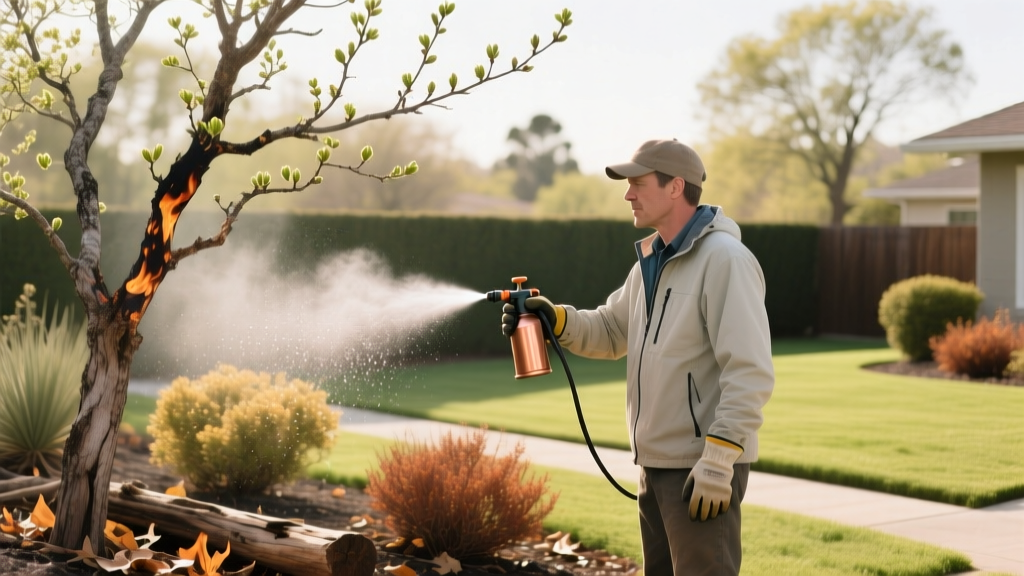
Fire Blight ID and Copper Spray Prevention 2026
Lisa ThompsonPublished
The Intersection of Plant Pathology and Wildfire Defense
When homeowners think of fire-resistant landscaping, they typically envision hardscaping, irrigated lawns, and carefully spaced, low-saponin shrubs. However, one of the most critical threats to a defensible space is biological rather than environmental. Fire blight, a destructive bacterial disease caused by Erwinia amylovora, creates rapid canopy dieback that transforms healthy shade trees into vertical columns of flash fuel. In 2026, as spring temperatures fluctuate and erratic rainfall patterns create ideal breeding grounds for bacteria, managing fire blight is no longer just an orchard concern—it is a vital component of wildfire mitigation for residential landscapes.
Identifying Fire Blight: The "Scorched" Illusion
The name "fire blight" is notoriously misleading in the context of fire-resistant landscaping. The disease does not result from heat or flames; rather, it earns its name because infected trees look as though they have been scorched by a blowtorch. According to the Colorado State University Extension, the bacteria primarily attack members of the Rosaceae family, including ornamental pears (such as the ubiquitous Bradford pear), crabapples, hawthorns, and pyracantha.
Key Symptoms to Monitor in 2026
- The Shepherd’s Crook: The most iconic symptom is the wilting and bending of the terminal shoot, forming a shape resembling a shepherd's crook. This occurs as the bacteria destroy the vascular tissue, cutting off water to the growing tip.
- Scorched Foliage: Leaves turn brown to black but remain firmly attached to the dead twigs. In a defensible space, these retained, desiccated leaves act as fine, highly combustible kindling.
- Bacterial Ooze: During warm, humid spring days, you may notice amber-colored droplets of bacterial ooze exuding from cankers on the trunk or older branches. This ooze is easily transported by pollinators, rain splash, and pruning tools.
- Canker Margins: On the main trunk, look for slightly sunken, darkened areas of bark. If you carefully peel back the outer bark, the underlying cambium will appear reddish-brown and water-soaked, contrasting sharply with healthy white or green tissue.
The Defensible Space Hazard: Ladder Fuels and Snags
Why does a bacterial disease matter for wildfire defense? The core principle of the Home Ignition Zone (the 30 to 100 feet immediately surrounding your home) is the elimination of continuous fuel pathways. Fire blight directly violates this principle.
When a mature ornamental pear or crabapple is infected, the resulting deadwood often remains in the canopy for months or even years. These dead branches, heavily laden with dry, retained leaves, create "ladder fuels." If a wind-blown ember from a distant wildfire enters your yard, it can ignite these elevated snags. Once the canopy catches fire, the flames are immediately elevated, bypassing ground-level defensible space barriers and directly threatening your roof and eaves. Furthermore, the stress of a fire blight infection causes trees to drop excessive amounts of dead twigs and bark, increasing the fine fuel load on the ground directly beneath the canopy.
Copper Spray Prevention: Products and Application
Because Erwinia amylovora is a bacterium, traditional fungal disease treatments are ineffective. Prevention relies heavily on copper-based bactericides, which work by releasing copper ions that denature bacterial proteins and disrupt cell membranes. For 2026, integrated pest management (IPM) protocols emphasize using copper sprays strategically to protect vulnerable bloom periods without causing phytotoxicity (leaf and fruit damage).
According to Penn State Extension, timing is everything. Copper is a protectant, not a cure; it must be on the bark and bud scales before the bacteria are introduced by rain or insects.
2026 Copper Bactericide Comparison Chart
| Product Type | Active Ingredient | Best Application Timing | Relative Cost (2026) | Notes for Landscapes |
|---|---|---|---|---|
| Bordeaux Mixture | Copper sulfate + hydrated lime | Dormant season (Late Winter) | $ | Excellent for overwintering cankers. Can leave a visible white residue on bark. |
| Kocide 3000 / Champ | Copper hydroxide | Early bloom (Pink bud stage) | $$ | Highly effective but carries a risk of fruit russetting on edible apples and pears. |
| Cueva / Camelot | Copper octanoate (Copper soap) | Bloom and early shoot growth | $$$ | Lower risk of phytotoxicity. Preferred for organic residential landscapes and sensitive ornamentals. |
Application Best Practices
- Dormant Sprays: Apply a higher-concentration Bordeaux mixture or fixed copper in late winter, just before bud swell. This targets the overwintering bacteria residing in the margins of active trunk cankers.
- Bloom Sprays: If your area experiences warm (75°F to 85°F), wet weather during the bloom period, the risk of infection spikes. Apply a lower-concentration copper octanoate or copper hydroxide spray at the "pink bud" stage and repeat every 5 to 7 days if wet conditions persist until petal fall.
- Avoid Overuse: Repeated application of metallic copper during the growing season can cause severe leaf drop and fruit russetting. Always follow the 2026 label rates precisely.
Pruning Protocols for Blighted Wood
If prevention fails and fire blight establishes itself in your landscape trees, aggressive and sanitary pruning is the only way to save the tree and remove the fire hazard. The bacteria can move rapidly down the branch into the main trunk, especially in highly susceptible species like the Bradford pear.
The 12-Inch Rule and Tool Sterilization
When pruning out infected wood, you must cut at least 12 to 18 inches below the lowest visible margin of the canker or necrotic tissue. Because the bacteria travel internally through the xylem and phloem before visible symptoms appear, cutting too close will leave the infection behind.
Critical Warning: Pruning tools become heavily contaminated with Erwinia amylovora. If you do not sterilize your tools between cuts, you will manually inoculate healthy branches, rapidly destroying the tree's canopy and creating massive amounts of dead fuel. Between every single cut, wipe your pruning saws and loppers with 70% isopropyl alcohol or a 10% bleach solution. (Note: Bleach can corrode metal tools, so oil your blades immediately after finishing your pruning session).
The "Ugly Stub" Method
For infections on the main trunk or major scaffold limbs where a 12-inch cut is impossible, arborists recommend the "ugly stub" method. Cut the infected branch 8 to 12 inches away from the trunk, leaving an ugly stub. The bacteria cannot easily move past the base of the branch collar into the main trunk. A year later, once the blight is no longer active, you can return and make a clean, flush pruning cut to remove the stub.
Long-Term Landscape Resilience: Selecting Resistant Cultivars
The ultimate fire-resistant landscaping strategy is to eliminate the threat before it begins. If you are replacing trees in your defensible space in 2026, avoid highly susceptible species like the Callery (Bradford) pear, which is not only prone to severe fire blight but also structurally weak, creating physical storm hazards.
Instead, opt for blight-resistant cultivars that maintain a healthy, green, moisture-rich canopy. For edible and ornamental apples, look for 'Enterprise', 'Liberty', or 'William's Pride'. For pears, 'Moonglow', 'Luscious', and 'Seckel' offer excellent resistance. By combining resistant genetics with vigilant copper spray prevention and strict sanitation, you ensure that your landscape remains a lush, fire-resilient sanctuary rather than a hidden wildfire fuel trap.