Tree Care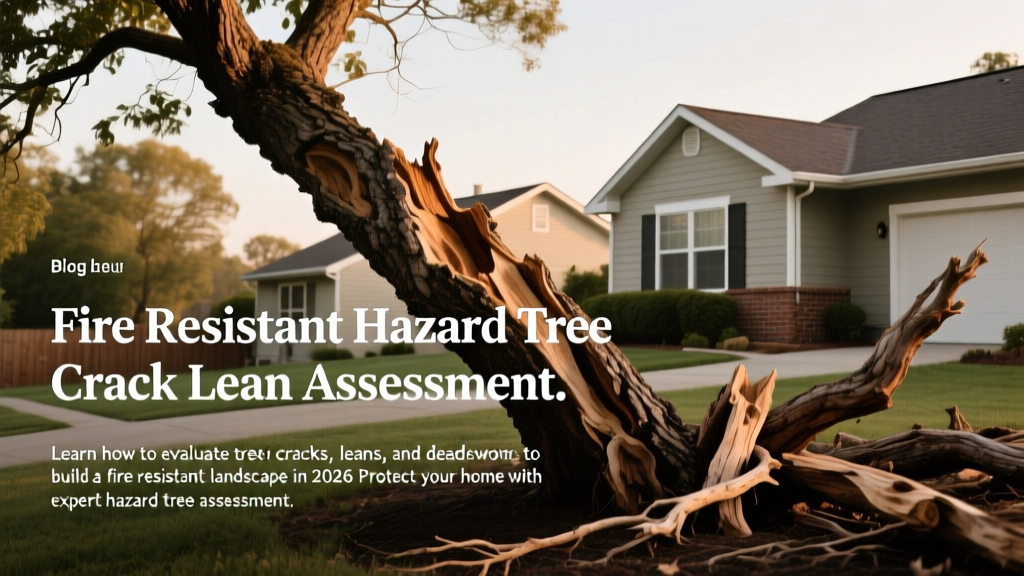
2026 Hazard Tree Assessment: Cracks, Leans & Fire Risk
Anna KowalskiPublished
Introduction to Fire-Resistant Hazard Tree Assessment in 2026
As we navigate the increasingly unpredictable 2026 wildfire season, homeowners living in the Wildland-Urban Interface (WUI) must look beyond basic brush clearance. A truly fire-resistant landscape requires a meticulous hazard tree assessment, specifically focusing on cracks, leans, and deadwood evaluation. While clearing ground vegetation is essential, ignoring the structural integrity of your canopy leaves your property vulnerable to catastrophic failure during fire-induced wind events. In 2026, updated building codes and fire marshal guidelines emphasize that a hazardous tree is not just a falling risk—it is a primary vector for ember generation and structural ignition.
According to the NFPA's Firewise USA program, embers are responsible for up to 90% of homes destroyed in wildfires. Deadwood, compromised trunks, and leaning trees act as massive ember catchers and fuel ladders. This comprehensive guide will walk you through the critical steps of evaluating tree hazards through the lens of fire-resistant landscaping, ensuring your property remains defensible and secure.
The Hidden Dangers: How Hazard Trees Accelerate Wildfires
When assessing a landscape for fire resistance, arborists and fire ecologists look at the three-dimensional fuel profile. A tree with significant deadwood, deep trunk cracks, or an unnatural lean presents a multi-faceted threat. First, dead and decaying wood has a significantly lower moisture content than live tissue, meaning it ignites faster and burns hotter. Second, a structurally compromised tree is highly susceptible to windthrow (uprooting) or snapping during the severe downdrafts and thermal winds that accompany approaching fire fronts.
If a leaning, dead-laden tree falls onto your roof or a nearby power line during a fire event, it immediately breaches your home's defensive envelope. Furthermore, falling trees can crush fencing, break windows, and create direct pathways for flames to enter the home. Therefore, hazard tree evaluation is a non-negotiable pillar of modern fire-resistant landscaping.
Step 1: Deadwood Evaluation and Ladder Fuel Mitigation
Deadwood evaluation is the first and most critical step in reducing your property's fire risk. Dead branches, especially those located in the lower and middle canopy, create ladder fuels. These are continuous vertical paths of vegetation that allow a low-intensity ground fire to climb into the tree canopy, transforming it into a high-intensity crown fire.
Identifying and Measuring Deadwood
In 2026, best practices dictate that all deadwood greater than 2 inches in diameter should be removed from trees within 30 feet of any structure. For highly flammable species such as Juniper, Eucalyptus, and Monterey Pine, this clearance zone should be extended to 50 feet. Look for branches lacking foliage, peeling bark, and brittle twigs that snap cleanly rather than bending.
Canopy cleaning, or skirting, involves pruning the lower branches of a tree to a height of at least 6 to 10 feet from the ground, or one-third of the tree's total height, whichever is lower. This breaks the vertical continuity of fuels. Ensure that pruning is done during the dormant season or periods of high humidity to avoid attracting wood-boring insects or stressing the tree during peak heat.
Step 2: Assessing Trunk Cracks and Structural Decay
Trunk cracks are glaring indicators of internal decay and structural failure. From a fire perspective, a cracked trunk is a chimney waiting to happen. Deep fissures accumulate dry leaf litter, pine needles, and spider webs, which can easily be ignited by wind-blown embers. Once ignited, the fire can burn deep into the heartwood, hollowing out the tree and causing it to collapse without warning.
Types of Cracks to Monitor
- Longitudinal Cracks: Running vertically up and down the trunk. If a crack extends through the bark and into the sapwood, it compromises the tree's ability to withstand the lateral pressure of fire winds.
- Transverse Cracks: Horizontal cracks that often indicate severe root damage or a failing branch union. These are exceptionally dangerous in high-wind fire scenarios.
- Frost Cracks and Sunscald: While sometimes superficial, repeated seasonal cracking exposes the dry inner wood to embers.
If a tree exhibits multiple intersecting cracks, or if a crack is accompanied by the presence of conks (fungal fruiting bodies) or carpenter ant frass, the tree is a severe hazard. In the context of CAL FIRE's Defensible Space guidelines, such trees located in Zone 1 (0-30 feet from the home) must be removed immediately, as they cannot be reliably mitigated through pruning alone.
Step 3: Evaluating Tree Lean and Root Heaving
Not all leaning trees are hazardous; many species naturally grow toward the sun (phototropism). However, a recent or progressive lean, especially when accompanied by soil mounding or root heaving at the base, indicates active root failure. In a fire-resistant landscape, a leaning tree is a ticking time bomb.
The Physics of Lean and Fire Winds
Wildfires generate their own weather systems, including erratic, high-velocity winds. A tree that is already leaning has a shifted center of gravity. When subjected to the thermal updrafts of a wildfire, the leverage placed on the compromised root plate is immense. If the tree is leaning toward your home, a detached garage, or critical infrastructure like propane tanks, it must be evaluated by a certified arborist.
To assess the lean, stand at a 90-degree angle to the direction of the lean and use a clinometer or a digital angle finder app. A lean exceeding 15 degrees from vertical, combined with a sparse canopy or deadwood, warrants immediate removal. Furthermore, inspect the base of the tree for soil mounding—a visible lifting of the earth on the side opposite the lean. This is a definitive sign that the root anchors are actively pulling out of the ground.
Defensible Space Zones: Where Hazard Trees Must Go
Understanding where hazard trees are permissible versus where they must be eradicated is crucial for compliance with 2026 fire codes. The following table outlines the strict requirements for managing cracked, leaning, and deadwood-heavy trees across the three primary defensible space zones.
| Defensible Space Zone | Distance from Structure | Hazard Tree Protocol (Cracks, Lean, Deadwood) |
|---|---|---|
| Zone 0 (Ember-Resistant) | 0 - 5 Feet | Zero tolerance. No trees or woody plants allowed. All deadwood and overhanging branches must be entirely removed. |
| Zone 1 (Lean & Clean) | 5 - 30 Feet | Remove all deadwood. Trees with trunk cracks, fungal conks, or leans toward the structure must be felled and removed. |
| Zone 2 (Reduce & Replace) | 30 - 100 Feet | Prune deadwood up to 6-10 ft. Leaning trees threatening power lines or escape routes must be removed. Cracked trees may be monitored if they pose no structural threat. |
Modern 2026 Assessment Technologies
The field of arboriculture has advanced significantly by 2026, offering homeowners and professionals high-tech tools for hazard tree evaluation. Sonic Tomography and Resistograph drilling allow arborists to map internal decay and hollows without felling the tree. Additionally, drone-mounted LiDAR (Light Detection and Ranging) is now widely used to assess canopy density, identify hidden deadwood in the upper crowns of massive conifers, and map the precise angle of lean relative to nearby structures.
Utilizing these technologies ensures that you are not unnecessarily removing healthy, fire-resistant native trees, while accurately targeting the hazardous specimens that threaten your defensible space.
Proper Disposal of Hazardous Wood
Once a hazardous tree is felled, the debris must be managed carefully. Leaving cracked logs or deadwood piles on the property simply relocates the fuel source. In 2026, many municipalities in fire-prone regions offer municipal chipping programs that convert hazardous wood into compost or biochar. Biochar production is particularly beneficial, as it sequesters carbon while eliminating the wildfire fuel load. Never burn hazard wood in open pits during fire season; always utilize professional removal services or designated green-waste facilities.
Conclusion
A proactive hazard tree assessment focusing on cracks, leans, and deadwood evaluation is the cornerstone of a resilient, fire-resistant landscape. By eliminating ladder fuels, removing structurally compromised trunks, and addressing dangerous leans, you drastically reduce the likelihood of ember ignition and structural damage. Consult with an ISA-certified arborist holding a Tree Risk Assessment Qualification (TRAQ) to ensure your property meets the rigorous 2026 defensible space standards, protecting both your home and the surrounding wildland ecosystem.