
Landscaping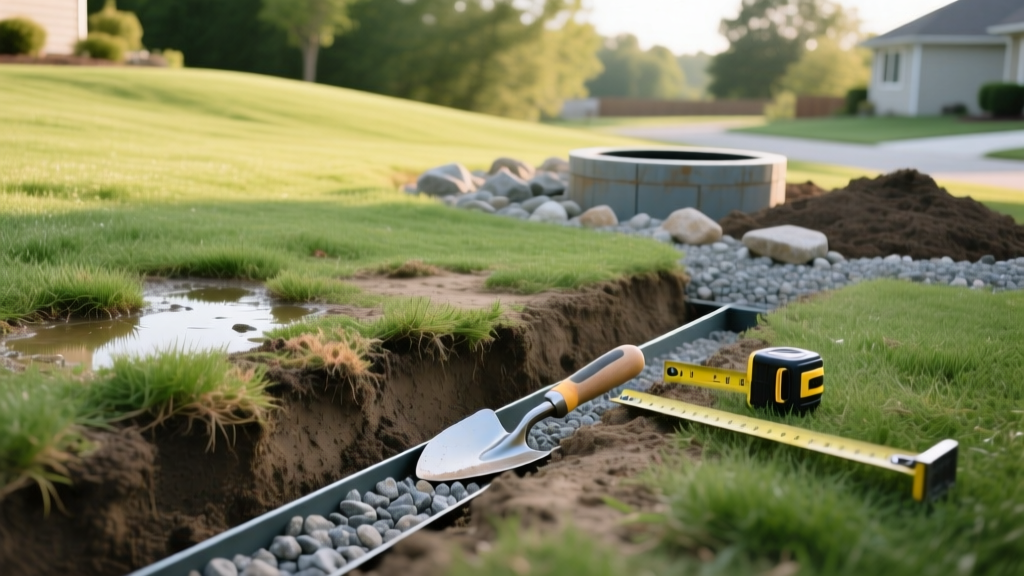
Expert Guide to Diagnosing and Fixing Yard Drainage
Anna KowalskiPublished
The Hidden Costs of Poor Yard Drainage
Standing water in your yard is more than just a muddy inconvenience; it is a silent threat to your home's structural integrity and your landscape's health. When water pools near your foundation, it can lead to basement flooding, cracked concrete, and wood rot. In your garden, poor drainage suffocates turfgrass roots, promotes fungal diseases, and drowns expensive ornamental plants. According to the American Society of Home Inspectors, water intrusion and drainage issues account for a significant percentage of foundation failures in residential properties. Before you spend thousands of dollars on random landscaping fixes, you must accurately diagnose the root cause of your yard's drainage failure and implement a targeted, engineered solution.
Diagnosing the Root Cause of Standing Water
Water always follows the path of least resistance. If it is pooling in your yard, it is due to one of three primary culprits: negative grading, compacted soil, or a high water table. To determine which issue you are facing, you need to perform two critical diagnostic tests.
1. The Grading and Slope Test
Your yard should slope away from your home's foundation at a minimum rate of 1/4 inch per foot for the first 10 feet. To test this, use a string line and a line level, or rent a laser level from your local hardware store. Drive a stake at the foundation and another 10 feet away. If the ground level at the second stake is higher than or equal to the foundation stake, you have negative grading. This means surface runoff is flowing directly toward your home instead of away from it.
2. The Soil Percolation Test
If your grading is correct but water still pools for hours after a rainstorm, you likely have a soil drainage issue, often caused by heavy clay or severe compaction. The University of Missouri Extension recommends a simple percolation test to measure your soil's infiltration rate. Dig a hole 12 inches deep and 12 inches wide. Fill it with water and let it drain completely to pre-moisten the soil. Then, fill it again and measure the water level with a ruler. Check the level every hour. Ideal landscape soil should drain at a rate of 1 to 2 inches per hour. If the water level drops less than 1 inch per hour, your soil is heavily compacted or clay-dominant, requiring mechanical aeration or subsurface drainage solutions.
Proven Solutions for Landscape Drainage Problems
Once you have identified the source of the problem, you can select the appropriate hardscaping or landscaping intervention. Below are the most effective, industry-standard solutions for resolving yard drainage issues.
Regrading and Topdressing
For minor negative grading issues, regrading is the most cost-effective solution. This involves adding a layer of heavy, clay-rich topsoil (not lightweight potting mix or mulch, which wash away) against the foundation to create a proper slope. Ensure the final grade remains at least 6 inches below your home's siding or brick weep holes to prevent pest intrusion and moisture damage to the framing. For larger areas, you may need to hire a landscaping crew with a skid-steer loader to cut and fill the soil, which typically costs between $1.50 and $3.00 per square foot.
Installing a French Drain System
When surface grading is impossible due to property lines or existing hardscapes, a French drain is the ultimate subsurface solution. A French drain intercepts groundwater and surface runoff, channeling it to a safe discharge point like a municipal storm drain, a dry creek bed, or a lower elevation on your property.
Step-by-Step Installation Guide:
- Call Before You Dig: Always dial 811 a few days before trenching to have underground utilities marked.
- Dig the Trench: Dig a trench 12 to 24 inches deep and 6 to 8 inches wide. Maintain a consistent slope of 1 inch per 8 feet toward the discharge point.
- Line with Fabric: Line the trench with a high-quality, non-woven geotextile fabric (such as Mirafi 500X) to prevent soil from clogging the system over time.
- Add Base Gravel: Place 2 inches of washed, angular river rock (3/4-inch crushed stone is ideal) at the bottom.
- Lay the Pipe: Install a 4-inch perforated corrugated pipe (like ADS N-12) or rigid PVC with the holes facing downward. This allows water to enter from the bottom and sides while preventing sediment buildup.
- Bury and Cover: Cover the pipe with more washed rock, leaving 2 inches at the top. Fold the excess landscape fabric over the rock to create a 'burrito' effect, then cover with topsoil and sod.
Cost Expectation: DIY materials cost about $5 to $8 per linear foot. Professional installation ranges from $20 to $35 per linear foot.
Constructing a Dry Well
If you have nowhere to discharge a French drain, a dry well is an excellent alternative. A dry well is an underground chamber that collects stormwater and allows it to slowly percolate into the surrounding subsoil. While you can build one using a 3-foot-deep pit filled with gravel, manufactured solutions like the NDS Flo-Well dry well system are far more efficient. A single 24-inch NDS Flo-Well can hold up to 50 gallons of water and is connected directly to your downspouts or French drain pipes. Installation requires excavating a pit 3 to 4 feet deep, lining it with landscape fabric, placing the basin, and surrounding it with 3/4-inch crushed gravel to create a massive underground reservoir.
Building a Bioretention Rain Garden
For eco-friendly drainage, consider a rain garden. According to Penn State Extension, rain gardens are shallow, vegetated depressions designed to capture and filter stormwater runoff. By amending the soil in a low-lying area with a mix of 50% sand, 25% topsoil, and 25% compost, you create a highly permeable zone. Planting deep-rooted native species like Swamp Milkweed, Joe-Pye Weed, and Blue Flag Iris helps break up compacted subsoil while absorbing excess moisture. A properly designed rain garden should drain completely within 24 to 48 hours to prevent mosquito breeding.
Comparison of Drainage Solutions
Choosing the right intervention depends on your budget, soil type, and the severity of the water issue. Use the table below to compare the most common landscape drainage solutions.
| Solution | Best Used For | Estimated Cost | DIY Difficulty | Time to Install |
|---|---|---|---|---|
| Regrading | Fixing negative slope near foundations | $1.50 - $3.00 / sq ft | Moderate | 1 - 2 Days |
| French Drain | Intercepting subsurface and surface water | $20 - $35 / linear ft | Hard | 2 - 4 Days |
| Dry Well | Managing downspout runoff with no discharge | $300 - $800 per well | Moderate | 1 - 2 Days |
| Rain Garden | Eco-friendly runoff filtration in clay soils | $5 - $15 / sq ft | Easy | 1 - 2 Days |
| Channel Drain | Cutting off water across driveways/patios | $30 - $50 / linear ft | Hard | 1 - 2 Days |
Long-Term Maintenance and Pro Tips
Installing a drainage system is only half the battle; maintaining it ensures your yard stays dry for decades. French drains and dry wells can fail prematurely if they become clogged with sediment, silt, or invasive tree roots.
- Catch Basin Maintenance: If your French drain connects to a surface catch basin, clean out the debris trap at least twice a year, especially in late autumn after the leaves have fallen.
- Root Barriers: When routing drainage pipes near large trees, install a copper or plastic root barrier to prevent aggressive roots from piercing the corrugated pipe in search of moisture.
- Avoid Mulch in Drainage Paths: Never use lightweight wood mulch in areas where water flows rapidly. It will wash into your drain grates and clog the system. Use heavy river rock or decorative gravel instead.
- Gutter Management: Your yard drainage system cannot handle the load if your roof gutters are dumping hundreds of gallons of water directly at your foundation. Ensure all downspouts are extended at least 10 feet away from the house or tied directly into your underground drainage network.
By taking a methodical approach to diagnosing your soil and grading, and investing in the correct engineered solution, you can permanently eliminate standing water, protect your home's foundation, and transform your landscape into a healthy, thriving outdoor space.

