
Landscaping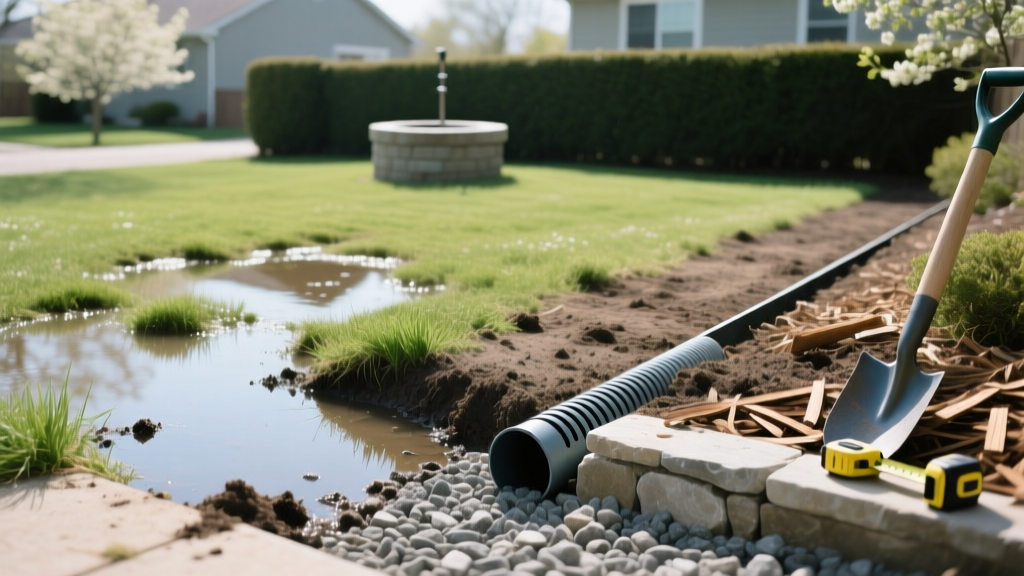
How to Diagnose and Fix Yard Drainage and Standing Water
Emily WatsonPublished
The Hidden Costs of Ignoring Yard Drainage Issues
Standing water in your yard is more than just an aesthetic nuisance that ruins your weekend barbecue plans. It is a critical landscaping problem that can lead to severe structural damage to your home's foundation, kill your expensive turfgrass, and create a breeding ground for mosquitoes and water-borne pathogens. When water pools in your landscape for more than 24 hours after a heavy rainfall, it indicates a fundamental flaw in your yard's hydrology. Addressing this issue requires a systematic approach to problem diagnosis and the implementation of targeted, engineered solutions. In this comprehensive guide, we will walk you through the exact steps to diagnose the root cause of your drainage woes and provide actionable, cost-effective solutions to permanently redirect water away from your property.
Step 1: Diagnose the Root Cause of Standing Water
Before you purchase a single bag of gravel or rent a trencher, it is vital to understand the financial and structural risks of poor drainage. According to the American Society of Home Inspectors, water intrusion and poor exterior grading are responsible for nearly 85% of all basement leaks and foundation settling issues. The cost to repair a compromised foundation can easily exceed $10,000, whereas proactive landscape drainage solutions typically range from $500 to $5,000. Furthermore, chronically wet soil suffocates turfgrass roots by displacing vital oxygen, leading to widespread lawn death and the proliferation of anaerobic soil diseases. You cannot fix a drainage problem until you understand why the water is accumulating. Water behaves predictably, always following the path of least resistance and pooling in the lowest topographical depressions. The two primary culprits are poor soil percolation and negative grading.
The Soil Percolation Test
Soil composition dictates how quickly water infiltrates the ground. Clay-heavy soils are notorious for poor drainage because their tightly packed particles leave virtually no pore space for water to escape. To test your soil's percolation rate, perform a simple DIY infiltration test. Dig a hole exactly 12 inches deep and 12 inches wide in the area where water typically pools. Fill the hole with water and allow it to drain completely to saturate the surrounding soil. Refill the hole to the top and measure the water level drop every hour for four hours. If the water level drops less than one inch per hour, you have heavy clay soil that requires mechanical drainage solutions rather than simple soil amendments.
Identifying Grading and Slope Failures
Grading refers to the slope of your landscape. Building codes universally require that the ground immediately adjacent to your home slopes away from the foundation to prevent hydrostatic pressure buildup. The industry standard is a minimum 2% grade, which translates to a drop of one-quarter inch per foot for the first 10 feet away from your foundation. To diagnose grading failures, use a laser level or a traditional string line level with a line level vial. Measure the elevation at the foundation wall and compare it to the elevation 10 feet out. If the ground is flat or slopes back toward the house (negative grading), water will inevitably pool against your siding and basement walls.
Step 2: Proven Solutions for Common Drainage Problems
Once you have identified whether your issue is soil-based or topography-based, you can select the appropriate hardscaping and landscaping interventions.
Solution A: Regrading and Topsoil Amendment
If your soil percolation is adequate but your grading is flawed, regrading is the most permanent solution. This involves stripping the existing topsoil, adding subsoil to build up low areas, and re-sloping the yard to a designated exit point, such as a municipal storm drain or a natural swale. For localized low spots, you can amend heavy clay soil by tilling in a 50/50 mix of coarse builder's sand and organic compost. This breaks up the clay matrix and improves infiltration. Professional regrading costs between $1,500 and $3,500 depending on yard size and equipment access, while DIY topsoil amendment will cost roughly $40 to $60 per cubic yard of material.
Solution B: Installing a French Drain System
When water is trapped in a low-lying area or constantly seeping into a basement, a French drain is the gold standard for subsurface water management. A French drain is essentially a gravel-filled trench containing a perforated pipe that intercepts groundwater and redirects it to a safe discharge point. To install one, dig a trench 12 inches wide and 18 to 24 inches deep, ensuring the trench maintains a continuous 1% downward slope (1/8 inch per foot) toward the discharge area. Line the trench with heavy-duty non-woven geotextile landscape fabric to prevent soil from clogging the system. Lay a 4-inch SDR-35 rigid PVC pipe with the perforations facing downward. Cover the pipe with 3/4-inch washed crushed stone, fold the fabric over the top, and cover with 2 inches of topsoil and sod. Material costs average $10 to $15 per linear foot for DIY, while professional installation ranges from $30 to $75 per linear foot.
Solution C: Dry Wells for Downspout Runoff
Roof runoff is a massive contributor to yard flooding. A single inch of rain on a 1,000-square-foot roof generates over 600 gallons of water. If your downspouts discharge directly onto the lawn, install a dry well. A dry well is an underground chamber, typically a 50-gallon to 100-gallon perforated plastic basin, buried below the frost line. Connect your downspout extensions to the inlet of the dry well. The basin temporarily stores the surge of stormwater and allows it to slowly percolate into the surrounding subsoil over 24 to 48 hours. Surround the basin with 3/4-inch gravel to increase the storage capacity and prevent the surrounding soil from collapsing into the perforations.
Comparison Chart: Drainage Solutions at a Glance
To help you choose the right intervention, review the comparison matrix below detailing the specific applications, costs, and difficulty levels of each method.
| Solution | Best Application | Estimated Cost | DIY Difficulty |
|---|---|---|---|
| Regrading | Negative slope near foundations | $1,500 - $3,500 | High (Requires machinery) |
| French Drain | Subsurface groundwater interception | $10 - $75 per linear ft. | Medium (Trenching required) |
| Dry Well | High-volume downspout runoff | $200 - $600 per unit | Medium (Deep excavation) |
| Topsoil Amendment | Localized clay-heavy pooling | $40 - $60 per cubic yard | Low (Tilling and mixing) |
Expert Insights and Authoritative Guidelines
When designing a comprehensive drainage plan, it is crucial to rely on peer-reviewed landscaping and agricultural science. The University of Minnesota Extension emphasizes the importance of managing water before it becomes a subsurface problem. According to their guidelines on residential water management:
'The most effective way to handle excess water is to intercept it at the surface before it infiltrates the soil profile. Surface swales, proper grading, and gutter management should always be your first line of defense, reserving subsurface French drains and dry wells for unavoidable groundwater issues.'
— University of Minnesota Extension, Residential Water Management Guidelines
This expert consensus highlights a common DIY mistake: homeowners often rush to dig expensive French drains when simply extending downspouts by 10 feet and regrading a small depression would entirely solve the problem. Always prioritize surface water diversion over subsurface piping.
Long-Term Maintenance for Drainage Systems
Installing a drainage system is only half the battle; maintaining it ensures your landscape remains dry for decades. Catch basins and surface grates must be cleared of autumn leaves, twigs, and debris bi-annually to prevent surface blockages. For French drains, it is highly recommended to install a cleanout access pipe at the highest elevation point of the system. Every two to three years, insert a garden hose into the cleanout and flush the perforated pipe with high-pressure water to clear out silt, mineral buildup, and invasive tree roots. Additionally, avoid driving heavy machinery or parking vehicles over your drainage fields, as soil compaction will crush corrugated pipes and destroy the soil pore space required for the dry well to function. By combining accurate diagnosis with engineered solutions and routine maintenance, you can transform a waterlogged, unusable yard into a pristine, structurally sound landscape.

