Tree Care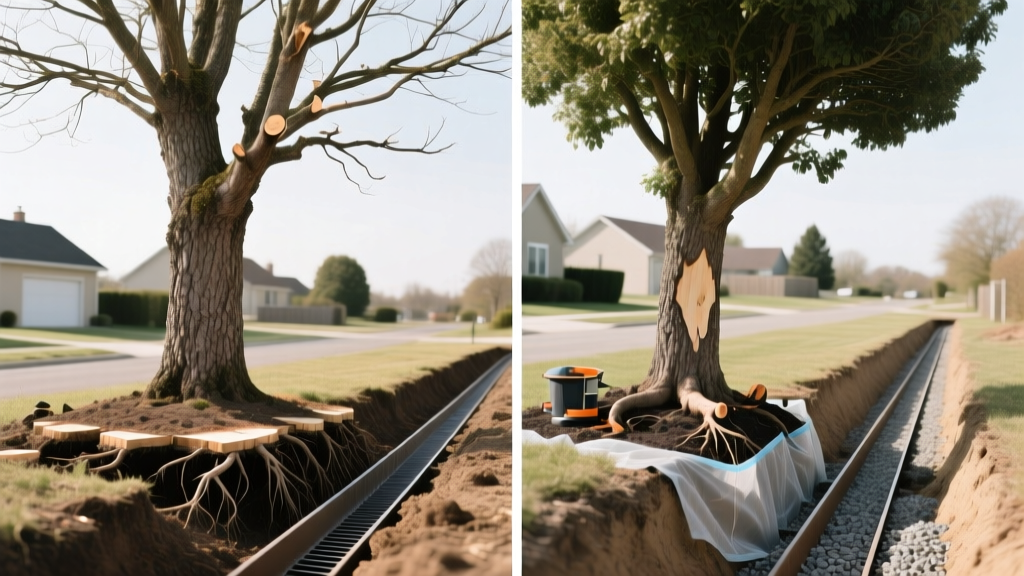
Crown Thinning vs Raising: French Drain Tree Prep 2026
Sarah ChenPublished
The Intersection of French Drain Installation and Tree Health
Installing a French drain is one of the most effective ways to resolve yard waterlogging, protect foundations, and manage heavy stormwater runoff. However, as we navigate the 2026 landscaping season, homeowners and contractors must recognize the hidden cost of drainage solutions: severe disruption to the Critical Root Zone (CRZ) of mature trees. A standard French drain requires trenching 12 to 18 inches deep to accommodate a perforated pipe, gravel base, and filter fabric. Because roughly 90% of a tree's structural and feeder roots reside in the top 18 inches of soil, trenching within the dripline inevitably severs vital root networks.
When roots are severed, a tree loses both its water-gathering capacity and its structural anchorage. This asymmetrical root loss dramatically increases the risk of windthrow during the extreme micro-bursts and high-wind events that have become increasingly common in 2026. To mitigate this risk and balance the tree's canopy with its compromised root system, arborists rely on targeted pruning. The two primary techniques debated in this scenario are crown thinning and crown raising. Understanding the difference between these methods is crucial for protecting your trees during and after a French drain installation.
Crown Thinning: Reducing the 'Wind Sail' Effect
Crown thinning involves the selective, uniform removal of secondary and tertiary branches throughout the entire canopy. The primary goal is not to alter the overall size or shape of the tree, but to reduce its density. According to the Arbor Day Foundation, proper thinning allows wind to pass through the canopy rather than pushing against it like a solid sail.
When a French drain trench severs the windward roots of a mature oak or maple, the tree's leverage is dangerously compromised. By thinning the crown, you reduce the 'wind sail' effect, decreasing the mechanical stress placed on the remaining intact roots. In 2026, certified arborists recommend removing no more than 15% to 20% of the live foliage in a single season to prevent triggering a stress-induced epicormic growth response (water sprouts). Thinning is highly effective for species with dense, heavy canopies, such as Norway Maples or American Elms, which are highly susceptible to uprooting when their lateral root flares are cut by drainage excavations.
Crown Raising: Clearance and Lower-Root Relief
Crown raising is the selective removal of the lower branches of a tree's canopy to provide vertical clearance. In the context of French drain installation, crown raising serves two distinct purposes. First, it provides the necessary vertical clearance for modern low-ground-pressure mini-excavators and trenching equipment to navigate the yard without tearing through the lower canopy. Second, it reduces the heavy lever-arm effect that massive, low-slung lateral branches exert on the root flare.
As detailed in research by Penn State Extension, removing lower limbs shifts the tree's center of gravity slightly upward and reduces the pendulum-like stress that heavy lower branches place on the root plate during high winds. However, crown raising does not significantly reduce the overall wind resistance of the upper canopy. If a French drain trench runs directly beneath the primary drip line, removing too many lower branches can actually make the tree more top-heavy and prone to snapping at the trunk if the upper canopy catches severe wind. Therefore, crown raising is best utilized when the drain trench is located near the outer edge of the CRZ, where equipment clearance is the primary concern rather than catastrophic root loss.
Head-to-Head Comparison: Thinning vs. Raising
| Feature | Crown Thinning | Crown Raising |
|---|---|---|
| Primary Objective | Reduce wind resistance (sail effect) | Increase vertical clearance |
| Root Loss Mitigation | Excellent (compensates for severed anchor roots) | Moderate (relieves lever-arm stress on root flare) |
| Equipment Clearance | Poor (does not alter lower canopy height) | Excellent (allows trenchers and excavators access) |
| Impact on Photosynthesis | Moderate (removes distributed foliage) | Low (older, lower leaves are less efficient) |
| Best Use Case for Drains | Trenches cutting deep into the inner CRZ | Trenches near the dripline requiring machinery access |
2026 Execution Best Practices and Equipment
If your 2026 landscape design requires a French drain near mature trees, timing and technique are everything. The ideal time to prune is during the late dormant season (late winter), just before the spring flush, allowing the tree to rapidly compartmentalize the pruning wounds before the stress of summer drought and the altered hydrology of the new drain.
Modern arboriculture has moved away from flush cuts and heading cuts. Every pruning cut must be made just outside the branch collar and branch bark ridge to facilitate natural compartmentalization. For the physical work, the industry has shifted heavily toward battery-powered equipment to reduce soil compaction and noise pollution. The 2026 lineup of professional arborist saws, such as the Stihl MSA 300 C-O, offers the torque needed to slice through dense hardwood limbs without the vibration and exhaust fumes of gas-powered alternatives, which can further stress a tree with a compromised root system.
For smaller, precision thinning cuts, Japanese pull saws like the Silky Bigboy or Gomboy remain the gold standard. Their razor-sharp, impulse-hardened teeth create glass-smooth cuts that heal faster and resist fungal pathogens, which is critical when a tree's immune system is already distracted by healing severed trench roots.
Post-Installation Mulching and Hydration
Pruning is only half the battle. Once the French drain is backfilled and the trenching equipment has left the site, the remaining root system must be supported. The International Society of Arboriculture (ISA) emphasizes the importance of proper mulching to retain soil moisture and regulate temperature. Apply a 2-to-3-inch layer of organic wood chip mulch over the remaining root zone, extending out to the dripline. Crucially, keep the mulch at least 3 inches away from the trunk flare to prevent rot and girdling roots.
Because the French drain will actively pull moisture away from the surrounding soil profile, the remaining feeder roots may experience localized drought. Implement a deep, slow-watering schedule using a soaker hose or root-feeder probe during the first two growing seasons post-installation. By combining the correct pruning strategy—whether thinning to reduce wind sail or raising for equipment clearance—with diligent post-installation aftercare, you can successfully integrate essential yard drainage without sacrificing the health and structural integrity of your most valuable landscape trees.
