
Landscaping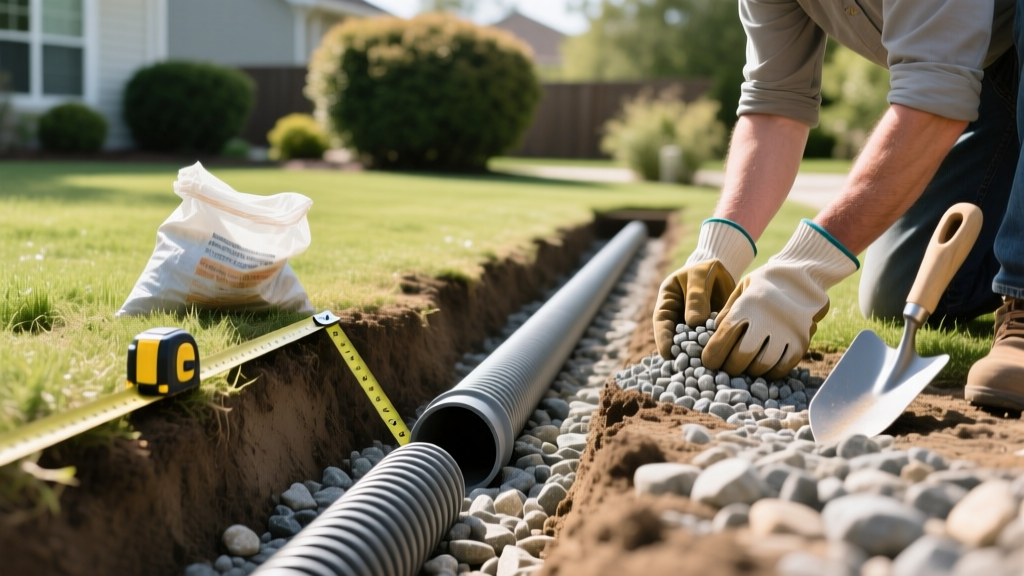
French Drain Installation: Expert Tips for Soggy Yards
Sarah ChenPublished
Standing water in your yard is more than just a nuisance; it is a direct threat to your home's foundation, your lawn's root system, and your landscape investments. When surface grading and shallow swales fail to move water away from your property, a subsurface French drain is the ultimate solution. As a landscaping best practice, installing a French drain requires precise engineering, proper material selection, and an understanding of local soil dynamics. In this comprehensive guide, we will walk you through the expert tips, measurements, and best practices for designing and installing a French drain that will keep your yard dry for decades.
Understanding Shallow vs. Deep French Drains
Before grabbing a shovel, it is critical to determine which type of French drain your landscape requires. Not all drainage issues are created equal, and misdiagnosing the problem can lead to wasted labor and continued waterlogging.
Shallow Curtain Drains
A curtain drain is typically dug 12 to 18 inches deep and 6 to 12 inches wide. Its primary purpose is to intercept surface water and shallow groundwater before it reaches a low-lying area or your home's foundation. These are ideal for soggy lawns, garden bed runoff, and mild slope drainage issues.
Deep Footing Drains
If you are dealing with hydrostatic pressure pushing against a basement wall or a severe spring issue, you need a deep footing drain. These trenches can range from 24 to 48 inches deep (or more) and are usually installed directly adjacent to the foundation footer. Deep drains require heavy machinery, strict safety shoring protocols, and professional waterproofing membranes to be effective.
Assessing Your Soil and Drainage Route
The success of your French drain relies heavily on your soil's percolation rate and the availability of a proper exit point. Water must always be daylighted to a storm drain, a dry well, or a lower elevation on your property.
The Percolation Test
To understand how fast your native soil absorbs water, perform a simple percolation test. Dig a hole 12 inches deep and 12 inches wide. Fill it with water and let it drain completely to saturate the surrounding earth. Refill the hole to the top, insert a ruler, and measure the water level drop every 15 minutes for one hour. If the water drops less than 1 inch per hour, you have heavy clay soil. Clay soils require a wider trench and a larger aggregate reservoir to temporarily hold water before it slowly percolates into the ground.
Planning the Exit Point
Never install a French drain without a guaranteed exit point. Daylighting the pipe at a lower slope is the most cost-effective method. If your property is entirely flat, you may need to terminate the drain into a subterranean dry well filled with crushed stone, or connect it to a municipal storm sewer (always check local municipal codes and obtain permits before tying into city infrastructure).
Selecting Professional-Grade Materials
Cutting corners on materials is the most common mistake DIYers make. A French drain is a permanent underground infrastructure; using subpar materials guarantees a clogged, failed system within three to five years.
Pipe Selection: SDR 35 PVC vs. Corrugated
While black corrugated flexible pipe is cheap and easy to bend, it is highly susceptible to crushing under soil load and its ribbed interior traps sediment, leading to clogs. Landscape professionals overwhelmingly recommend SDR 35 or Schedule 40 PVC pipe. The smooth interior allows water to flow rapidly and makes it easy to snake out debris years down the line. Use 4-inch diameter pipe for standard residential applications.
Geotextile Fabric: Non-Woven is Mandatory
You must wrap your drain trench in geotextile fabric to prevent fine soil particles from migrating into the gravel and clogging the pipe. Do not use cheap, woven weed barrier fabric from big-box stores; it lacks the proper flow rate and will blind over with silt. Invest in a heavy-duty, non-woven geotextile fabric (such as Mirafi 500X or equivalent) which acts as a true filter, allowing water to pass while blocking soil.
Aggregate: Washed Clean Stone
Use 3/4-inch washed clean stone (often called washed river rock or clean crushed stone). The keyword is washed. Avoid 'crusher run' or '3/4-inch minus' gravel, as the stone dust and fine particles will wash into the pipe and create a concrete-like blockage over time.
Step-by-Step Installation Best Practices
Step 1: Digging the Trench
For a standard curtain drain, dig a trench 12 inches wide and 18 inches deep. Ensure the trench walls are as vertical as possible to maximize gravel volume. Remove all large roots and sharp rocks that could puncture your fabric or pipe.
Step 2: Establishing the Slope
Gravity is the engine of your drainage system. You must maintain a minimum slope of 1 percent, which equates to a 1/8-inch drop per linear foot of trench. For a 50-foot run, your trench must drop at least 6.25 inches from start to finish. Use a laser level or a string line with a line level to verify your grade before laying the pipe. If you cannot achieve a 1 percent slope, you must dig deeper at the exit point or install a catch basin with a sump pump.
Step 3: Lining and Bedding
Drape the non-woven geotextile fabric into the trench, leaving at least 12 inches of excess fabric on both sides to fold over the top later. Add a 2-inch base layer of washed stone and tamp it down to create a stable, sloped bedding for the pipe.
Step 4: Pipe Placement and Backfilling
Lay the perforated PVC pipe with the holes facing downward. This counterintuitive placement actually prevents sediment from washing directly into the holes; water rises through the gravel bed and enters the pipe from the bottom and sides. Cover the pipe with washed stone until you have 3 to 4 inches of clearance from the surface. Fold the excess fabric over the gravel to create a complete 'burrito' wrap, then top off with native soil or sod.
Material Comparison and Cost Breakdown
Understanding the cost and performance trade-offs of drainage materials will help you budget accurately for your landscaping project. Below is a comparison of standard versus professional-grade materials.
| Material | Pros | Cons | Est. Cost |
|---|---|---|---|
| SDR 35 PVC Pipe | Rigid, smooth interior, easy to snake | Requires precise fittings, rigid | $1.50 - $3.00 / ft |
| Corrugated Pipe | Flexible, cheap, easy to bend | Prone to crushing, hard to clean | $0.50 - $1.00 / ft |
| Non-Woven Geotextile | Superior filtration, prevents clogging | Higher upfront cost | $0.40 - $0.80 / sq ft |
| Woven Weed Barrier | Inexpensive, high tensile strength | Clogs easily with silt, fails over time | $0.15 - $0.30 / sq ft |
| 3/4-inch Washed Stone | Excellent void space, no stone dust | Heavier to transport and shovel | $40 - $70 / ton |
On average, a professionally installed French drain costs between $20 and $50 per linear foot, depending on soil conditions, depth, and restoration requirements. DIY installation can reduce this cost to $5 to $10 per linear foot, primarily covering materials and equipment rentals like a mini-excavator or trencher.
Expert Insights from University Extensions
When dealing with complex landscape drainage, relying on anecdotal advice can lead to costly errors. According to the North Carolina State University Cooperative Extension, "Poor drainage is often the result of compacted soils and improper grading, which prevent water from infiltrating the soil profile or moving away from structures." The Extension emphasizes that relying solely on surface amendments like topsoil is insufficient for heavy clay soils, making subsurface interception via French drains a critical landscaping intervention.
Furthermore, experts at the University of Minnesota Extension warn against terminating French drains into undeveloped, poorly draining low spots on your property. Doing so simply creates a localized swamp that will eventually back up into the drain system. Always ensure your discharge point has the capacity to handle the volume of water generated during a 100-year storm event.
Long-Term Maintenance for Longevity
A properly installed French drain is largely maintenance-free, but a few proactive steps will ensure it lasts a lifetime. First, install a catch basin or a cleanout riser at the highest point of the system. This allows you to insert a garden hose and flush the pipe annually to clear out any accumulated silt or organic matter. Second, ensure that surface water entering the system via catch basins is filtered by grates to prevent large leaves and twigs from entering the subsurface pipe. Finally, avoid planting deep-rooted trees or shrubs directly over the drain line, as roots will inevitably seek out the moisture and nutrients concentrated in the gravel bed, eventually infiltrating and destroying the pipe.
Conclusion
Installing a French drain is a highly effective, permanent solution to yard drainage woes. By prioritizing professional-grade materials like SDR 35 PVC and non-woven geotextile fabric, adhering to strict slope measurements, and understanding your soil's percolation rate, you can protect your landscape and your home's foundation. Approach your project with patience and precision, and you will enjoy a dry, healthy, and beautiful yard for decades to come.

