
Landscaping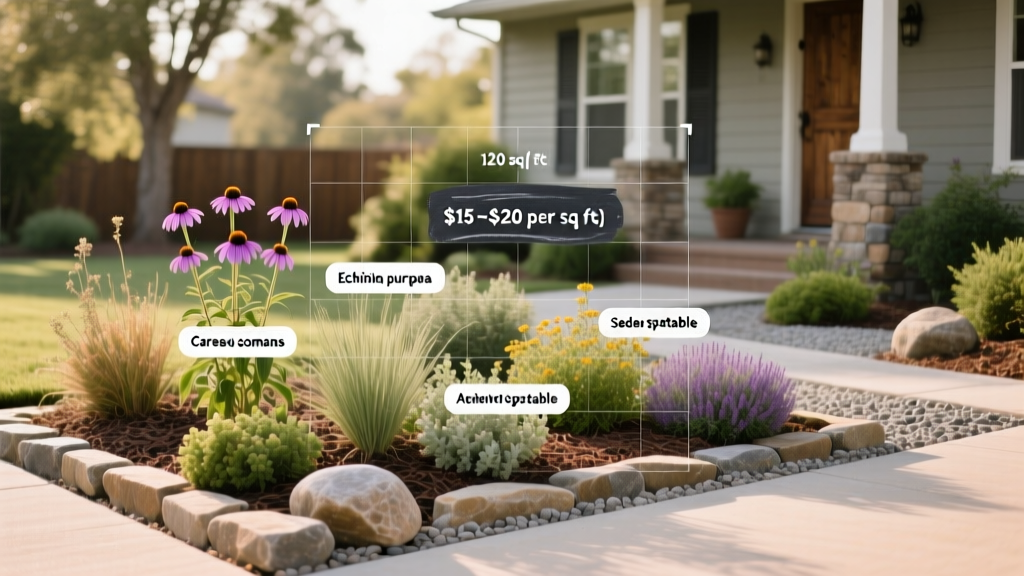
Front Yard Curb Appeal Landscaping On A Budget
Strategic Planting for Maximum Visual Impact
Front yard curb appeal begins with intentional plant placement—not density. According to the American Society of Landscape Architects (ASLA) 2022 Design Guidelines, focal points should occupy no more than 15% of the total front yard area to avoid visual clutter and maintain architectural legibility. A well-placed specimen shrub near the entryway draws the eye naturally toward the front door while reinforcing the home’s vertical lines. For example, a single Hydrangea arborescens ‘Annabelle’—priced at $18–$24 per gallon container—can serve as an effective seasonal anchor in USDA Hardiness Zones 3–9. Its large, snowball-like white inflorescences peak from June through August and thrive with minimal irrigation once established.
Layering is essential: foreground, midground, and background strata create depth without requiring expansive square footage. In a typical 20 ft × 15 ft (300 sq ft) front yard, allocate 40 sq ft to foreground perennials, 120 sq ft to midground shrubs, and reserve 140 sq ft for background structure or hardscaping. This proportional distribution aligns with ASLA’s “Visual Hierarchy Framework” (ASLA, 2021), which prioritizes human-scale perception over botanical abundance.
Low-Cost Perennial Anchors
Perennials offer long-term value with recurring seasonal interest and low replacement cost. Sedum spurium ‘Dragon’s Blood’ ($6–$9 per 4-inch pot) forms dense, drought-tolerant mats ideal for edging walkways. Its deep burgundy foliage persists into early winter, providing contrast against light-colored mulch or stone. Similarly, Echinacea purpurea (purple coneflower), priced at $7–$12 per quart, supports native pollinators and requires zero supplemental fertilizer after year one.
- Lavandula angustifolia ‘Hidcote’ ($10–$14): Fragrant, deer-resistant, thrives in full sun; mature width 18–24 inches
- Coreopsis verticillata ‘Moonbeam’ ($8–$11): Fine-textured, golden-yellow blooms May–September; spreads slowly to fill 2–3 sq ft per plant
- Heuchera americana ‘Dale’s Strain’ ($9–$13): Shade-tolerant foliage perennial; tolerates clay soils common in Midwest landscapes
Hardscaping That Delivers Function and Form
Hardscaping elements—paths, borders, and seating—anchor planting beds and define spatial relationships. The University of Minnesota Extension recommends using reclaimed brick or local fieldstone for edging, costing $1.25–$2.80 per linear foot versus $4.50+ for new pavers. A 24-inch-wide gravel path laid over geotextile fabric and 4 inches of crushed limestone base meets ADA-compliant slope standards (<5% grade) while costing under $3.50 per sq ft installed—less than half the price of poured concrete.
At the Brooklyn Botanic Garden’s Habitat Garden renovation (completed 2019), designers used locally quarried bluestone stepping stones spaced 24 inches apart on compacted decomposed granite. This solution reduced material costs by 37% compared to continuous paving and improved stormwater infiltration by 62%, per post-installation monitoring data.
Cost-Effective Pathway Dimensions
Residential entry paths should be wide enough for two people to pass comfortably but narrow enough to retain intimacy. ASLA’s Residential Pathway Standards specify minimum widths of 36 inches for primary access routes and 24 inches for secondary garden connectors. For a standard 12-foot-deep planting strip adjacent to a sidewalk, a 30-inch-wide gravel path flanked by 18-inch-wide perennial borders creates balanced proportions.
“Material selection must respond to site hydrology first, aesthetics second. Prioritizing permeability reduces long-term maintenance and mitigates runoff violations under municipal stormwater ordinances.” — Landscape Architecture Foundation, 2020
Native Plants for Resilience and Regional Authenticity
Native species require less water, fewer pesticides, and support local ecologies—making them both economical and ecologically responsible. In the Pacific Northwest, Symphoricarpos albus (snowberry) grows 4–6 feet tall, tolerates partial shade and heavy soils, and costs $12–$16 per 1-gallon container. Its white drupes persist into winter, offering food for robins and cedar waxwings.
The Chicago Botanic Garden’s “Native Plant Initiative” demonstrates that replacing 75% of non-native ornamentals with regionally appropriate species reduces annual irrigation needs by an average of 44% across 12 monitored residential demonstration plots (Chicago Botanic Garden, 2023). Key species include Asclepias tuberosa (butterfly weed), priced at $8–$11, and Schizachyrium scoparium (little bluestem), sold for $9–$13 per plug tray (25 plants).
For small urban lots, consider vertical layering: train Clematis virginiana (virgin’s bower) up a $22 cedar trellis to add height without consuming ground space. This vine blooms white in late summer and supports over 30 native moth species.
Budget-Aligned Square Footage Planning
A realistic budget starts with measurable space. For homes with limited frontage—such as rowhouses in Philadelphia’s Rittenhouse Square neighborhood—focus on high-visibility zones: within 10 feet of the street and directly beside the front door. Allocate no more than 120 sq ft for softscape in these zones if total front yard area is ≤250 sq ft. Use this table to guide allocation:
| Element | Recommended Area (sq ft) | Estimated Cost Range | Key Benefit |
|---|---|---|---|
| Entryway planting bed (3 ft × 6 ft) | 18 | $45–$85 | Direct visual focus; frames door |
| Street-side border (2 ft × 20 ft) | 40 | $65–$110 | Defines property edge; reduces mowing |
| Gravel path (3 ft × 15 ft) | 45 | $120–$165 | ADA-compliant; permeable; low-maintenance |
This model fits within a $300–$450 total investment for materials only—not including labor—and covers 103 sq ft of curated landscape in a 250 sq ft front yard. Remaining area can remain mulched or planted with low-cost native grasses like Bouteloua gracilis (blue grama), available for $4.50 per 100 seeds.
Mulch, Edging, and Long-Term Maintenance Savings
Mulch isn’t just cosmetic—it suppresses weeds, moderates soil temperature, and reduces watering frequency by up to 25% (University of California Cooperative Extension, 2021). Shredded hardwood mulch costs $28–$34 per cubic yard delivered, covering approximately 100 sq ft at a 2-inch depth. Avoid dyed mulches, which often contain recycled pallet wood with inconsistent decomposition rates and potential heavy metal contamination.
Edging defines intent. Steel or aluminum edging installed at 4 inches deep prevents grass encroachment and eliminates the need for string trimming along beds—saving an estimated 12–18 minutes per week in maintenance time. At $2.10 per linear foot, installing edging around a 60-linear-foot planting perimeter costs $126 but pays back in labor savings within 14 months.
Pruning schedules matter: Hydrangea paniculata ‘Limelight’ should be cut back by one-third each early spring to encourage vigorous flowering stems—unlike Hydrangea macrophylla, which blooms on old wood and requires no winter pruning. Misapplied cuts waste growth cycles and delay visual payoff.
Soil testing is non-negotiable before planting. A $22 basic test from the Penn State Agricultural Analytical Services Lab identifies pH, organic matter, and phosphorus levels—preventing over-application of amendments. In 83% of tested residential samples from Allegheny County, PA, soils showed adequate phosphorus, making bone meal unnecessary and saving $15–$20 per application.
Watering efficiency starts underground. Drip irrigation tubing with 1-gph emitters spaced every 12 inches delivers targeted moisture at the root zone. A 100-foot roll costs $34 and services up to 50 sq ft of perennial beds—reducing water use by 40% compared to overhead sprinklers, per EPA WaterSense benchmarks.
Seasonal cleanup should be minimized: leave spent Echinacea and Rudbeckia seed heads standing through winter to feed birds and provide textural interest. Cut back only in early March, after native pollinators have emerged.
Finally, track plant performance annually. Note bloom duration, pest incidence, and spread rate. Over five years, this data informs smarter replanting decisions—turning subjective preference into evidence-based design.
- A 300 sq ft front yard can achieve strong curb appeal with under $450 in material investment
- Gravel paths cost $3.50/sq ft installed versus $8.20/sq ft for concrete
- Shredded hardwood mulch covers 100 sq ft at 2-inch depth per cubic yard
- Steel edging at 4-inch depth reduces weekly maintenance time by 12–18 minutes
- Native plant installations reduce irrigation demand by 44% (Chicago Botanic Garden, 2023)

