Tree Care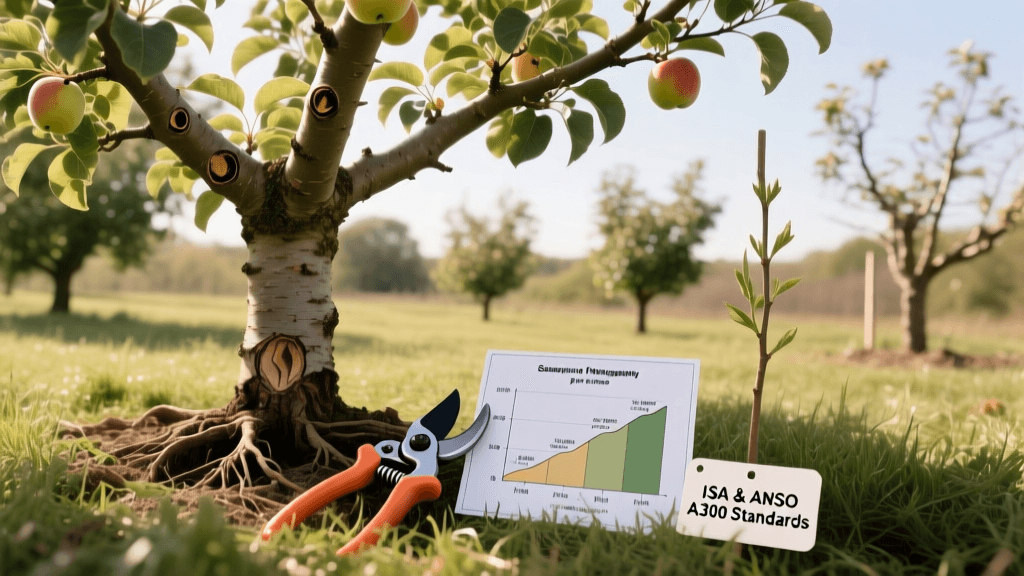
Fruit Tree Pruning Guide For Home Orchards
Getting Started with Home Orchard Pruning
Pruning fruit trees is a skill that pays off quickly for home growers. Done well, it helps shape the tree, lets more light into the canopy, keeps disease in check, and often leads to bigger, better fruit. Done poorly—or skipped altogether—the tree gets crowded, branches grow at weak angles, and fruit ends up small and shaded, while the whole thing becomes harder to work with. The basics are pretty consistent across most common fruit trees, and once you get the hang of timing, technique, and what your specific tree needs, even a first-year grower can make clean, confident cuts.
The International Society of Arboriculture (ISA) and the ANSI A300 pruning standards lay out best practices used by professional arborists. Though written mainly for landscape trees, their core ideas—like removing no more than 25% of live crown in one season, cutting just outside the branch collar, and keeping structure sound—work just as well for fruit trees in a home orchard.
When to Prune: Timing by Season and Species
When you prune matters just as much as how you prune. It affects how fast wounds close, how the tree responds, and its risk of infection. For most deciduous fruit trees in temperate areas, late dormancy—roughly late February through early March in USDA Hardiness Zones 5–7—is usually the best time. By then, the tree has met its chilling requirement, carbohydrates are still stored in the roots and trunk, and the chance of cold damage to fresh cuts has passed.
Summer pruning, usually done in June or July after spring growth has hardened off, serves a different purpose. It slows leafy growth, opens up the canopy for better light, and works especially well for trees that grow too vigorously—or for training young trees on dwarfing rootstocks. The University of California Cooperative Extension suggests summer pruning for mature apple and pear trees when canopy size is an issue, noting it can cut regrowth by 30–40% compared to dormant pruning alone.
Stone fruits—peaches, cherries, plums, and apricots—need extra care around timing because they’re prone to fungal diseases like Cytospora canker and bacterial canker (Pseudomonas syringae). Pruning them during wet spring weather leaves open wounds that fungi and bacteria can easily enter. UC Davis Plant Pathology recommends pruning stone fruits in dry summer conditions when possible—or right after harvest.
Dormant Pruning Window by Region
| USDA Zone | Recommended Dormant Pruning Window | Notes |
|---|---|---|
| Zone 4–5 | Mid-March to early April | Wait until coldest nights are above 10°F (-12°C) |
| Zone 6–7 | Late February to mid-March | Ideal window before bud swell |
| Zone 8–9 | January to mid-February | Trees may have short or incomplete dormancy |
| Zone 10 | December to January | Prune after leaf drop; some species semi-evergreen |
Core Pruning Techniques
Most pruning decisions come down to two basic types of cuts: heading cuts and thinning cuts. A heading cut removes the tip of a branch, which encourages buds below the cut to break and grow—leading to denser, bushier growth. A thinning cut removes a whole branch back to where it joins another branch or the trunk. It doesn’t trigger a flush of new shoots like heading cuts do. For fruit trees, thinning cuts are usually the better choice—they open the canopy without setting off a wave of water sprouts.
The ANSI A300 Part 1 standard says all pruning cuts should land just outside the branch bark ridge and branch collar—the slightly raised ring of tissue at the base of every branch. Cutting into the collar removes the tree’s main wound-healing tissue and slows healing. Leaving a stub beyond the collar creates dead wood that decays inward. The right cut follows the branch bark ridge on top and exits just outside the collar underneath, usually at a 45–60 degree angle to the branch.
The Three-Cut Method for Large Branches
For any branch thicker than 1.5 inches (3.8 cm), use the three-cut method to keep bark from tearing. First, make an undercut 12–18 inches from the trunk, cutting upward about one-third of the way through. Second, make a top cut 2–3 inches further out, cutting downward until the branch falls—the undercut keeps bark from peeling down the trunk. Third, remove the remaining stub with a final cut just outside the branch collar. This method is taught at the Morton Arboretum in Lisle, Illinois, one of North America’s top arboricultural education centers.
Species-Specific Pruning Guidance
Fruit trees vary widely in how they grow, where they bear fruit, and how their branches arrange themselves—so pruning has to match. Knowing where your tree makes fruit is key. Cut the wrong wood, and you’ll lose this year’s crop—or next year’s.
Apples and Pears
Apples and pears set fruit on spurs—short, stubby shoots that form on wood two years old or older. These spurs stay productive for 8–15 years before fading. Pruning these trees means keeping the canopy open so light reaches the spurs, removing branches that cross or shade each other, and occasionally cutting back to younger wood to refresh older spur systems. Standard apple trees on seedling rootstock can reach 20–30 feet tall with a spread of 15–25 feet. Dwarf trees on Malling 9 (M.9) rootstock stay under 10 feet and start bearing fruit in 2–3 years—compared to 5–8 years for standard trees.
The central leader system fits apples and pears well. Keep one strong, upright leader, and choose scaffold branches spaced 18–24 inches apart vertically, rotated about 120 degrees around the trunk to avoid stacking. Scaffold branches should have crotch angles of 45–60 degrees—angles narrower than 30 degrees form weak V-shaped unions that can split under a heavy fruit load.
Peaches and Nectarines
Peaches and nectarines fruit on last year’s wood—shoots that grew the previous season. That means every year you need to cut out older, fruited wood and encourage strong new shoots. A healthy mature peach tree should put out 18–24 inches of new growth each year; less than 12 inches often signals stress or overcrowding. The open-center (vase) system is standard for peaches: 3–5 main scaffold limbs, no central leader, and plenty of light reaching all the way in.
Peaches need more aggressive annual pruning than apples. Removing 30–40% of last year’s growth is normal—and necessary—to keep fruiting wood near the main scaffold limbs. Without it, fruiting moves to the outer tips, making harvest tough and causing interior branches to die back from lack of light.
Managing Tree Size and Rootstock Considerations
How big your fruit tree gets depends mostly on the rootstock you chose when planting—but pruning plays a steady role in keeping size in check. Dwarfing rootstocks like M.9 and M.26 for apples or Gisela 5 for sweet cherries produce smaller trees that are easier to pick, spray, and manage. But they need staking and more careful watering and feeding. Semi-dwarf rootstocks like M.7 and MM.106 grow to 12–15 feet—offering a middle ground between yield and ease of care for many home orchards.
Root spread matters when placing trees and planning paths or irrigation. Apple trees on standard rootstock develop roots that stretch 1.5–2 times the canopy width—often 30–40 feet across in deep, well-drained soil. Dwarf trees on M.9 have much tighter root systems—usually 6–10 feet wide—which is why they need permanent stakes and are more sensitive to drought or competition from grass and weeds near the trunk.
"Proper pruning, with an understanding of tree physiology and species-specific growth habits, is the single most important cultural practice for maintaining long-term orchard productivity and tree structural integrity."
— International Society of Arboriculture, Best Management Practices: Pruning, 2008
Tools, Sanitation, and Wound Care
Sharp, clean tools make all the difference. Dull blades crush and tear instead of cutting cleanly—slowing healing and opening the door for disease. For branches up to 3/4 inch, bypass hand pruners do the job. Loppers handle branches from 3/4 to 1.5 inches. Anything larger needs a pruning saw—a folding Japanese-style pull saw or a fixed-blade curved saw both work well.
Cleaning tools between trees—and especially between cuts on stone fruits—cuts down on spreading bacteria and fungi. A 10% bleach solution (1 part bleach to 9 parts water) or 70% isopropyl alcohol wiped on blades between cuts does the trick. The Washington State University Tree Fruit Research and Extension Center in Wenatchee, Washington—one of North America’s largest applied fruit tree research programs—prefers alcohol-based sanitizers over bleach in the field. Bleach corrodes metal over time and loses strength fast when mixed with plant sap or debris.
Wound sealants—once routine—are no longer recommended by the ISA or ANSI A300. Research from the 1980s and 1990s showed they don’t stop decay, and sometimes trap moisture and pathogens against the wound, speeding up internal rot. Trees heal best when cuts are made correctly and left uncovered to dry.
Recognizing and Responding to Structural Problems
Take time each pruning season to really look at your tree—not just to cut, but to assess its shape and health. A few issues show up often:
- Included bark: When two major stems grow close together at a narrow angle, bark gets trapped between them instead of forming a solid union. That makes the junction weak—it can split in wind or under fruit weight. Fixing included bark is easiest when the tree is young: remove one of the competing stems early rather than trying to manage a large, risky union later.
- Water sprouts and suckers: Vigorous vertical shoots coming from the trunk or main limbs (water sprouts) or from below the graft union (suckers) should be removed as soon as you see them. Suckers grow from rootstock tissue and won’t produce good fruit. Water sprouts can be rubbed off by hand in spring while they’re still soft and green.
- Dead, diseased, and damaged wood: Always start pruning by taking out the “three Ds.” Dead wood carries disease and adds no value. Diseased wood—like fire blight cankers on apples and pears—should be cut 8–12 inches below visible signs, with tools cleaned between each cut.
- Crossing and rubbing branches: When branches rub, they wear spots in the bark—open doors for disease. Remove the weaker or less well-placed of the two.
- Overly long scaffold limbs: On standard trees, branches stretching more than 8–10 feet from the trunk get hard to reach and more likely to break. Use reduction cuts—cutting back to a side branch that’s at least one-third the diameter of the limb being shortened—to shorten them while keeping the tree’s natural shape.
Young trees need careful attention in their first three years—not to boost fruiting, but to build good structure. Letting them grow unchecked to speed up harvest often backfires: poor structure gets harder and riskier to fix as the tree ages. Cornell University’s Cooperative Extension in Ithaca, New York, advises picking scaffold branches in the first two dormant seasons and removing all competing leaders—even if it means giving up some early fruit.
- Year 1 after planting: Cut the central leader at 30–36 inches to encourage side branches. Remove any branches below 18 inches from the ground.
- Year 2: Pick 3–4 well-spaced scaffold branches with wide crotch angles. Cut out competing upright shoots. Trim the central leader again if needed to prompt the next tier of scaffolds.
- Year 3: Add scaffolds for the second tier. Start light thinning inside the canopy to let in more light. By now, the tree’s basic framework should be in place.
- Year 4 and beyond: Shift to maintenance pruning—removing dead, diseased, or crossing wood each year, renewing fruiting wood as needed for your species, and using reduction cuts to manage size.
Pruning a little every year works far better than waiting several seasons and then doing heavy cutting. Mature trees hit with drastic pruning tend to respond with lots of water sprouts, get stressed, and may take two or three years to bounce back in terms of fruit production. In a well-managed home orchard, pruning stays a regular, modest task—keeping trees steady and productive, not a last-minute fix for something that got away.