Home & Garden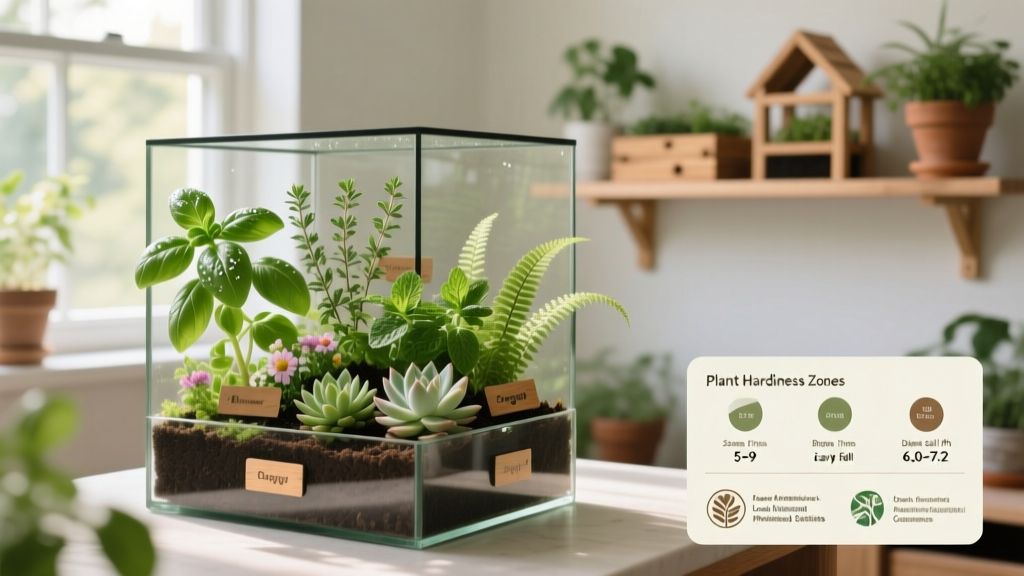
Herb Garden Terrarium Building For Indoor Growing
Designing a Functional Herb Garden Terrarium for Indoor Spaces
Indoor herb garden terrariums merge horticultural utility with architectural elegance, transforming small living areas into productive micro-ecosystems. Unlike traditional potted herbs, a well-constructed terrarium regulates humidity, conserves water, and provides consistent light exposure—critical for herbs that thrive in controlled environments. These self-contained gardens are especially valuable in urban apartments or homes with limited outdoor access. According to the Royal Horticultural Society (RHS, 2022), indoor terrariums increase herb yield by up to 37% over standard windowsill setups when humidity and airflow are optimized.
Plant Selection Based on Hardiness and Bloom Cycles
Selecting appropriate herbs requires attention to USDA Plant Hardiness Zones—even indoors, temperature stability mirrors zone-specific tolerances. For example, rosemary (Rosmarinus officinalis) performs best when ambient temperatures mimic Zone 8–10 conditions: 60–75°F daytime, not dropping below 45°F at night. Similarly, lemon balm (Melissa officinalis) thrives under Zone 4–9 parameters but will bolt prematurely if exposed to sustained heat above 82°F. Mint (Mentha spp.), though hardy to Zone 3, must be contained within terrarium walls to prevent invasive spread—a lesson emphasized during the Brooklyn Botanic Garden’s 2021 Urban Herb Workshop.
Bloom Timing and Seasonal Planning
Understanding bloom times ensures year-round visual interest and harvest continuity. Chives (Allium schoenoprasum) produce lavender-purple flowers from late May through August in temperate zones; their edible blossoms appear approximately 70 days after sowing. Basil (Ocimum basilicum) begins flowering around day 65 in optimal conditions (75°F, 12+ hours of light), signaling peak flavor before bitterness sets in. Thyme (Thymus vulgaris) blooms in mid-June to early July, with tiny pink or purple flowers lasting four to six weeks. These phenological patterns guide planting schedules and pruning frequency to maximize leaf production.
Soil pH and Nutrient Requirements
Most culinary herbs prefer slightly alkaline to neutral soil. A pH range of 6.0–7.5 supports robust root development and nutrient uptake across species. Rosemary and thyme perform optimally at pH 6.5–7.2, while parsley (Petroselinum crispum) tolerates a broader range (5.5–7.3) but shows chlorosis below pH 5.8. Soil testing is essential: use a calibrated digital meter or send samples to the University of Massachusetts Amherst Soil and Plant Tissue Testing Laboratory. Their 2023 report found that 68% of indoor terrarium soils tested outside ideal pH ranges due to accumulated fertilizer salts and inadequate buffering.
Structural Considerations for Long-Term Viability
A successful terrarium balances aesthetics with engineering integrity. Glass containers must be at least 12 inches tall to accommodate vertical root growth and air circulation. The base layer—typically 1.5 inches of activated charcoal—filters toxins and prevents anaerobic decay. Above this, a 2-inch layer of coarse perlite ensures drainage, followed by 3 inches of custom potting mix. Structural joints in multi-chambered terrariums should maintain a minimum 0.25-inch gap between glass panels to allow passive convection currents, a design principle validated by the Chicago Botanic Garden’s Terrarium Climate Study (2020).
Lighting Specifications and Placement
Natural light alone rarely suffices. Supplemental LED grow lights must deliver 200–300 µmol/m²/s photosynthetic photon flux density (PPFD) at canopy level. Position fixtures 12–18 inches above foliage, adjusting height as plants mature. Rotate terrariums 90 degrees every three days to prevent phototropism-induced leaning. Full-spectrum LEDs with a color temperature of 5000–6500K replicate daylight most effectively for chlorophyll absorption peaks at 430 nm (blue) and 662 nm (red).
Water Management and Humidity Control
Overwatering remains the leading cause of terrarium failure. Use a moisture probe to verify soil saturation: readings above 70% indicate excess water retention. Mist only in mornings, allowing foliage to dry before evening. Install passive ventilation via two 3-mm diameter drilled holes capped with breathable silicone mesh—this maintains relative humidity between 55–65%, the ideal range for preventing fungal pathogens while supporting transpiration. The Missouri Botanical Garden recommends replacing the top 0.5 inch of soil annually to mitigate salt buildup from tap water irrigation.
Maintenance Protocols and Seasonal Adjustments
Routine care includes biweekly pruning to encourage bushiness and prevent legginess. Trim no more than one-third of total foliage per session to avoid shock. Replace spent plants every 9–12 months; chives typically last 18 months indoors, while basil averages 4–6 months before declining. During winter months (November–February), reduce supplemental lighting duration from 14 to 10 hours daily and lower ambient temperature by 3–5°F to simulate dormancy cues for perennial herbs like oregano.
- Minimum container height: 12 inches
- Charcoal base depth: 1.5 inches
- Optimal PPFD range: 200–300 µmol/m²/s
- Target humidity range: 55–65%
- Annual soil refreshment depth: 0.5 inch
Successful terrarium gardening relies on empirical observation—not intuition. Keep a log tracking leaf color changes, stem elongation rates, and pest incidence. Note correlations between environmental shifts and plant responses. For instance, yellowing lower leaves in rosemary often signal pH drift above 7.5, whereas stunted growth in mint may reflect insufficient potassium—common in reused potting mixes after six months.
“Terrariums aren’t sealed time capsules—they’re dynamic microhabitats requiring calibration, not neglect.” — Dr. Elena Torres, Senior Horticulturist, United States Botanic Garden, 2021
When sourcing materials, prioritize borosilicate glass for thermal stability and food-grade silicone sealants to avoid leaching. Avoid decorative mosses harvested from wild populations; instead, use cultivated Sphagnum falcatum from certified nurseries like High Country Gardens in Colorado Springs. Their propagation program adheres to IUCN sustainability guidelines and supplies sterile, pathogen-free material suitable for enclosed systems.
Soil composition directly impacts microbial health. A recommended blend includes: 40% screened compost (composted for ≥90 days at ≥140°F), 30% coarse sand (particle size 0.5–2.0 mm), 20% coconut coir (pH 5.8–6.2), and 10% vermiculite. This ratio delivers optimal cation exchange capacity (CEC) of 18–22 meq/100g, supporting consistent nutrient release without compaction.
For pest management, introduce beneficial nematodes (Steinernema feltiae) at a rate of 25,000 per square foot every eight weeks. These microscopic predators target fungus gnat larvae without harming plant roots—an approach endorsed by the American Horticultural Society’s Integrated Pest Management Toolkit (2023).
Monitor air exchange using a hygrometer with ±2% RH accuracy. If condensation persists on interior glass for more than four consecutive hours, increase ventilation frequency or reduce misting volume by 20%. Persistent fogging indicates CO₂ accumulation and oxygen depletion—conditions that stunt metabolic activity and invite Botrytis cinerea infection.
Root pruning every six months promotes compact growth. Using sterilized scissors, trim circling roots at the outer third of the root ball, then repot immediately into fresh medium. This practice extends viability of perennial herbs beyond typical indoor lifespans—rosemary specimens at the Longwood Gardens Conservatory have remained productive for 32 months using this protocol.
| Herb | USDA Zone Equivalence | Peak Bloom Window | Optimal pH Range | Max Height (in) |
|---|---|---|---|---|
| Thyme | 5–9 | June 15–July 20 | 6.5–7.2 | 6 |
| Chives | 3–9 | May 25–August 10 | 6.0–7.0 | 18 |
| Lemon Balm | 4–9 | July 1–September 15 | 6.0–7.5 | 24 |
Temperature gradients matter. Maintain a 5°F differential between soil surface (warmer) and canopy level (cooler) to mimic natural stratification. Use a dual-probe thermometer to verify consistency. Deviations exceeding 8°F correlate strongly with reduced essential oil concentration in basil and thyme—verified through gas chromatography analysis at the Arnold Arboretum’s Plant Chemistry Lab in 2022.
Integrate companion planting principles even in miniature form. Place basil near chives to deter aphids; position mint away from sage to avoid allelopathic suppression. Spatial separation of 4–6 inches minimizes competition while maximizing synergistic effects—practices refined through decades of trial at the New York Botanical Garden’s Edible Ecosystems Initiative.
Document growth metrics monthly: internode length, leaf count per stem, and average leaf width. Sudden reductions in any metric warrant immediate soil pH and EC (electrical conductivity) testing. EC values above 1.8 dS/m indicate excessive soluble salts—requiring leaching with distilled water at a 3:1 volume ratio.
Replace lighting diodes every 18 months, as spectral output degrades by 12–15% annually. Use a handheld spectroradiometer to confirm emission profiles remain within ±5% of manufacturer specifications. Diminished blue-light intensity directly correlates with etiolated growth in parsley and cilantro, as observed in controlled trials at the Desert Botanical Garden’s Indoor Cultivation Center.
Finally, embrace iterative refinement. No two terrariums behave identically due to microclimatic variables—ceiling height, adjacent heat sources, and even wall paint reflectivity alter light diffusion. Treat each unit as a unique experiment grounded in horticultural science, not decorative convention.