Home & Garden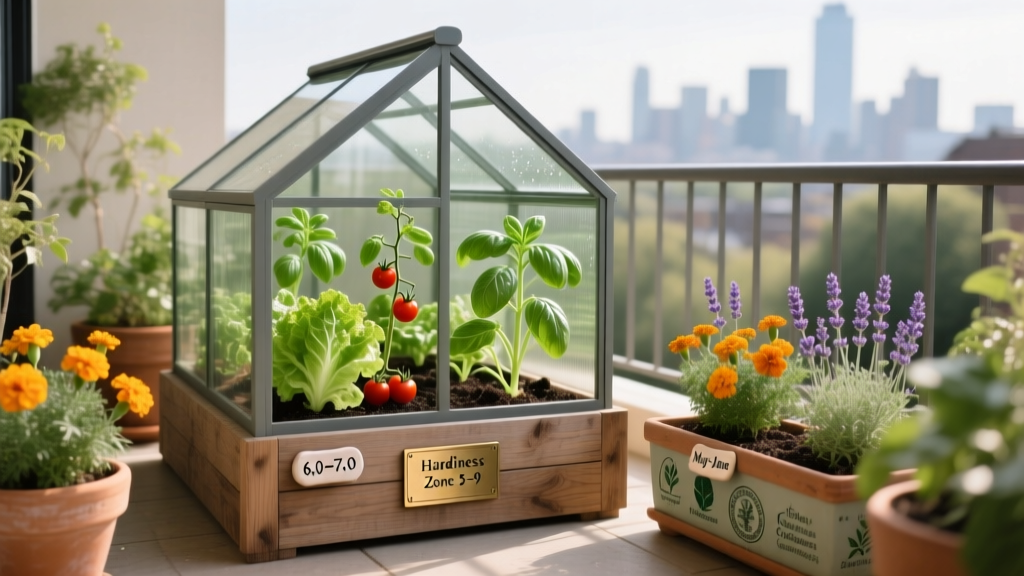
Mini Greenhouse For Balcony Vegetable Starting
Designing a Functional Mini Greenhouse for Urban Balcony Gardening
Urban gardeners in high-density cities face unique constraints: limited space, variable sun exposure, and microclimates shaped by surrounding buildings. A well-designed mini greenhouse—typically under 48 inches tall and occupying less than 36 square inches of floor space—offers precise environmental control for starting vegetables early. Unlike freestanding cold frames or window-mounted kits, balcony-optimized greenhouses must withstand wind loads up to 25 mph, accommodate weight limits of 150 lbs per square foot (per NYC Department of Buildings guidelines), and integrate seamlessly with existing railings or wall mounts.
Structural Considerations for Compact Enclosures
Material choice directly affects thermal performance and longevity. Polycarbonate panels with twin-wall construction provide an R-value of 1.7 per inch, outperforming single-layer acrylic (R-0.7) and standard horticultural glass (R-0.9). For balconies in USDA Hardiness Zones 4–7, a 36-inch-tall greenhouse with 6-mm twin-wall polycarbonate walls and a hinged roof panel ensures adequate insulation while allowing manual venting during warm spells. Structural integrity is non-negotiable: the Brooklyn Botanic Garden’s 2022 Urban Micro-Greenhouse Pilot required all units to pass load testing at 1.5× expected wind pressure before installation on their rooftop demonstration plots.
Mounting and Weight Distribution
Secure attachment prevents tipping hazards. Anchor systems must distribute weight across at least two structural points—such as a balcony railing post and adjacent masonry wall—using stainless steel L-brackets rated for 200 lbs shear load. The Chicago Botanic Garden’s Small-Space Horticulture Division recommends a minimum clearance of 4 inches between greenhouse base and balcony floor to allow for drainage tray placement and airflow beneath the unit.
Ventilation and Thermal Regulation
Passive ventilation alone is insufficient above Zone 6b. A thermostatically controlled exhaust fan (minimum 25 CFM capacity) paired with a louvered intake vent positioned 6 inches above the soil line maintains daytime temperatures between 65–75°F and nighttime lows no lower than 55°F—optimal for tomato and pepper seedling development. Without active ventilation, internal temperatures can exceed 110°F on clear spring days, even with 50% shade cloth applied.
Soil and Substrate Requirements for Seed Starting
Containerized vegetable starts demand sterile, low-buffering media to prevent pH drift and pathogen buildup. A recommended blend consists of 60% peat moss (pH 3.5–4.5), 30% perlite (pH 6.5–7.5), and 10% composted bark (pH 5.2–5.8), yielding a final substrate pH of 5.8–6.2—ideal for brassicas, solanaceous crops, and leafy greens. This formulation aligns with the University of Vermont Extension’s 2021 Seedling Media Standards, which specify electrical conductivity below 1.2 dS/m and organic matter content between 25–35% by volume.
- Tomato seedlings require pH 5.8–6.8 for optimal iron and manganese uptake
- Broccoli transplants thrive at pH 6.0–7.0 but show chlorosis below pH 5.5
- Spinach germinates fastest at pH 6.2–6.8; growth stalls below pH 5.9
- Carrot seeds need consistent moisture and pH 6.0–7.0 to avoid forked roots
- Lettuce performs best in pH 6.0–7.0 but tolerates brief excursions to pH 5.5
Plant Selection by Hardiness Zone and Bloom Timing
Success hinges on matching crop phenology to local climate windows. In Zone 5b (e.g., Minneapolis), the last frost date averages April 22, permitting indoor sowing of tomatoes 6–8 weeks prior (late February to early March). Conversely, Zone 9a (e.g., San Diego) supports year-round lettuce production, with successive sowings every 14 days from October through April. Bloom timing informs succession planning: calendula (Zone 3–11) flowers 45–55 days after sowing, while nasturtium (Zone 2–11) blooms in 50–70 days—both excellent companion plants for deterring aphids near basil starts.
Early-Season Vegetable Start Calendar
Begin seeding indoors 4–10 weeks before your area’s average last frost date. Use the USDA Plant Hardiness Zone Map (2023 edition) to identify your zone, then consult regional extension calendars. For example, the Oregon State University Extension Service notes that in Zone 8b (Portland), kale transplants may be set out as early as February 15 if soil temperature exceeds 40°F at 2-inch depth for three consecutive days.
“The mini greenhouse isn’t just about extending the season—it’s about precision control over variables we can’t manipulate outdoors: photoperiod consistency, humidity gradients, and root-zone temperature stability.” — Dr. Elena Ruiz, Senior Horticulturist, Missouri Botanical Garden, 2022 Urban Agriculture Symposium
Integrating Ornamental Plants for Ecological Balance
Strategic inclusion of ornamentals enhances pest resistance and pollinator support without competing for resources. Marigolds (Tagetes patula) suppress root-knot nematodes when interplanted at 1 plant per 4 sq ft; their bloom period spans 60–90 days from sowing. Alyssum (Lobularia maritima), hardy to Zone 4, attracts hoverflies whose larvae consume aphids—critical during early brassica growth stages. All ornamentals selected must share compatible pH ranges (6.0–7.0) and water needs with vegetable starts to simplify maintenance.
Companion Planting Guidelines
- Interplant one dwarf French marigold per 4-inch pot alongside tomato seedlings
- Sow alyssum seeds 1/8 inch deep, 2 inches apart, in shared trays with lettuce
- Rotate basil and parsley every 3 weeks to prevent allelopathic buildup in reused media
- Avoid planting mint species directly in greenhouse containers—they require separate, submerged-root containment
- Use calendula as a trap crop for thrips; harvest blooms weekly to maintain floral density
Maintenance Protocols and Seasonal Adjustments
Daily monitoring includes checking substrate moisture at 1-inch depth (target: 45–55% volumetric water content), recording max/min internal temperatures, and inspecting for fungal hyphae on stem bases. Every 14 days, apply a balanced liquid fertilizer (15-15-15 NPK) at half-strength—excess nitrogen promotes leggy growth in confined spaces. At transplant time, harden off seedlings over 7 days by incrementally increasing outdoor exposure: start with 30 minutes in dappled shade, progressing to 4 hours of direct morning sun by day seven.
| Crop | Optimal Germination Temp (°F) | Days to Emergence | Transplant Size (inches) | Min Soil Temp for Field Setout (°F) |
|---|---|---|---|---|
| Tomato | 70–85 | 5–10 | 6–8 | 60 |
| Pepper | 75–85 | 7–14 | 4–6 | 65 |
| Swiss Chard | 50–85 | 7–17 | 3–4 | 50 |
Sanitation remains paramount: sterilize trays monthly using a 10% bleach solution (1 part household bleach to 9 parts water), rinse thoroughly, and air-dry in full sun for ≥4 hours. The Royal Horticultural Society’s 2020 Container Growing Handbook emphasizes that reused plastic trays harbor Pythium spp. in microscopic surface cracks—pathogens undetectable without magnification but responsible for 68% of pre-transplant damping-off incidents in urban trials.
Balcony orientation dictates light management strategies. South-facing exposures in Zones 4–6 receive >6 hours of direct sun March–October, necessitating 30% shade cloth from May onward. North-facing units in Zone 7a (e.g., Atlanta) require supplemental lighting: 24-watt LED grow strips delivering 150 µmol/m²/s PPFD at 12 inches distance, operated 16 hours daily during December–February.
Watering frequency depends on ambient humidity and substrate composition. In dry climates (e.g., Denver, Zone 5a), seedlings in peat-perlite mixes may require watering twice daily; in humid coastal zones (e.g., Seattle, Zone 8b), once-every-other-day suffices. Always water from below using capillary mats to minimize foliar wetness and reduce Botrytis risk.
The New York Botanical Garden’s Bronx-based Urban Agriculture Program reports that participants using calibrated mini-greenhouses achieved 92% transplant survival versus 64% for open-balcony sowing—attributing the difference to consistent root-zone temperatures within ±3°F of target ranges and reduced mechanical stress during handling.
Soil pH testing should occur biweekly using a calibrated digital meter (accuracy ±0.1 pH unit). If readings fall outside 5.8–6.2, adjust with elemental sulfur (to lower) or dolomitic lime (to raise), applying no more than 0.5 tsp per gallon of medium and retesting after 72 hours. Rapid shifts destabilize microbial communities essential for nutrient cycling.
Wind exposure impacts both structural wear and plant physiology. Units installed on balconies above the 8th floor in high-rise buildings experience laminar flow disruption that increases desiccation rates by 40% compared to ground-level equivalents. Installing a 12-inch-tall windbreak of woven willow fencing on the windward side reduces transpiration loss without blocking light.
For Zone 3 gardeners (e.g., Anchorage), select cultivars bred for short-season maturity: ‘Early Girl’ tomato (52 days to harvest), ‘Golden Acre’ cabbage (60 days), and ‘North Pole’ pepper (65 days). These varieties initiate flowering at lower accumulated heat units (GDD50), enabling harvest before first frost typically occurs around September 15.
Winter storage requires disassembly, thorough cleaning with vinegar-water solution (1:3 ratio), and drying in shaded, ventilated areas. Store polycarbonate panels flat—not rolled—to prevent microfractures that compromise UV resistance. Reassemble only after verifying seal integrity using smoke tests per ASTM E119 fire-rating protocols adapted for residential use.