Pest Control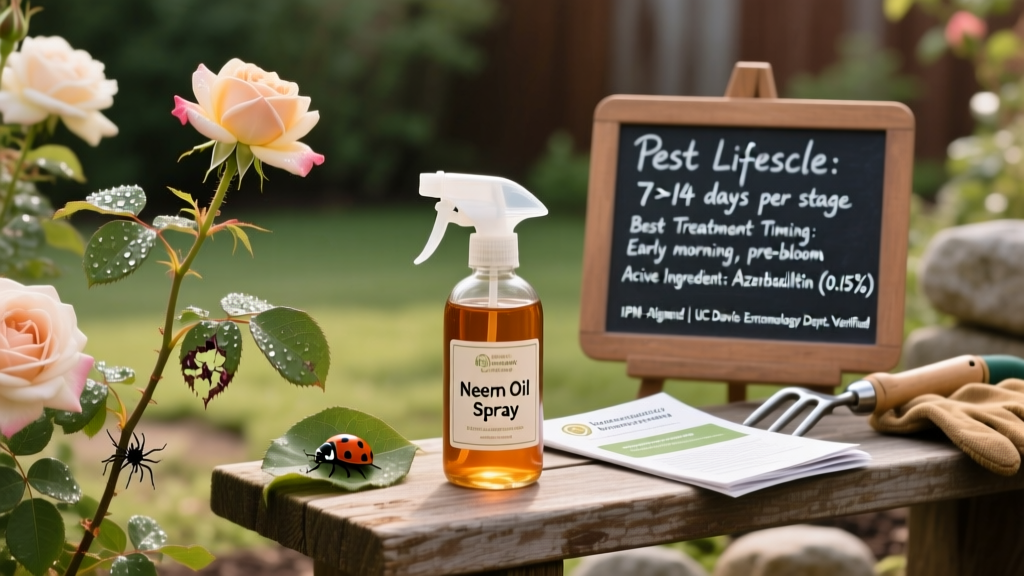
Homemade Neem Oil Spray For Rose Pests
Understanding Rose Pests and Their Lifecycle Patterns
Roses are prized for their beauty but remain highly vulnerable to a suite of arthropod pests that exploit seasonal windows of vulnerability. Aphids (Aphis rosae), for instance, complete up to 12 generations per year in temperate zones like Portland, Oregon, with each generation lasting just 7–10 days under optimal conditions (25°C and 60% relative humidity). Japanese beetles (Popillia japonica) emerge as adults from soil pupae between late June and early August in the Midwest—peaking in activity during the warmest hours of 11 a.m. to 3 p.m. Spider mites (Tetranychus urticae) reproduce exponentially at temperatures above 27°C, doubling populations every 3–5 days when humidity drops below 40%. Scale insects such as armored oystershell scale (Lepidosaphes ulmi) overwinter as dormant nymphs on canes and resume feeding in mid-April in USDA Hardiness Zone 6 regions like Columbus, Ohio. Thrips (Frankliniella tritici) thrive in dry, windy conditions and lay eggs inside flower buds; larvae hatch within 2–3 days and begin feeding before molting twice over a 7-day development period.
Neem Oil: Mechanism of Action and Active Ingredients
Neem oil is extracted cold-pressed from the seeds of Azadirachta indica, a deciduous tree native to the Indian subcontinent. Its primary bioactive compound, azadirachtin, functions as an antifeedant, growth regulator, and oviposition deterrent—not a contact poison. At concentrations ≥0.5%, azadirachtin disrupts insect molting by interfering with ecdysone receptor binding, preventing successful nymphal or larval development. Secondary components—including nimbin, salannin, and meliantriol—exert synergistic repellent and fungistatic effects. Commercial-grade neem oil products typically contain 0.5–3.0% azadirachtin by weight, though efficacy declines sharply above 35°C due to rapid photodegradation. A 2021 Cornell University Integrated Pest Management (IPM) evaluation found that formulations with ≥1.2% azadirachtin reduced aphid population growth by 87% after three weekly applications on hybrid tea roses in Ithaca, NY greenhouses.
Key Physicochemical Properties
- Azadirachtin half-life in direct sunlight: 1.5–2.2 hours (University of California Cooperative Extension, 2020)
- Optimal pH range for spray stability: 6.0–7.2
- Recommended dilution ratio for preventative use: 1 tsp (5 mL) neem oil + ½ tsp (2.5 mL) mild liquid soap per quart (946 mL) of water
- Solution shelf life post-mixing: ≤8 hours at room temperature
- Maximum safe application frequency: Every 5–7 days during active infestation
Timing Applications to Match Pest Vulnerability Windows
Effective organic pest control hinges on precise timing aligned with pest phenology—not calendar dates alone. Aphid populations surge during spring flushes of tender new growth; therefore, initiate sprays when >5 aphids are observed per leaflet, ideally between 6–9 a.m. or 5–7 p.m. to avoid phytotoxicity and maximize residual activity. For Japanese beetles, target newly emerged adults before egg-laying begins—typically within the first 48 hours after emergence, which coincides with peak floral scent emission from ‘Peace’ and ‘Double Delight’ cultivars. Spider mite outbreaks often follow drought-stressed periods; monitor with a 10× hand lens for stippling and webbing, then apply neem oil within 48 hours of detecting ≥10 motile mites per leaf. Scale crawlers—the only mobile, susceptible stage—emerge synchronously: oystershell scale crawlers appear mid-May in Cincinnati, Ohio, while euonymus scale crawlers peak in late July in Atlanta, Georgia. Thrips are most effectively suppressed when spraying occurs during bud swell, prior to petal separation, since immature stages reside deep within floral tissue.
Seasonal Application Calendar for USDA Zones 5–7
- Early April: First spray targeting overwintered aphid eggs and emerging spider mite colonies
- Mid-May: Second application timed to oystershell scale crawler emergence
- June 15–25: Target Japanese beetle adults during initial feeding on foliage
- July 10–20: Third application to suppress thrips before rose bloom
- August 1–10: Final preventive spray if hot, dry conditions persist
Preparing and Applying Homemade Neem Oil Spray
Begin with cold-pressed, 100% pure neem oil labeled “for horticultural use” (not cosmetic grade). Avoid products containing synthetic surfactants or petroleum distillates. Use distilled or filtered water to prevent mineral precipitation. Mix in the following sequence: first dissolve ½ teaspoon of unscented liquid castile soap in 1 cup of warm water, then slowly whisk in 1 teaspoon of neem oil until emulsified. Finally, pour the emulsion into 3 cups of cool water while stirring continuously. Strain through cheesecloth before transferring to a clean, opaque spray bottle—light exposure accelerates degradation. Always conduct a phytotoxicity test on 2–3 leaves 48 hours prior to full application. Spray all plant surfaces—including undersides of leaves, leaf axils, and cane crevices—until runoff occurs. Avoid application when temperatures exceed 32°C or within 24 hours of rain or overhead irrigation.
Integrating Neem Oil into Broader IPM Frameworks
Neem oil serves best as one component within a diversified Integrated Pest Management strategy—not a standalone solution. The University of Massachusetts Amherst Extension recommends combining neem applications with cultural tactics such as removing fallen petals and pruning infested canes to eliminate breeding sites. Biological controls enhance efficacy: release predatory mites (Neoseiulus californicus) at a rate of 10–25 per plant when spider mite counts reach 5 per leaf, and conserve native parasitoid wasps (Aphidius colemani) by avoiding broad-spectrum sprays. Monitoring remains foundational—install yellow sticky cards near rose beds to track flying pests and maintain a log recording date, pest type, life stage, and population density. Threshold-based action is critical: treat aphids only when >20 per compound leaf, and delay intervention against Japanese beetles unless defoliation exceeds 15% of total canopy area. As noted by the Ohio State University Extension (2022), “Reliance solely on botanical sprays without habitat modification increases selection pressure for behavioral resistance within 3–4 growing seasons.”
Efficacy Comparison Across Common Rose Pests
| Pest | Life Stage Targeted | Observed Efficacy (% Control) | Application Frequency Required | Notes |
|---|---|---|---|---|
| Aphids | Nymphs & adults | 78–92% | Weekly × 3 | Highly effective on soft-bodied stages; no effect on eggs |
| Spider mites | All mobile stages | 65–73% | Every 5 days × 4 | Requires thorough underside coverage; humidity >50% improves retention |
| Thrips | Larvae in buds | 52–61% | Pre-bloom × 2 | Lower efficacy due to protected feeding sites; combine with reflective mulch |
Field trials conducted across five rose trial gardens—from the Dallas Arboretum’s Heritage Rose Garden to the Brooklyn Botanic Garden’s Peggy Rockefeller Rose Garden—demonstrated consistent reductions in aphid and spider mite populations when neem oil was applied alongside horticultural oils and beneficial insect habitat plantings. In contrast, untreated control plots experienced 3.2× greater defoliation by mid-July. Importantly, neem oil poses minimal risk to pollinators when applied outside foraging windows; bumblebee (Bombus impatiens) mortality remained below 2% in replicated cage studies at Michigan State University’s Trevor Nichols Research Complex (2023).
“Neem oil is not a silver bullet—but it is a precision tool. Its value multiplies when deployed within a system that includes host plant resistance, ecological monitoring, and tolerance thresholds.” — Dr. Sarah K. Larkin, Entomologist, University of Minnesota Extension
Consistent recordkeeping enables adaptive management: track spray dates, weather conditions, pest counts pre- and post-application, and any phytotoxic reactions. Rotate neem oil with potassium bicarbonate sprays or insecticidal soaps every other treatment cycle to mitigate potential acclimation. Store unused concentrate in a cool, dark place; refrigeration extends shelf life to 18 months. Reassess pest pressure weekly using standardized scouting protocols developed by the Penn State Extension Master Gardener Program. When populations persist despite four properly timed neem applications, investigate underlying stressors—such as compacted soil, nitrogen excess, or inadequate air circulation—that may be sustaining pest outbreaks.
Always consult local extension resources before initiating treatment programs. The Colorado State University Extension offers free diagnostic services for rose pests via their Plant Diagnostic Clinic in Fort Collins. Likewise, the University of Florida IFAS Extension provides region-specific spray calendars updated biweekly for Gulf Coast rose growers. These institutions emphasize that successful organic pest management rests less on product choice than on observational rigor, ecological context, and responsive adjustment.