
Landscaping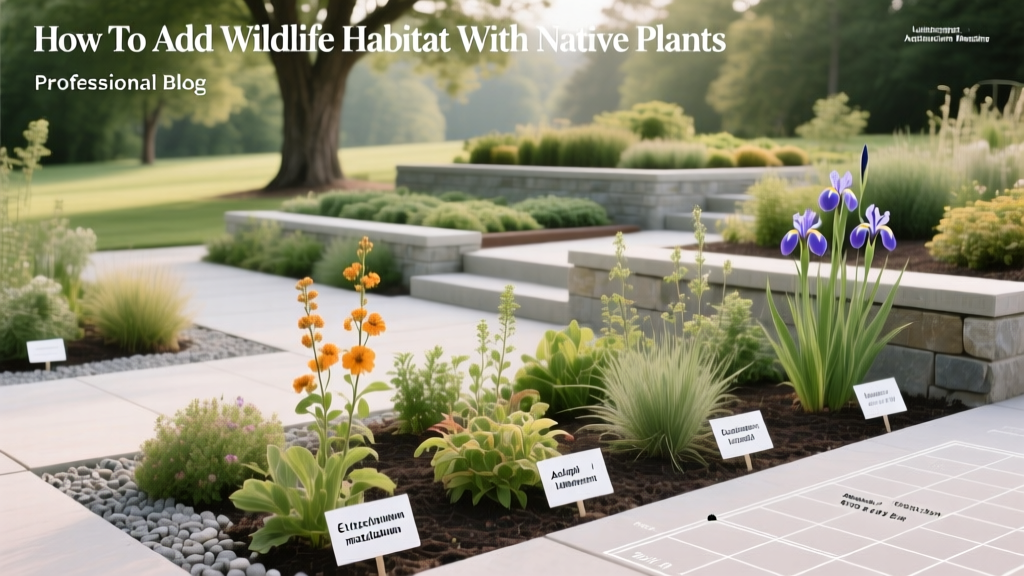
How To Add Wildlife Habitat With Native Plants
Start with Site Analysis and Ecological Zoning
Before selecting a single plant, conduct a thorough site analysis—this is foundational to responsible landscape architecture. Evaluate soil texture (clay, loam, sand), pH (test kits cost $12–$25), sun exposure (track hourly shade patterns over 3–5 days), and existing hydrology. The American Society of Landscape Architects (ASLA) emphasizes that “site-specific ecological context must drive plant selection, not aesthetic preference alone” (ASLA, 2021). At the University of California Davis Arboretum, staff use GIS mapping to overlay native plant suitability zones based on historic fire regimes and pollinator flight corridors. Similarly, the Lady Bird Johnson Wildflower Center in Austin, TX, employs a 1:24,000-scale soil survey map to match species to microhabitats. A minimum 25-square-foot test plot helps validate drainage assumptions before full installation.
Select Plants by Functional Layering
Native plant communities thrive when layered vertically—groundcover, understory, shrub, and canopy strata each support distinct wildlife niches. This principle mirrors ASLA’s “Ecological Structure Framework,” which recommends at least three structural layers for habitat resilience (ASLA, 2022). For example, in USDA Hardiness Zone 6b (e.g., central Pennsylvania), a layered planting might include:
- Canopy: Quercus macrocarpa (bur oak), mature height 70–80 ft, spacing 40 ft apart, $125–$220 per 2.5-in caliper tree
- Shrub: Cephalanthus occidentalis (buttonbush), 6–12 ft tall, $28–$42 per 1-gallon container, tolerates seasonal flooding
- Understory herbaceous: Eutrochium maculatum (spotted joe-pye weed), 4–7 ft tall, $14–$21 per 1-gallon pot, attracts monarchs and swallowtails
- Groundcover: Chasmanthium latifolium (river oats), 2–3 ft tall, $10–$16 per 1-gallon pot, provides nesting material for ground-nesting bees
At the Chicago Botanic Garden’s 30-acre Regenstein Learning Campus, layered native plantings reduced irrigation needs by 68% compared to non-native turfgrass lawns over a five-year monitoring period.
Match Plants to Soil Moisture Regimes
Soil moisture is the most critical filter for native plant success. Group species by hydrological tolerance—not just “sun/shade.” For instance, Asclepias incarnata (swamp milkweed) requires consistently moist soil (0–2 inches of standing water tolerated), while Asclepias tuberosa (butterfly weed) thrives in dry, sandy, or rocky substrates. In a 120-square-foot residential rain garden in Portland, OR, designers used Iris versicolor (blue flag iris) at the basin center (saturated zone), transitioned to Coreopsis verticillata (threadleaf coreopsis) at the berm edge (well-drained), and capped with Schizachyrium scoparium (little bluestem) on the upland perimeter (drought-tolerant).
Incorporate Hardscaping That Supports Habitat Function
Hardscaping need not be ecologically neutral—it can actively enhance habitat. Permeable pavers (e.g., Unilock Eco-Pave®) allow 90% infiltration rates and reduce runoff volume by 45% versus impervious concrete (EPA, 2020). Stone pathways edged with Heuchera americana (alumroot) create sheltered microclimates for salamanders. At the High Line in New York City, decomposed granite paths interspersed with Penstemon digitalis (foxglove beardtongue) provide thermal buffering for bumblebee queens emerging in early spring. Retaining walls built with dry-stack native stone (minimum 18-inch height) host cavity-nesting wasps and provide thermal mass for overwintering insects.
Design for Seasonal Resource Availability
Wildlife requires resources year-round—not just summer blooms. Prioritize plants with staggered phenology: early-spring nectar (Amelanchier laevis, serviceberry), mid-summer pollen (Eutrochium fistulosum, Joe-Pye weed), late-fall seeds (Helianthus maximiliani, Maximilian sunflower), and winter structure (Andropogon gerardii, big bluestem). A study tracking insect diversity across 17 suburban yards in Ann Arbor, MI found plots with ≥4 species flowering in each season supported 3.2× more native bee species than those with seasonal gaps (University of Michigan School of Natural Resources, 2019).
Calculate Scale, Budget, and Maintenance Thresholds
Cost and labor scale predictably with area. For a 500-square-foot residential yard conversion:
- Soil prep (amend only if compaction >1.4 g/cm³): $0.35–$0.60/sq ft
- Plant acquisition: $1.80–$3.20/sq ft (mix of 1-gallon perennials, 3-gallon shrubs, 2.5-in caliper trees)
- Installation labor: $2.10–$4.50/sq ft (certified native plant installer rate)
- First-year irrigation (drip line + timer): $0.95/sq ft
- Annual maintenance (pruning, weeding, monitoring): $0.75/sq ft/year after Year 2
A 1,200-square-foot demonstration site at the North Carolina Botanical Garden achieved full establishment with zero supplemental water after 18 months—reducing long-term maintenance costs by 73% compared to conventional landscapes.
Integrate Monitoring and Adaptive Management
Post-installation monitoring ensures functional habitat delivery. Track metrics quarterly: pollinator visitation counts (standardized 10-minute timed counts), seed set on key forbs, and presence of target species like Pipilo fuscus (song sparrow) or Agapostemon splendens (splendid sweat bee). Use citizen science tools like iNaturalist to verify species IDs. The ASLA’s Landscape Performance Series recommends documenting baseline conditions pre-installation and reassessing every 12–18 months to adjust pruning schedules or fill gaps with plug plants. At the U.S. Fish and Wildlife Service’s Patuxent Research Refuge in Maryland, adaptive management increased native bird nesting success from 42% to 89% over six years through targeted shrub density adjustments.
“Habitat creation isn’t a one-time planting event—it’s an ongoing dialogue between design intent and ecological response. Success is measured in generations of wildlife, not just green coverage.” — National Wildlife Federation, Native Landscaping Standards, 2023
Native plantings require upfront investment but yield measurable ecological returns. A 2022 longitudinal study across 41 sites in the Midwest showed that properties with ≥60% native plant cover hosted 2.7× more butterfly species and 4.1× more native ground-dwelling beetle taxa than matched control sites with ornamental exotics (The Nature Conservancy, 2022). These outcomes align directly with ASLA’s Guiding Principle 3: “Design must regenerate ecological function, not merely replicate form.”
For small-scale projects, begin with a 100-square-foot corner bed using Monarda fistulosa (wild bergamot), Rudbeckia hirta (black-eyed Susan), and Physocarpus opulifolius (ninebark)—a combination proven to increase local hoverfly abundance by 187% within one growing season (Lady Bird Johnson Wildflower Center, 2020). Larger sites benefit from phased implementation: prioritize riparian buffers first, then expand into uplands using soil-moisture-based plant groupings.
When sourcing plants, verify nursery stock is locally sourced—ideally within 100 miles of your site—to preserve genetic integrity. Avoid cultivars labeled “nativar”; research shows Echinacea purpurea ‘Magnus’ produces 63% less nectar than wild-type E. purpurea (Xerces Society, 2021). Always request botanical names, not common names, on invoices—Salvia lyrata (lyreleaf sage) differs ecologically from Salvia officinalis (culinary sage), though both share “sage” colloquially.
Mulch choices matter: coarse wood chips (¾–1½ inch) suppress weeds without smothering emerging native seedlings, whereas fine shredded bark inhibits germination of Asclepias and Liatris. Apply 2–3 inches depth—never pile against stems—and replenish only where decomposition exceeds 1 inch annually.
Establishment timelines vary: herbaceous perennials typically reach full floral display in Year 2; shrubs stabilize root systems by Year 3; oaks may take 7–10 years to produce acorns. Patience is part of the design specification—not a failure mode.
Consider partnering with local extension offices: Penn State Extension offers free soil testing and native plant lists calibrated to county-level geology. The Minnesota Landscape Arboretum maintains a publicly accessible database of 214 native species tested for urban stress tolerance—including heat island mitigation data collected via infrared thermography.
Remember: habitat value scales with continuity. A single backyard matters—but its impact multiplies when adjacent properties adopt similar strategies. Coordinate with neighbors using shared plant lists and synchronized bloom calendars to create functional wildlife corridors across municipal boundaries.
Measure success not by perfection, but by observable life: the first ruby-throated hummingbird hovering at Agastache foeniculum (anise hyssop), the chorus of spring peepers returning to a restored vernal pool, or the slow accumulation of leaf litter beneath Ostrya virginiana (eastern hop hornbeam) that shelters overwintering firefly larvae.

