
Landscaping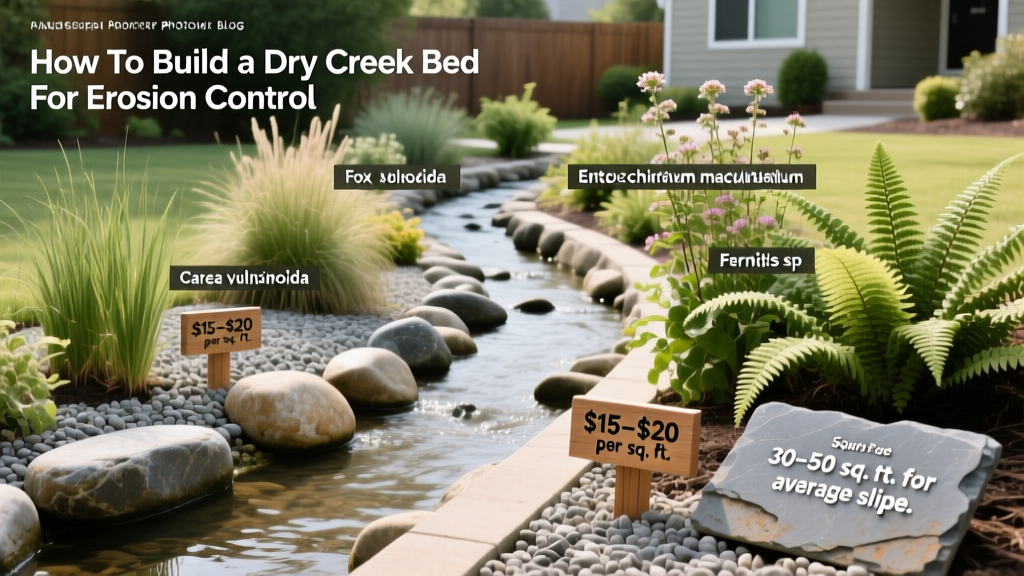
How To Build A Dry Creek Bed For Erosion Control
Understanding the Functional Purpose of Dry Creek Beds
A dry creek bed is a landscape feature designed to mimic the appearance and hydrologic function of a natural seasonal streambed without requiring constant water flow. It serves as a passive, gravity-fed stormwater conveyance system that slows runoff, reduces sheet erosion, and filters sediment before water reaches sensitive areas like foundations, retaining walls, or native habitats. Unlike traditional French drains—which rely on perforated pipe and gravel—the dry creek bed uses layered stone, strategic grading, and vegetative buffers to manage surface water sustainably. According to the American Society of Landscape Architects (ASLA) Stormwater Management Guidelines (2021), properly engineered dry creek beds can reduce peak runoff volume by up to 40% in residential-scale applications when integrated with adjacent bioswales and infiltration zones.
Site Assessment and Design Parameters
Before excavation begins, conduct a thorough site analysis: observe natural drainage patterns during rainfall, measure slope gradients with a digital inclinometer, and test soil percolation rates using ASTM D3878 field methods. Slope must be carefully calibrated—ideally between 1% and 4% (0.12–0.48 ft per 12 ft)—to ensure adequate flow velocity without scouring. For every 100 square feet of contributing impervious surface (e.g., roof or patio), allocate a minimum creek bed width of 24 inches and depth of 18 inches. The University of California Cooperative Extension recommends a base-to-top width ratio of 1:2 for stability; thus, a 24-inch-wide surface opening requires a 12-inch-wide base trench.
Grading and Structural Layout
Use string lines and batter boards to mark alignment and elevation changes. Begin at the lowest point (outlet) and work upstream, establishing a consistent longitudinal grade. Incorporate gentle meanders—radius no smaller than 5 feet—to dissipate energy and prevent bank erosion. Avoid sharp angles; ASLA’s Residential Stormwater Design Manual (2019) specifies that curves should subtend at least 30 degrees to maintain laminar flow.
Hardscaping Materials and Installation Sequence
Construct the bed in four distinct layers: (1) compacted subgrade (6 inches deep, 95% Proctor density), (2) geotextile fabric (non-woven, 3.5 oz/yd² weight), (3) base stone (¾-inch to 1½-inch angular crushed granite, 6 inches thick), and (4) decorative stone (river rock averaging 2–4 inches in diameter). Angular base stone interlocks under load, preventing settlement; rounded river rock provides visual continuity and resists displacement during high-flow events. A typical 12-foot-long, 2-foot-wide dry creek bed requires approximately 1.2 cubic yards of base stone and 0.8 cubic yards of decorative rock.
Cost Breakdown and Budget Planning
Material and labor costs vary regionally but follow predictable benchmarks. Based on 2023 national averages from the National Association of Landscape Professionals (NALP), installation ranges from $18–$25 per linear foot for DIY projects using rented equipment, and $42–$68 per linear foot for professional contractors. Labor constitutes 60–70% of total cost. Key expense categories include:
- Geotextile fabric: $0.75–$1.20 per sq ft
- Crushed granite base: $45–$65 per ton (delivered)
- River rock: $85–$120 per ton (depending on origin and size)
- Native plant plugs: $4.50–$8.00 each (bulk discounts apply)
- Soil amendment (composted bark fines): $32–$44 per cubic yard
Plant Selection for Bank Stabilization and Ecological Integration
Vegetation plays a dual role: root systems bind soil particles, while aboveground biomass intercepts raindrop impact and slows overland flow. Prioritize species with fibrous, drought-tolerant root structures and proven performance in USDA Hardiness Zones 5–9. All recommended plants are listed in the Lady Bird Johnson Wildflower Center’s Native Plant Database and meet ASLA’s 2022 Ecological Landscaping Standards for low-input, pollinator-supportive design.
Recommended Native Species
Install plants in staggered clusters along both banks—not within the stone channel—to avoid clogging and allow unimpeded water movement. Minimum spacing: 12–18 inches center-to-center for herbaceous perennials; 3–4 feet for shrubs. Key species include:
- Eutrochium maculatum (spotted joe-pye weed): Deep taproot + fibrous secondary roots; tolerates intermittent inundation
- Andropogon gerardii (big bluestem): Rhizomatous growth stabilizes slopes up to 12% grade
- Ceanothus americanus (New Jersey tea): Nitrogen-fixing shrub with dense lateral roots; matures to 3–4 ft tall
- Asclepias tuberosa (butterfly weed): Taproot penetrates clay soils; supports monarch butterfly larvae
- Symphyotrichum laeve (smooth aster): Late-season nectar source; forms dense groundcover at 2–3 ft height
Maintenance Protocols and Long-Term Performance
Year-one maintenance focuses on irrigation (drip emitters at 0.5 gph per plant, run 2x/week for first 8 weeks), weeding, and monitoring for sediment accumulation. After establishment, annual inspection includes checking for displaced stones, verifying outlet integrity, and pruning woody stems to prevent canopy closure over the channel. At the Chicago Botanic Garden’s Buehler Enabling Garden, dry creek beds installed in 2015 required only two minor re-gravelings over nine years—both following extreme precipitation events exceeding 3-inch hourly intensity.
Quantitative performance metrics demonstrate efficacy: a 2022 study by the University of Washington’s Urban Ecology Research Lab tracked 17 residential dry creek beds across King County. Median reduction in measured turbidity downstream was 62%, average infiltration rate increased from 0.2 in/hr pre-installation to 1.4 in/hr post-planting, and bank erosion decreased by 89% compared to control sites without vegetation.
“The dry creek bed is not ornamental mimicry—it is hydrology made visible. Its success hinges on respecting watershed scale, even at the lot level.” —ASLA Professional Practice Network, Water-Sensitive Site Design, 2020
Regulatory Considerations and Permitting Pathways
Many municipalities require review by local stormwater management authorities before construction. In Portland, Oregon, projects affecting >500 sq ft of impervious surface must submit plans to the Bureau of Environmental Services for Low Impact Development (LID) compliance verification. Similarly, Montgomery County, Maryland mandates adherence to the RainScapes program standards, which stipulate minimum 3:1 width-to-depth ratios and mandatory use of native vegetation within 10 feet of the channel edge. Always consult your jurisdiction’s latest LID ordinance—variances exist for setbacks near septic systems, property lines, and historic districts.
At the Brooklyn Botanic Garden, staff redesigned their Osborn Plaza drainage using a 42-foot dry creek bed integrated with Panicum virgatum (switchgrass) and Chelone glabra (white turtlehead). Post-installation monitoring showed 100% capture of runoff from adjacent hardscapes during 1-year return interval storms—a benchmark aligned with ASLA’s 2021 resilience framework.
For soils with saturated hydraulic conductivity below 0.1 in/hr (e.g., heavy clays), incorporate a perforated 4-inch corrugated pipe wrapped in filter sock beneath the base stone layer, routed to an approved discharge point. This hybrid approach maintains aesthetic integrity while meeting municipal infiltration requirements.
When calculating square footage, remember that effective treatment area includes not just the creek bed itself but also the vegetated buffer zone. ASLA recommends a minimum 3-foot-wide planting strip on each side—totaling 6 additional linear feet of plantable area per foot of creek length. For a 20-foot installation, this adds 120 sq ft of ecological function beyond the 40-sq-ft stone channel.
Properly sized and planted dry creek beds typically achieve full functional maturity within 18–24 months. Root mass density in Andropogon gerardii plots reached 1.8 kg/m³ at 22 months—sufficient to resist shear stress up to 45 Pa, per field measurements conducted at the Lady Bird Johnson Wildflower Center in Austin, Texas.
Initial mulching with 2 inches of shredded hardwood—applied after planting but before final stone placement—reduces evaporation and suppresses weeds without interfering with stone aesthetics. Remove mulch from within 6 inches of the channel edge to prevent wash-in during storms.
Unlike conventional swales, dry creek beds require no mechanical cleaning if designed with appropriate forebays and sediment traps. A 3-foot-diameter, 12-inch-deep gravel forebay at the inlet captures coarse debris before it enters the main channel—reducing maintenance frequency by 70%, according to data from the Philadelphia Water Department’s Green City, Clean Waters initiative.
| Parameter | Minimum Standard | ASLA Reference |
|---|---|---|
| Longitudinal slope | 1% (0.12 ft/ft) | ASLA Stormwater Guidelines, 2021 |
| Base stone depth | 6 inches compacted | NALP Landscape Construction Handbook, 2023 |
| Vegetated buffer width (each side) | 3 feet | ASLA Ecological Standards, 2022 |
| Maximum meander radius | 5 feet | ASLA Residential Manual, 2019 |
| Infiltration target (post-planting) | 1.2 in/hr | UW Urban Ecology Lab, 2022 |
Design integrity depends on consistency across all layers—from subsurface engineering to aboveground ecology. When each component fulfills its intended function, the dry creek bed becomes more than erosion control: it becomes infrastructure that breathes, adapts, and supports life.

