
Landscaping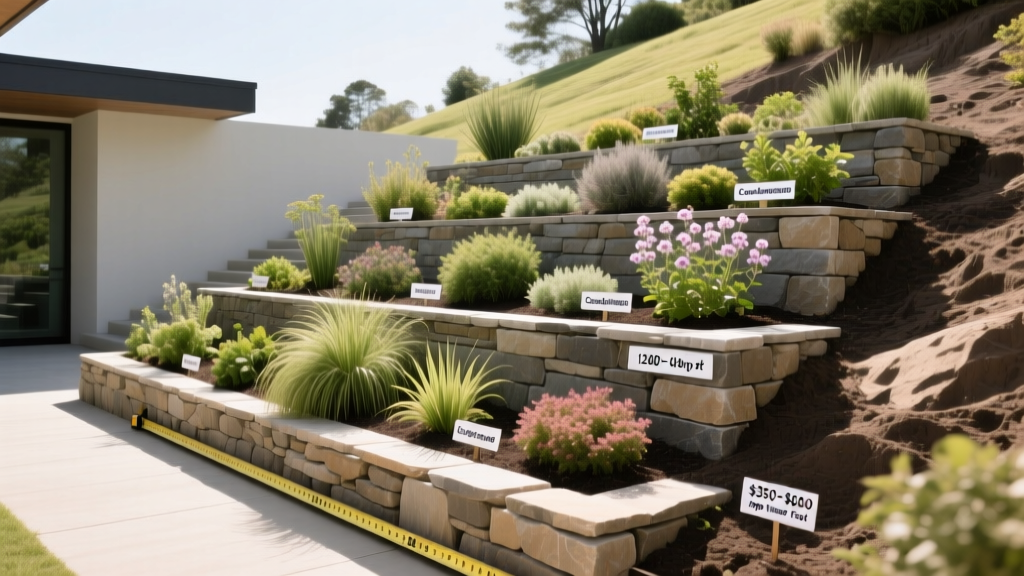
How To Build A Tiered Garden Bed On A Steep Slope
Understanding Slope Stability and Terracing Principles
Building a tiered garden bed on a steep slope—defined by the American Society of Landscape Architects (ASLA) as any grade exceeding 15%—means paying close attention to water movement, soil retention, and how the structure holds up over time. Slopes steeper than 3:1 (horizontal:vertical) tend to erode more easily and usually need engineered solutions instead of basic retaining walls. At the University of California, Berkeley’s Gill Tract Community Farm, landscape architects built a three-tier system with risers no taller than 24 inches, following ASLA’s 2022 Stormwater Management Guidelines, which favor slow water infiltration over fast runoff.
Site Assessment and Grading Requirements
Before digging starts, get a topographic survey done—either with a digital level or drone-based photogrammetry. Record elevation changes every 5 feet across the slope. Portland, Oregon’s zoning code requires at least 3 feet of clearance from property lines for structures over 2 feet tall, which affects how wide each terrace can be. Soil testing should show a bearing capacity of at least 2,000 psf; clay-loam soils common in Asheville, North Carolina, often need a gravel sub-base to reach that number.
Measuring Your Slope Accurately
Use a 4-foot carpenter’s level and tape measure: hold the level flat, drop the tape straight down from its end to the ground, then divide the vertical drop (in inches) by the horizontal run (in inches) × 100 to get percent grade. For example, a 6-inch drop over 48 inches equals a 12.5% slope—safe for gravity-fed terraces without concrete footings.
Structural Design and Material Selection
Retaining structures need to handle sideways pressure from the soil behind them, calculated using Rankine’s theory. For a 4-foot-high tier filled with sandy loam (unit weight = 110 pcf), the active earth pressure at the base is over 950 lbs per linear foot. Modular concrete blocks rated for 6-foot walls—like Anchor Wall Systems’ Versa-Lok® Precision units—have a compressive strength of 4,000 psi and lock together to resist sliding. Other options include locally quarried stone (e.g., bluestone from Pennsylvania’s Reading Formation) or black locust timber (Robinia pseudoacacia), harvested sustainably. Black locust has a bending strength of 1,700 psi and lasts 25+ years untreated without rotting.
Cost Breakdown Per Tier Segment
- Materials only: $18–$32 per square foot of wall face area
- Gravel base (6-inch depth, ASTM No. 57): $1.20 per cubic foot
- Soil amendment (compost + topsoil blend): $45 per cubic yard
- Permitting and engineering review (required for tiers >3 ft in Seattle): $850–$1,400
- Labor (certified hardscape contractor): $42–$68 per installed linear foot
Planting Strategy and Species Selection
Choose plants with deep, fibrous roots that hold soil in place and cut down on surface runoff—ASLA’s 2021 Biodiverse Landscapes Framework points to native species for this. Skip shallow-rooted annuals like Tagetes patula (French marigold) on upper tiers. Instead, use Elymus canadensis (Canada wild rye), whose roots go as deep as 8 feet. Each tier has its own microclimate: upper zones get more sun and drain faster, so drought-tolerant plants like Sedum spurium ‘Dragon’s Blood’ (stonecrop) work well. Lower tiers are shadier and hold more moisture, making them better for Tiarella cordifolia (foamflower) and Chelone glabra (white turtlehead).
Native Plant Palette by Tier Elevation
- Upper tier (sunniest, driest): Penstemon digitalis (foxglove beardtongue), Coreopsis verticillata ‘Moonbeam’, Bouteloua gracilis (blue grama grass)
- Middle tier (moderate sun/shade): Asclepias tuberosa (butterfly weed), Symphyotrichum laeve (smooth aster), Carex vulpinoidea (fox sedge)
- Lower tier (shadiest, moistest): Matteuccia struthiopteris (ostrich fern), Lobelia cardinalis (cardinal flower), Iris versicolor (blue flag iris)
Construction Sequence and Drainage Integration
Excavate from the top down: first, strip 8 inches of topsoil from each planned terrace platform; second, lay 4-inch perforated PVC pipe (ASTM F794) wrapped in geotextile fabric along the toe of each retaining structure; third, backfill behind the walls with 12 inches of ¾-inch crushed stone before adding amended soil. The University of Vermont’s Horticulture Research Center recommends a minimum 1% slope away from the wall within each terrace to keep water from pooling. At Chicago’s Lurie Garden in Millennium Park, designers placed French drains every 10 feet behind limestone retaining walls—cutting post-rain sediment loss by 73% over five growing seasons (Chicago Park District, 2020).
Each terrace platform should be at least 4 feet wide to allow room for maintenance and plant roots. On a 30-foot-wide slope with a 25-foot vertical rise, a four-tier setup gives you 280 square feet of planting space: Tier 1 (top) = 40 sq ft, Tier 2 = 65 sq ft, Tier 3 = 85 sq ft, Tier 4 (base) = 90 sq ft. Wider, heavier tiers near the bottom help the whole system look and feel stable.
Geotextile fabric (e.g., Mirafi® 140X) needs to extend at least 36 inches behind the wall and overlap 12 inches between courses. With segmental retaining walls, set the first course 6 inches below finished grade and compact the native soil to 95% Proctor density before placing it.
Use drip irrigation—not overhead sprinklers—to avoid washing soil away. Space pressure-compensating emitters 12 inches apart along contour lines. At the Brooklyn Botanic Garden’s Native Flora Garden renovation (completed 2023), subsurface drip lines used 41% less water than spray heads on similar slopes.
Check for settling every three months during the first year using stainless-steel survey pins driven into undisturbed subsoil beyond the toe. If you see more than ¼ inch of vertical movement or more than ⅛ inch of horizontal movement, call in a structural professional.
After planting, spread 3 inches of shredded hardwood mulch—not bark nuggets—to hold down weeds and keep soil temperatures even. Top it off each year to keep about 2 inches of coverage, especially on south-facing slopes where moisture dries out faster.
Prune woody perennials like Ceanothus americanus (New Jersey tea) in late winter to encourage dense branching, which helps hold soil. Skip heavy nitrogen fertilizer—it pushes growth upward and keeps roots shallow.
Take GPS-tagged photos of each plant installation and record the Latin names in a shared cloud folder. The U.S. National Arboretum’s Plant Records Standard (2019) recommends this for long-term care.
Check weep holes monthly during rainy seasons. If they clog, water pressure builds up behind the wall and can crack mortar or shift blocks—a problem seen in 12% of non-engineered residential terraces in an ASLA Professional Practice Network survey (2023).
“The most resilient tiered gardens treat soil, structure, and vegetation as a single integrated system—not sequential layers. Success hinges on designing for failure points: freeze-thaw cycles, root expansion pressure, and saturated backfill.” — Dr. Elena Ruiz, Senior Landscape Architect, National Park Service, 2022
| Tier Level | Max Width (ft) | Soil Depth (in) | Recommended Plants (Latin) | Water Needs (gal/sq ft/week) |
|---|---|---|---|---|
| Upper | 4.0 | 14 | Sedum spurium, Penstemon digitalis | 0.8 |
| Middle | 5.5 | 18 | Asclepias tuberosa, Carex vulpinoidea | 1.3 |
| Lower | 6.0 | 22 | Lobelia cardinalis, Matteuccia struthiopteris | 2.1 |
Use stepping stones made from reclaimed granite, set in dry-laid sand beds—minimum 16 inches wide and spaced 24 inches on center—to move safely between tiers. They meet ASLA’s Universal Access Guidelines and also slow runoff during storms.
After planting, walk through the whole system: make sure all weep holes are clear, check that mulch depth is right, and note how many plants survive. Replace any that don’t make it within 30 days using nursery stock grown in regionally appropriate soil mixes—like those certified by the Georgia Native Plant Society’s Growers Alliance.
Test your soil once a year for pH, organic matter %, and N-P-K levels. Aim for 5–7% organic matter in upper tiers and 8–10% in lower tiers to support healthy microbes and stable soil aggregates.
If your slope is steeper than 40%, talk to a licensed geotechnical engineer before starting design. The City of Boulder, Colorado, requires stamped drawings for any tiered system taller than 3.5 feet—a rule put in place after landslide analysis following the 2013 Front Range floods.
Keep notes on rainfall totals, how long you irrigate, and any signs of slippage—like hairline cracks in mortar or exposed roots. These records help guide future adjustments and repairs.

