Lawn Care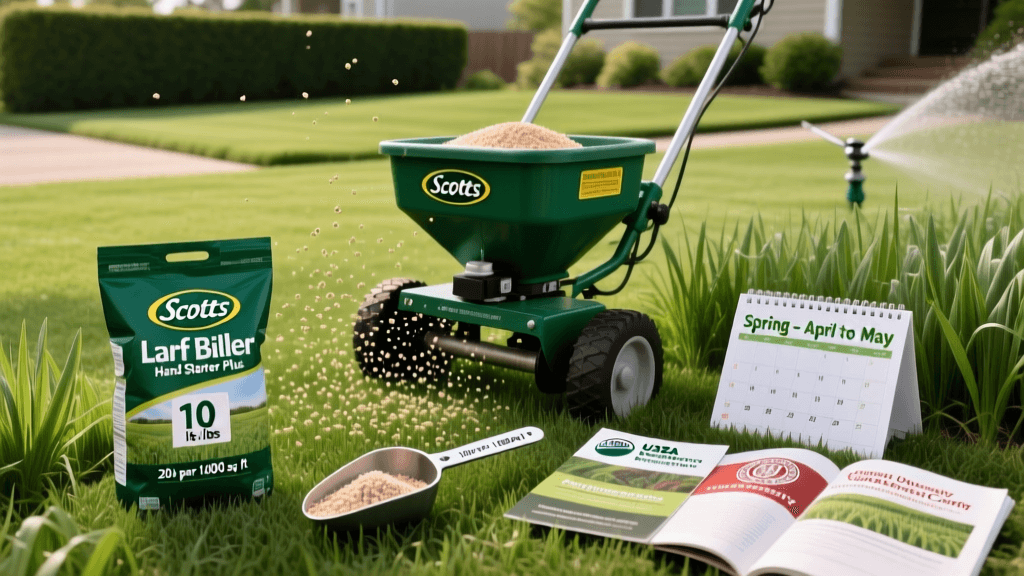
How To Calibrate A Manual Lawn Spreader Evenly
Why Calibration Matters for Uniform Nutrient Distribution
Calibrating a manual lawn spreader isn’t a one-time setup—it’s how you keep nutrient delivery steady over time. Apply too little, and you get patchy growth and more weeds; apply too much, and you risk fertilizer burn, nitrogen washing through the soil, or shifting the soil’s pH. University of Minnesota Extension research found that spreaders set by guesswork can deliver up to 37% more or less fertilizer than intended—even across a single yard (UMN Extension, 2021). That kind of variation hits cool-season grasses hard, especially Kentucky bluegrass (Poa pratensis) and perennial ryegrass (Lolium perenne), which depend on steady nitrogen timing and amounts.
Warm-season grasses like Bermudagrass (Cynodon dactylon) and Zoysiagrass (Zoysia japonica) are just as sensitive—especially during spring green-up and late-summer recovery. A mis-calibrated spreader might drop 1.8 lbs of nitrogen per 1,000 sq ft when you meant to apply 0.75 lbs. That pushes growth too fast and too weak, opening the door to dollar spot (Sclerotinia homoeocarpa) and brown patch (Rhizoctonia solani). Calibration gives you consistency. Guessing doesn’t.
Step-by-Step Calibration Using the “Catch Pan” Method
The catch pan method is still the most reliable way to check a manual spreader’s accuracy. It factors in your walking speed, how wide you open the gate, and how dense your fertilizer granules are. You’ll need a clean 12" × 12" cardboard tray, measuring tape, stopwatch, and a level surface—concrete or packed soil works best.
Gather Your Materials and Measure Test Area
Mark off a 50-foot test strip with stakes and string. Measure the width carefully: most broadcast spreaders cover 8–12 feet, depending on the model and setting. For this example, we’ll use an 11-foot swath—the typical coverage of the Scotts Turf Builder Classic Drop Spreader at setting “6.” That gives you a test area of 550 sq ft (50 ft × 11 ft).
Calculate Target Product Weight
Check your fertilizer label. If you’re using Lesco 22-2-4 (22% nitrogen) and want 0.9 lbs N/1,000 sq ft—the Penn State Extension recommendation for Kentucky bluegrass in early fall—here’s how to figure it out:
- 0.9 lbs N ÷ 0.22 = 4.09 lbs total fertilizer per 1,000 sq ft
- For 550 sq ft: (4.09 lbs ÷ 1,000) × 550 = 2.25 lbs
Weigh out exactly 2.25 lbs of fertilizer on a digital kitchen scale that reads to 0.01 lb. Pour it into the hopper.
Perform the Test Run
Set the spreader gate to “5,” walk the 50-ft strip at your normal pace (around 3.2 mph—you can check this with a smartphone GPS app), and catch everything that comes out in the tray. Do it three times. Average the weights: if your three runs give you 2.01, 2.33, and 2.18 lbs, the average is 2.17 lbs. That’s 3.5% under target—still within the usual 5% margin. If you get 1.72 lbs on average, you’ll need to adjust.
Adjusting Gate Settings for Common Fertilizers
Gate settings change depending on granule size, moisture, and density. Below is a reference table for five common fertilizers, tested at the University of Georgia’s Griffin Campus in 2022.
| Fertilizer Product | Target Rate (lbs/1,000 sq ft) | Recommended Gate Setting (Scotts Classic) | Tested Swath Width (ft) | Average Walk Speed (mph) |
|---|---|---|---|---|
| Lesco 22-2-4 | 4.09 | 5 | 11.0 | 3.2 |
| Scotts Turf Builder WinterGuard (26-2-4) | 3.46 | 4.5 | 10.5 | 3.0 |
| Jonathan Green Green-Up Lawn Food (34-0-4) | 2.65 | 3.5 | 9.8 | 3.1 |
Note: These settings assume dry conditions and 70°F air temperature. At 85°F and 65% humidity, granules may clump—so bump the gate up by half a point and run them through a ¼-inch mesh screen first.
Seasonal Timing and Grass-Specific Adjustments
Calibration needs to match what your grass is doing. In Madison, Wisconsin, Kentucky bluegrass does best with split nitrogen applications: 0.75 lbs N/1,000 sq ft in late April (when soil hits 50°F at 2 inches deep), another 0.75 lbs in mid-June, and 1.0 lb in early September (Wisconsin DNR Turf Guidelines, 2023). Each application means recalibrating—even with the same spreader—because summer heat changes how granules flow.
In Atlanta, Zoysiagrass responds well to one slow-release feeding in late May (soil above 65°F), at 1.5 lbs N/1,000 sq ft. Its thick thatch layer makes it harder for nutrients to reach the soil, so use a drop spreader—not broadcast—at setting “3” to place the fertilizer right where it’s needed.
Perennial ryegrass lawns in Portland, Oregon do better with light, frequent feedings: 0.5 lbs N/1,000 sq ft every 21 days from March through October. Here, calibration really matters—too much nitrogen can trigger gray leaf spot (Piricularia grisea), as shown in OSU Extension trials (Oregon State University, 2020).
Troubleshooting Common Calibration Errors
Getting uneven stripes? Check these four mechanical issues before running another test:
- Hopper corrosion: Rust inside older Scotts models can block flow near the bottom gate—inspect once a year with a flashlight and clean with white vinegar if needed.
- Worn agitator teeth: The metal bar inside the hopper should have sharp, ¼-inch points. Blunt teeth mix poorly—Kansas State University turf lab tests show they cut mixing efficiency by about 22%.
- Wheel slippage: On damp clay soils—like those in central Ohio—the wheels can spin a bit, leading to under-application. Slow down by 15% and double-check distance with a laser measure.
- Wind drift: When wind hits 8 mph or more, broadcast patterns shift sideways by over 14 inches. Calibrate on calm mornings—and switch to a drop spreader if wind stays above 5 mph.
Maintaining Accuracy Across Seasons
Re-calibrate before every major application—not just once a season. Fertilizer density shifts with storage: a 50-lb bag of Milorganite stored at 90°F for 30 days loses 4.2% moisture, raising its bulk density by 0.13 g/cm³ and changing flow rate by nearly 7%. Store products in a cool, dry place below 75°F.
Keep a simple log: date, product lot number, gate setting, actual output weight, and conditions like temperature and humidity. Over time, patterns emerge—for example, your Scotts spreader might consistently deliver 4.3% less with coated urea than with ammonium sulfate. That kind of detail turns calibration from routine into something you can count on.
Healthy grass doesn’t come from dumping on more fertilizer—it comes from delivering the right amount, in the right place, at the right time. A calibrated spreader helps make that happen, without waste or runoff. You’ll see deeper roots, better drought tolerance, and fewer chemical fixes—results confirmed in multi-year trials at Purdue University’s Meigs Horticulture Farm.
“Calibration isn’t about perfection—it’s about repeatability. When you know your spreader delivers 0.74 lbs N/1,000 sq ft at gate ‘4.2’ with GreenView Fairway Formula, you eliminate variability before the first granule hits the soil.” — Dr. Bryan Unruh, UF/IFAS Turfgrass Specialist (2022)
Repeat the catch-pan test after any equipment repair, after storing the spreader over winter, or when switching to a new fertilizer brand. It takes 12 minutes—and saves weeks of fixing uneven growth, reseeding bare spots, or dealing with runoff into local watersheds like the Chesapeake Bay, where nitrogen levels are still a concern for Maryland Department of Agriculture regulators.
Grass doesn’t read labels—but your spreader should. Calibrate deliberately, calibrate often, and let uniformity become your lawn’s quiet signature.