Lawn Care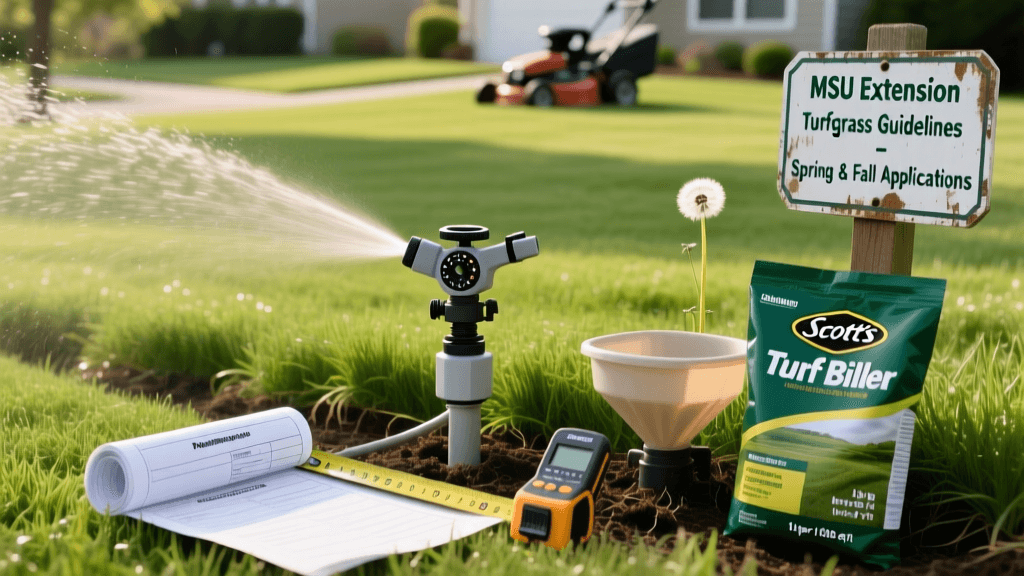
How To Calibrate Your Lawn Sprinkler For Even Watering
Understanding the Consequences of Uneven Sprinkler Distribution
Uneven watering is a common cause of lawn stress, patchy growth, and more disease. When sprinklers deliver inconsistent amounts across a zone—say, 0.3 inches near the head and only 0.08 inches at the far edge—dry spots develop shallow roots, while wetter areas get more fungal pressure (like rust from Puccinia graminis). Cool-season grasses such as Kentucky bluegrass (Poa pratensis) and tall fescue (Festuca arundinacea) need even moisture to keep growing thickly and spreading underground. Research from the University of Wisconsin–Madison Turfgrass Program found lawns with uneven irrigation had up to 42% more summer patch (Magnaporthe poae) than those calibrated to within ±10% distribution uniformity (DU) (WIS-2022).
Step-by-Step Calibration Using the Can Test Method
The can test is still the go-to method for checking residential sprinkler output. It’s simple, cheap, and gives real numbers. You’ll need nine identical straight-sided cans (like Campbell’s Tomato Soup cans, 4 oz), a ruler marked in millimeters, and a stopwatch.
Gathering Materials and Preparing the Test Zone
Arrange the nine cans in a 3×3 grid across the full wetted area of one sprinkler zone—three rows lined up with the direction water travels, spaced evenly every 2 feet. Set the cans on bare soil or turf, level and unobstructed. Run the zone for exactly 15 minutes at normal pressure.
Measuring and Interpreting Results
After 15 minutes, measure how deep the water is in each can—to the nearest 0.01 inch—using digital calipers or a precise ruler. Write down each value, then find the average depth and pick out the two lowest measurements. Distribution uniformity (DU) is: (average of the two lowest ÷ overall average) × 100%. A DU of 75% or higher is acceptable; 85% or higher is ideal for quality turf (Penn State Extension, 2021).
- Record depths: e.g., 0.22, 0.24, 0.19, 0.26, 0.21, 0.18, 0.25, 0.20, 0.17 in
- Average = 0.213 in; lowest quarter = (0.17 + 0.18) ÷ 2 = 0.175 in
- DU = (0.175 ÷ 0.213) × 100 = 82.2%
- If DU is under 75%, adjust nozzle arcs, clean filters, or swap worn nozzles
- Repeat until DU hits 85% or better on all zones
Selecting and Installing Precision Nozzles
Fixed-spray nozzles wear out fast—Rutgers University studies show flow rate and pattern drop 20–30% after just 18 months of seasonal use, mostly from mineral buildup and impact damage. Swap standard Rain Bird 1800 Series nozzles for pressure-regulated options like the Hunter MP Rotator® with PRV (Part #MPR-PRV-15) or the Toro Precision™ Nozzle Kit (Model #53872). These hold steady output between 30–70 psi and cut overspray by up to 35% compared to standard sprays (University of California Cooperative Extension, 2020).
For rotor zones, use matched-precipitation nozzles rated for specific distances: for example, the Hunter I-20 ADV at 3.0 GPM @ 60 psi covers 35 feet. Match nozzle output to head spacing—e.g., heads spaced 30 feet apart need nozzles delivering 2.8 GPM to apply 1.0 inch per hour at 60 psi.
Seasonal Adjustment Protocols for Regional Grass Types
Watering needs change with the season and local climate. In the northern U.S., Kentucky bluegrass often goes dormant in summer when soil temps top 75°F at 2-inch depth—usually mid-July in Chicago. During dormancy, water less often but longer to push roots deeper: aim for 1.25 inches weekly in early June (per Chicago Botanic Garden), then drop to 0.75 inches weekly by late August.
Tall fescue, common in places like Raleigh, NC, does best with deep, infrequent watering. NC State Extension recommends 1.0 inch every 5–7 days in spring and fall, stretching to every 10 days in July–August if soil moisture stays above 15% volumetric water content at 4-inch depth (measured with a calibrated TDR probe).
Bermudagrass (Cynodon dactylon) in Phoenix needs frequent, light watering: 0.5 inch every 2–3 days in May, bumping up to 0.75 inch every 48 hours in peak July heat (Arizona Cooperative Extension, 2023). Watering bermudagrass when soil temps are below 70°F raises the risk of dollar spot (Clarireedia jacksonii).
Integrating Calibration With Broader Lawn Maintenance
Good irrigation works with other lawn care—not instead of it. Mowing height changes how much water grass loses: raising Kentucky bluegrass from 2.0 to 3.0 inches cuts water loss by 18% and adds 2.4 inches to root depth (Purdue Turf Science Lab, 2019). Fertilizer timing matters too—poor timing leads to runoff and wasted nutrients. For cool-season lawns, apply slow-release nitrogen (like Scotts Turf Builder WinterGuard, 22-0-14) at 0.9 lb N/1000 ft² in early September. That lines up with peak root growth and avoids pushing top growth when soil moisture is low.
Match fertilizer to your system’s output. If your sprinklers deliver only 0.6 inches per cycle, skip quick-release urea—it needs immediate watering in. Try polymer-coated urea (like Nitroform 38-0-0) at 1.2 lb N/1000 ft² instead. Its 8–12 week release fits gradual water movement into the soil.
“The single greatest leverage point for improving lawn resilience in urban landscapes is not fertilizer choice or mowing frequency—it’s ensuring every square foot receives the same amount of water, every time.” — Dr. Becky Griffin, Ohio State University Extension, 2022
Troubleshooting Persistent Calibration Issues
Even after swapping nozzles and adding pressure regulation, low DU readings often come from underlying system problems. Look for these five signs:
- Static pressure at the valve box under 40 psi (ideal: 50–65 psi for rotors; 30–50 psi for sprays)
- Pressure drop over 10 psi between valve and farthest head (points to pipe too small or a blockage)
- Nozzle angle off horizontal by more than 5° (makes wind carry water away)
- Head-to-head coverage under 100% (check arc overlap: e.g., 25-ft spacing needs 25-ft radius nozzles)
- Soil infiltration under 0.25 inches/hour (test with a double-ring infiltrometer; add 0.5 inch compost if it’s under 0.15 in/hr)
If pressure drops more than 12 psi over a 100-ft run of 1-inch PVC pipe, talk to an irrigation pro about line sizing—undersized laterals cause about 68% of chronic low-uniformity issues in homes built before 2010 (University of Florida IFAS, 2021).
On slopes steeper than 4%, use rotors with built-in check valves (like the Rain Bird 5000+ with CV). They hold water in the lines for up to 90 seconds after shutdown, stopping low-head drainage that leaves lower zones dry.
Recalibrate once a year—early April works well, before summer demand ramps up—and after any big system change. Keep a simple spreadsheet: date, zone ID, pre-calibration DU, post-calibration DU, what you did, and any notes. That log helps spot slow decline and makes a case for upgrades later.
| Grass Species | Optimal Soil Temp Range (°F) | Target Weekly Water (in) | Max Interval Between Waterings | Key Stress Indicator |
|---|---|---|---|---|
| Kentucky bluegrass | 55–75 | 1.0–1.25 | 7 days (spring/fall); 10 days (dormant) | Footprinting lasting >30 sec |
| Tall fescue | 60–85 | 1.0–1.5 | 7–10 days year-round | Bluish-gray leaf cast + folded leaves |
| Bermudagrass | 75–95 | 0.5–1.0 | 2–5 days (active growth) | Gray-green color + leaf rolling |
Consistent calibration turns irrigation from a routine task into something more precise. It keeps nitrogen where roots can use it, makes mowing height adjustments more effective, and supports healthy soil life—all without new equipment or costly amendments. Pick one zone this weekend. Measure. Adjust. Repeat. Within 10 days, you’ll likely see thicker growth, fewer weeds, and better drought tolerance.