
Landscaping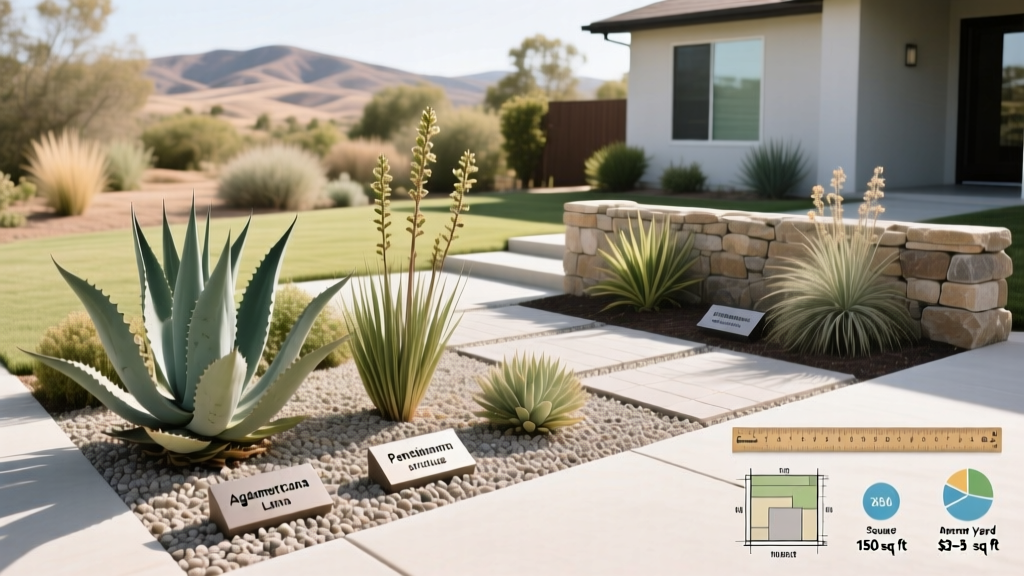
How To Create A Low Maintenance Xeriscape Front Yard
Designing for Water Efficiency and Long-Term Resilience
Xeriscaping is about more than just choosing drought-tolerant plants—it’s a landscape approach grounded in site analysis, how water moves across the land, and how plants fit into local ecology. The American Society of Landscape Architects (ASLA) calls water-wise design an ethical priority in arid and semi-arid regions, especially where people use more than 100 gallons of water per person each day (ASLA, 2022). In Phoenix, Arizona, where it rains only about 8.0 inches a year on average, xeriscape front yards use up to 60% less outdoor water than traditional lawns. A solid xeriscape starts with grading that guides runoff toward planting basins instead of storm drains, and soil improvements that boost infiltration by at least 35% over native compacted clay.
Site Assessment and Grading Strategy
Before picking plants or hardscape materials, take a close look at the site: measure slope percentages, track sun exposure through the seasons, and test soil texture using the jar test method. On a standard 2,400-square-foot residential lot, keep irrigated planting zones to no more than 30%—720 square feet. The rest can be hardscape or mulch that doesn’t need watering. ASLA’s Landscape Performance Series suggests a minimum 2% slope away from building foundations and a maximum 5% grade on swales to control erosion while letting water spread evenly (ASLA, 2021). At the Desert Botanical Garden in Phoenix, engineers reshaped 12,000 square feet of entry terrain into five wide, shallow basins—each between 180 and 220 square feet—to hold monsoon rainwater for deep-rooted perennials.
Soil Preparation Protocol
Native desert soils often have little organic matter and don’t hold water well. Mix in a 3-inch layer of composted granite and 2 inches of decomposed granite (DG), tilling down 12 inches. This blend holds 40% more water without slowing drainage—important for both succulents and shrubs.
Strategic Hardscaping Layout
Hardscape elements do more than look good: they cut evaporation, eliminate mowing, and define walking paths. Permeable pavers rated for 1,200 psi work well for foot traffic and let 90% of rain soak through. For a typical 16-foot-wide front walkway, 24-inch-wide concrete pavers set in a stabilized decomposed granite base cost about $8.40 per square foot installed. Retaining walls built with dry-stack limestone—like Texas Lueders stone—add thermal mass and help buffer microclimates; a 3-foot-high, 20-foot-long wall runs $2,100–$2,600 in Albuquerque, NM, depending on labor rates.
Permeable Surface Specifications
- Interlocking concrete pavers: ASTM C936 compliance, joint spacing ≤ ¼ inch
- Decomposed granite base: 6-inch depth, compacted to 95% Proctor density
- Infiltration rate target: ≥ 0.5 inches per hour (verified via double-ring infiltrometer)
Plant Selection Based on Microclimate Zones
Group plants by how much water they need, how much sun they get, and how big they’ll grow—not by botanical family. Skip monocultures. Instead, mix species vertically and across space, like plants do in natural desert washes. At the University of California, Davis Arboretum, mixed-species plantings used 22% less irrigation than single-species groupings of the same density. Stick to species proven in your USDA Hardiness Zone and Sunset Climate Zone. In Sunset Zone 11 (coastal Southern California), for example, Salvia clevelandii ‘Winnifred Gilman’ does well with drip irrigation every other week after it’s established, while Echinocereus triglochidiatus needs no extra water once its roots are settled.
Low-Water Perennials and Shrubs
- Lavandula angustifolia ‘Hidcote’ – 24–30 in. tall, 30–36 in. spread; matures in 2–3 years; $12–$18 per 1-gallon container
- Penstemon eatonii – 2–3 ft tall, drought-deciduous; blooms April–June; $9–$14 per 1-gallon
- Yucca baccata – 3–5 ft tall, evergreen; tolerates −20°F; $32–$48 per 5-gallon specimen
- Artemisia tridentata – 3–6 ft tall, silvery foliage; native to Great Basin; $7–$11 per 1-gallon
- Dasylirion wheeleri – 3–4 ft rosette, 15-ft flower spike; slow-growing; $45–$65 per 5-gallon
Space plants using the “mature spread × 0.7” rule so they fill in within five years without crowding. For Yucca baccata, with a 48-inch spread, place them 34 inches apart on center. Skip overhead spray irrigation entirely—use inline-drip tubing with 0.5 gph emitters spaced every 12 inches along beds.
Budgeting and Installation Timeline
A 1,200-sq-ft xeriscape front yard in Austin, TX, breaks down as follows:
| Component | Cost Range | Notes |
|---|---|---|
| Soil amendment & grading | $1,800–$2,400 | Includes hauling, compost, DG, and laser-leveling |
| Hardscape (pavers, walls, gravel) | $4,200–$6,100 | Based on 450 sq ft hardscape area |
| Plants (42 specimens, avg. $22 each) | $924 | Includes 5-gallon yuccas, 1-gallon perennials |
| Drip irrigation system | $1,350 | Controller, tubing, pressure regulator, filters |
| Labor (design + installation) | $5,800–$7,300 | Professional crew, 3–4 weeks onsite |
Total cost runs $14,000 to $22,000—about 20–30% more than conventional landscaping—but pays for itself in water savings within 4.2 years, based on Austin Water Utility’s tiered rates. After year two, maintenance drops to under 2 hours a month: mostly weeding, pruning spent blooms, and checking emitters.
“Xeriscaping succeeds when design decisions are driven by site physics—not aesthetics alone. Slope, soil texture, wind exposure, and solar azimuth must inform every line on the plan.” — Dr. Elena Ruiz, Senior Landscape Architect, City of Tucson Department of Transportation & Infrastructure
Maintenance Protocols for Sustained Performance
Year one needs attention: hand-water new plants twice a week for 6–8 weeks, then drop to once a week until roots reach 18 inches deep. Watch for bark-splitting on Quercus turbinella during sudden winter thaws—a known issue at the Santa Fe Botanical Garden. Cover all planting beds with 3 inches of crushed granite (not wood chips) to hold down weeds and smooth out summer soil temperature swings that can hit 40°F in a single day. Prune Salvia clevelandii back by one-third right after flowering to keep it from getting leggy and woody. Replace failed emitters every quarter; about 12% of systems using untreated city water with more than 120 ppm calcium carbonate see clogging (UC Cooperative Extension, 2023).
Check hardscape yearly for settling or white mineral deposits. Re-level paver joints every two years with polymeric sand rated for freeze-thaw cycles. Track plant health monthly on a simple 1–5 scale; if Penstemon eatonii starts looking weak, it’s often from too much water—not too little. Swap out struggling plants only with genetically diverse stock from local nurseries like High Country Gardens in Santa Fe or Las Vegas Valley Water District’s Certified Xeriscape Nursery Program.
Avoid artificial grass. It’s low-maintenance, sure, but it heats the air up to 35°F more than surrounding surfaces on summer afternoons—something ASLA’s Urban Heat Island Mitigation Guidelines advise against (ASLA, 2022). Instead, use boulders and native stone pathways. They absorb heat during the day and release it slowly at night, helping stabilize microclimates for pollinators.
Timing matters: plant woody species in fall (October–November in Zones 7–10) to give roots time to grow before summer hits. Perennials like Artemisia tridentata survive at 87% when planted October 15–November 30, but only 52% when planted in March (University of Nevada, Reno Extension Trial Data, 2020). Keep track of rainfall with a calibrated rain gauge—if 0.5 inches or more falls within 72 hours, skip irrigation.
Check soil moisture at 6 inches deep with a digital meter before turning on drip zones—many homeowners water 30–45% more than needed because the surface looks dry. Calibrate emitters each season so flow stays within ±5% of the rated amount. Log everything in a simple spreadsheet: date, zone, run time, soil moisture, and how plants respond. That data helps fine-tune irrigation starting in year three.
Build in habitat value. Include at least three nectar-rich species that bloom in sequence: Penstemon eatonii (spring), Lavandula angustifolia (summer), and Salvia clevelandii (late summer/fall). Set aside at least 5% of the planting area for native bee nesting sites—like south-facing bare soil patches or bundles of hollow stems. At the Lady Bird Johnson Wildflower Center in Austin, pollinator visits jumped 300% after adding sequential-bloom planning and nesting substrates.
Low maintenance doesn’t mean no maintenance. It means doing the careful work up front—analyzing the site, choosing the right materials, installing precisely—so the landscape runs on its own for decades. A well-done xeriscape front yard is a working ecosystem, not just a static picture.

